HOW DID TEXAS REDISTRICTING AFFECT ROMNEY’S CAMPAIGN?

THE HISPANIC BLOG IS THE LATEST HISPANIC NEWS BY JESSICA MARIE GUTIERREZ

Texas should be playing a role in Republican politics this year as big as, well, Texas.

The fast-growing state – the most populous by far in the Republican column – has four new seats in the U.S. House of Representatives, a big U.S. Senate race and more than a 10th of the delegates who will choose the party’s presidential nominee.

But a racially tinged dispute over redrawing its congressional districts has delayed the Texas primary by almost three months, complicated the U.S. Senate and House contests and altered the race for the White House.

A San Antonio court pushed Texas’ primary back to May 29 from March 6 after complaints that a new electoral map drawn by Republicans violated the federal Voting Rights Act by diluting the voting power of blacks and Latinos.

Three of Texas’ four new U.S. House seats were created in areas dominated by whites, even though Hispanics and blacks accounted for 90 percent of Texas’ population growth since 2000.

The battle sets white Republicans, who have firmly established political control in Texas within the past decade, against rising and strongly Democratic Hispanic and black populations, whose leaders argue that they are being unfairly denied an equal voice in state politics.

The stakes are high both for 2012, when the White House and control of the U.S. Congress are up for grabs, and longer term, when a rapidly growing Hispanic population is expected eventually to disadvantage Republicans and benefit Democrats.

“Republicans can work that racial solidarity thing for a while, but in the end, they’ve got to do better than 35 percent of the Hispanic vote or their election prospects are not great,” said Cal Jillson, a political science professor at Southern Methodist University in Dallas.

States with a history of minority voting rights violations must obtain pre-clearance from either the U.S. Department of Justice or the federal court in Washington, D.C., before they can use new maps. The new voter map in Florida, another fast-growing southern state, has also been subject to legal wrangling this year.

ALREADY A MINORITY

Non-Hispanic whites already account for a minority of Texas’ residents, with 45 percent of the population. The state is 38 percent Latino and 12 percent black, numbers expected to continue to rise.

President Barack Obama lost Texas by 11-percentage points in 2008. He got only 26 percent of the white vote, but was backed by 63 percent of Hispanics and 98 percent of blacks, fueling talk that it will not be long before Republican red Texas turns purple, if not Democratic blue.

“We sort of feel like we have the wind at our backs,” said Anthony Gutierrez, deputy executive director of the Texas Democratic Party.

Democrats have won Texas in only three of the last 15 presidential elections. The party has not won a statewide election since 1994, and Republicans cemented their control of the state with huge victories in the 2010 midterms.

But even Republicans acknowledge that changing demographics mean the party must appeal to Hispanics to hold onto power beyond the next few years. Latinos in Texas generally vote Democratic by a 2-to-1 margin, which won’t be helped by a redistricting fight seen as a battle to maintain white control.

“It is obviously a high-risk strategy in a state that is increasingly Hispanic,” said Michael Li, a Dallas-based election law lawyer who runs the blog “Texas Redistricting.” Li is not involved in the redistricting fight.

SUPER TUESDAY NOT SUPER FOR ROMNEY

The redistricting mess has already affected the 2012 presidential race, notably the hopes of Mitt Romney, who may have done well in the Texas primary if it had taken place on Super Tuesday – March 6 – as originally scheduled.
Texas would have been the biggest prize up for grabs on Super Tuesday, when 10 other states held primaries and caucuses.

Romney, with far more money and a bigger campaign organization than rivals Rick Santorum and Newt Gingrich, was best placed to compete in so many states at once. Texas alone has 20 media markets, meaning statewide advertising can cost millions.

Winning or putting in a good showing in Texas would have boosted Romney. The state’s 155 delegates, awarded proportionally, are a huge chunk of the 1,144 needed to become the nominee.

A strong performance on Super Tuesday also would have given Romney a badly needed breakthrough in the heart of southern Republican conservatism, weakening Santorum and perhaps cutting short what has become a protracted nomination fight.

Instead, Romney has been a weak front-runner and Santorum, a former Pennsylvania senator best known for strong religious conservatism, has been winning over the party’s right wing.

“It (a March 6 Texas primary) would have changed a lot of things. It would have changed the entire complexion of Super Tuesday,” said Matt Mackowiak, an Austin-based Republican strategist, especially with Santorum and Gingrich both vying for the support of the most conservative Texans.

“I suspect if the field was split and if Santorum and Gingrich hadn’t had $5 million or $3 million to spend, then Romney probably would have won Texas on March 6,” he said.

With Texas now one of the last states to vote, the nominee could be chosen by May 29. Even if it isn’t, Santorum is now considered more likely to take Texas, thanks to improving fund-raising and his solidified position as the conservative alternative to Romney.

“Romney starts with a significant disadvantage in terms of public opinion,” said Jim Henson, director of the Texas Politics Project at the University of Texas at Austin, although he added that Romney’s big campaign war chest means that he could spend heavily in Texas to target clusters of mainstream conservatives in major media markets.

A Wilson Perkins Allen Opinion Research poll last week showed Santorum eight percentage points ahead of Romney among likely Republican primary voters in Texas. Santorum was at 35 percent to 27 percent for Romney.

Gingrich was at 20 percent and Ron Paul, a Texas congressman lagging in most polls, was at 8 percent.

The redistricting mess is affecting races down the ticket as well, with many voters not sure where they are registered and many candidates unsure of where they should run or raise money while the court fight has continued.

“I can look around the state and see the confusion in the eyes of the average voter,” said Chris Elam, communications director for the state Republican party. Some 100 Republicans alone have applied to run for the 36 House seats, he said.

The interim map is expected to stand, but there is a chance it could be changed again by the Washington court.

The May 29 date is after schools close for the summer, leading to worries that turnout will be low, which often leads to unpredictable results.

The race to replace retiring Republican Senator Kay Bailey Hutchison has been most affected by the upheaval. Lieutenant Governor David Dewhurst has been favored to replace Hutchison, because of his statewide name recognition and fundraising prowess.

But the long delay has given opponents, especially Tea Party favorite Ted Cruz, time to raise money and their profiles. Former Dallas Mayor Tom Leppert and Craig James, a one-time television sports analyst, are also in the race.

If no one wins a majority on May 29, state law mandates a runoff vote on July 31, the heart of the hot Texas summer when an even smaller turnout would be expected.

On Monday, the Republican Party of Texas received a letter from the U.S. Department of Justice thatconfirmed federal pre-clearance of the temporary and emergency changes to the RPT rules that were adopted on February 29 at the emergency meeting of the State Republican Executive Committee.

As was reported in previous redistricting updates, during the February redistricting trial, the three-judge federal panel in San Antonio indicated to Chairman Munisteri that the RPT needed to obtain USDOJ pre-clearance on the party’s convention process. The DOJ attorney at the trial testified that his office would expedite the review of the changes and could reduce the approval time from a couple of months to a couple of weeks. The rules changes made by the SREC were submitted to the USDOJ on March 5, 2012 and this week the RPT received a letter verifying that the pre-clearance had indeed been expedited and approved.

Thus, the final legal obstacle has been overcome in the 2012 Republican Party of Texas convention process. The county and district conventions are moving forward on the dates of April 14 or April 21 (will vary by county), and the State Convention will be held on June 7-9 in Fort Worth. For a full list of RPT Rules governing the 2012 Election Cycle, you can visit www.TexasGOP.org and view the updated document.

READ MORE: REUTERS
 

HOW HAS ROMNEY’S POSITION CHANGED TOWARD THE LATINO ISSUES: FROM DREAM ACT TO IMMIGRATION

THE HISPANIC BLOG IS THE LATEST HISPANIC NEWS BY JESSICA MARIE GUTIERREZ

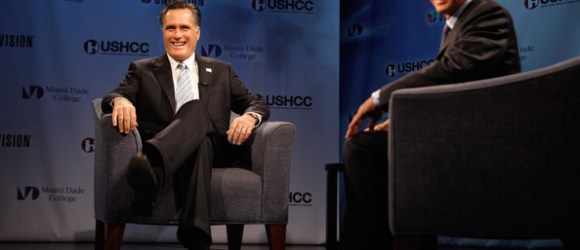
Hispanic Chamber Of Commerce And Univision Hold "Meet The Candidates" Event January 24, 2012 - Photo by Chip Somodevilla/Getty Images North America

Mitt Romney won a landslide victory over Rick Santorum in Puerto Rico last weekend and Santorum is not taking his 75-point defeat lightly.

Santorum, who spent two full days campaigning in the Caribbean island, congratulated Romney on his victory in a press release late Sunday night, but in the same breath accused the former governor of pandering to Puerto Rico’s Latino voters by switching his position on making English the official language of every U.S. state.

“Their decision to put political expedience and political deception ahead of previously held policy positions further erodes their candidate’s credibility and trust,” Santorum spokesman Hogan Gidley said of the Romney campaign in the statement. “We all know Mitt Romney will do and say anything to get votes, and this is just another example of that.”

But just how much of a conservative two-step did Romney dance while courting Puerto Ricans? Here’s a look at some of the positions Romney softened, and those he stood by while attempting to woo Latino voters.

English as the Official Language

After Santorum was skewered for saying Puerto Rico would have to make English their official language in order to become a state, Romney toned down his own position on the issue while campaigning in Puerto Rico last week.

“I don’t have preconditions that I would impose,” Romney said shortly after touching down on the Island Friday. “English has been an official language of Puerto Rico for 100 years and I think selecting the words of your governor, Spanish is the language of Puerto Rico’s heritage, English is the language of opportunity.”

Both languages are currently considered “official” in the island territory and Romney encouraged young people to “learn both.” While he emphasized the importance of learning English, he did not say it should be the sole official language.

But that’s not what he said during debates in January.

“I believe English should be the official language of the United States,” Romney said on the debate stage.

The U.S. currently does not have an “official” language. If English was adopted as the “official” language, no government documents could be printed or written in any language besides English. Many federal documents are currently printed in both Spanish and English.

At another January debate, Romney noted that “English is the language of this nation” and touted his efforts as the governor of Massachusetts to get rid of bilingual education in favor of English emersion programs.

“People need to learn English to be successful to get great jobs,” Romney said at the NBC Debate. “We don’t want to have people to be limited in their ability to achieve the American Dream because they don’t speak English.”

A Romney spokeswoman disputed that Romney’s position had changed, arguing that even though Romney supports making English the official language of the U.S., that would have no bearing on Puerto Rico becoming a state. “These positions are not at odds,” said campaign spokeswoman Andrea Saul in an email. “What the federal government does regarding the official language is separate from what states do.”

The Dream Act

Romney has been firm in his opposition to the Dream Act, which would give undocumented minors a path to legal residency if they attend college or join the military.

While campaigning in Iowa Romney explicitly said he would veto the Dream Act if elected president. As governor of Massachusetts he vetoed the state version of the bill which would have provided in-state tuition to undocumented immigrants.

“The answer is yes,” Romney said of whether he would veto the legislation at the federal level.

Romney later added that giving “special benefits” to “people who come here illegally” was “contrary to the idea of the nation of law.” Romney would, however, support giving legal status to undocumented immigrants who serve in the military.

“I am delighted with the idea that people who come to this country and wish to serve in the military can be given a path to become permanent residents in this country,” he said while campaigning in Iowa. “Those who serve in our military and fulfill those requirements I respect and acknowledge that path.”

Romney has more recently focused on this portion of the Dream Act that he does support.

“I wouldn’t sign the Dream Act as it currently exists, but I would sign the Dream Act if it were focused on military service,” Romney said during a debate in Florida, where 22 percent of the state’s population is Hispanic.

Latino Decisions poll conducted for Univision showed that 84 percent of Latinos nationwide support the Dream Act.

Supreme Court Justice Sonia Sotomayor

While Romney softened his firm opposition to the Dream Act while talking to Latino voters, he stood firm on his condemnation of Supreme Court Justice Sonia Sotomayor, whose parents are from Puerto Rico.

While campaigning in Puerto Rico last week, Romney said he would support a Puerto Rican Supreme Court justice, just not one whose “philosophy is quite different than my own.”

He also dubbed Sotomayor “an activist, a liberal jurist.”

The former governor launched a campaign ad against Santorum, criticizing the former Pennsylvania senator for voting to appoint Sotomayor to the Second Circuit Court of Appeals in 1998, a post that put her on the fast track to the Supreme Court, the ad claims.

Romney has never been a Sotomayor fan. During her bitter confirmation process in 2009 Romney said her nomination to the Supreme Court was “troubling.”

“There are some things she said that are troubling for those of us who believe that the job of a justice is to follow the law and the Constitution, not to create law,” Romney said in 2009, according to CNN.

Self-Deportation of Undocumented Immigrants

Romney has stood firm on his opposition to amnesty for undocumented immigrants, but his views on deporting the millions of illegal immigrants who are already in America took a new twist during this campaign cycle.

At a Florida debate in January, Romney said he supports “self-deportation,” in which conditions would become so unbearable for undocumented immigrants that they would chose to leave the country.

“The answer is self-deportation,” Romney said at an NBC debate. “People decide that they can do better by going home because they can’t find work here because they don’t have legal documentation to allow them to work here.”

Under Romney’s plan, legal immigrants would have a card proving they were eligible to work in the United States. Without a card, Romney said people would not be able to find work.

“If people don’t get work here, they’re going to self-deport to a place they can get work,” he concluded.

But during his 2008 bid for the presidency, Romney said undocumented immigrants should be allowed to stay in the country for a “set period” while applying for legal residency. If that is not granted within the allotted amount of time, he said they should return home.

“Those 12 million who’ve come here illegally should be given the opportunity to sign up to stay here, but they should not be given any advantage in becoming a permanent resident or citizen by virtue of simply coming here illegally,” Romney told with NBC’s Tim Russert during the 2008 campaign.

“For the great majority, they’ll be going home,” Romney added, stopping short of saying those unapproved immigrants would be deported.

READ MORE: ABC NEWS

Matthew Jaffe, who is covering the 2012 campaign for ABC News and Univision, contributed to this report

SUBSCRIBE to The Hispanic Blog to stay on top of the latest latino news, politics and entertainment!

Don’t be shy SUBSCRIBE – COMMENT – LIKE ME -CIRCLE ME AND FOLLOW ME

If you have any questions, concerns or simply would like to get a quote on my Marketing, Public Relations, Social Media and/or Events services, please feel free to contact me at thehispanicblog@gmail.com.

God Bless and may you have a fabulous day!

powered by Influential Access – “Transforming the Ordinary to EXTRAordinary!” – CEO – Jessica Marie Gutierrez – Creator of The Hispanic Blog #thehispanicblog

WILL ROMNEY HELP GOVERNOR LUIS FORTUñO PUSH FOR PUERTO RICO TO BECOME A STATE?

The most important issue for Gov. Luis Fortuño during Puerto Rico’s GOP primary may not be at the top of the list for most Latinos, but Mitt Romney hopes his endorsement will help win Latino voters.

Fortuño is pushing for Puerto Rico to become a state—and he sees Romney as an ally.

The former Massachusetts governor sympathizes more openly with Puerto Rico’s pro-statehood camp than his GOP competitors. While Romney’s top rival, Rick Santorum, called on Wednesday for Puerto Rico to adopt English as the island’s official language as a condition for becoming a state, Romney says Puerto Rico should be admitted to the union without such a condition if its citizens decide to vote to join in a referendum scheduled for Nov. 6.

“It just makes sense,” Fortuño told Fox News. “We have been part of the United States since 1898. Natural-born citizens since 1917. Our men and women have served in greater numbers than most states since then. And I believe that it’s the right thing to do in the 21st century, to allow almost 4 million American citizens to express our will and then to work with the White House and hopefully President Romney to address this issue.”

President Barack Obama does not have an official position on Puerto Rico’s status, saying he will respect the decision of the island’s voters.

Only voters affiliated with the Fortuño’s conservative New Progressive Party were permitted to cast ballots in the island’s Republican primary this year – a requirement that obligated pro-Republican Puerto Ricans to declare their support for statehood.

With the combined benefit of Fortuño’s endorsement and Santorum’s gaffes with the local press, Romney cruised to an easy victory, taking some 83 percent of the vote and all of the 20 delegates up for grabs. About 130,000 Puerto Ricans cast votes in Sunday’s primary, according to the Associated Press.

The victory emboldened Romney, who polls poorly among Latinos nationally.

“Those people who don’t think that Latinos will vote for a Republican need to take a look in Puerto Rico,” Romney said. “I intend to become our nominee and I intend to get Latino voters to vote for a Republican.”

A Fox News Latino poll found only 14 percent of likely Hispanic voters favored Romney in a head-to-head race with Obama.

SUMMARY

Puerto Rico Primary By the Numbers

83 percent of vote reported

VOTES    PERCENT

Romney        98,375      83%

Santorum        9,524       8%

Gingrich          2,431       2%

Paul                1,452       1%
Read more: LATINO FOX NEWS

SUBSCRIBE to The Hispanic Blog to stay on top of the latest latino news, politics and entertainment!

Don’t be shy SUBSCRIBE – COMMENT – LIKE ME -CIRCLE ME AND FOLLOW ME

If you have any questions, concerns or simply would like to get a quote on my Marketing, Public Relations, Social Media and/or Events services, please feel free to contact me at thehispanicblog@gmail.com.

God Bless and may you have a fabulous day!

powered by Influential Access – “Transforming the Ordinary to EXTRAordinary!” – CEO – Jessica Marie Gutierrez – Creator of The Hispanic Blog #thehispanicblog


ROMNEY WINS PUERTO RICO’S GOP PRIMARY

THE HISPANIC BLOG IS THE LATEST HISPANIC NEWS BY JESSICA MARIE GUTIERREZ

Romney handily wins Puerto Rico‘s GOP primary

Mitt Romney heads in to Illinois’s presidential primary this week with a handy win in Puerto Rico, pocketing the territory’s 20 GOP delegates in a bruising race that has become a numbers game for the Republican nomination.

With about 83% of total ballots accounted for early Monday in Puerto Rico, Romney had garnered more than 98,000 votes — or 83% of the total — based on unofficial results obtained from local party and election officials.

Rick Santorum was a distant second, at 8% with slightly more than 9,500 votes.

The other two candidates, former House Speaker Newt Gingrich and Texas Rep. Ron Paul, were barely registered in the race with 2,431 votes, or 2% of the vote, and 1,452 votes, or 1%, respectively.

Even as the vote was being counted in Puerto Rico, Romney, Santorum and the other candidates were already on the mainland vying for delegates in Illinois and Louisiana.

Illinois holds its primary on Tuesday and Louisiana on Saturday.

CNN’s latest delegate estimates show Romney with 518 delegates to Santorum’s 239. Gingrich has 139 delegates, and Paul, the libertarian champion, has 69 delegates. To secure the nomination, 1,144 delegates are needed.

Santorum, the former Pennsylvania senator, was in Louisiana late Sunday, where he is expected to win the primary.

Romney was in Illinois where polls indicate he holds a small lead over Santorum, with Gingrich and Paul well behind.

Romney framed his win in Puerto Rico as the territory’s desire for a candidate that “most represents their feelings” — and especially their desire to nominate some who can bring about a stronger economy and a smaller government.

He also said his party can appeal to Latinos, and win the presidency, with a low-tax, pro-business message.

“Those people who don’t think that Latinos will vote for a Republican need to take a look in Puerto Rico,” said the former Massachusetts governor, noting that the territory’s governor and its legislative leaders are conservative.

photo AP

“Hispanic voters are going to vote for Republicans if we stand for something — conservative principles that bring growth and good jobs and rising home values. That’s how we’re going to win, and we’re going to get Latino voters to help us out.”

Romney had entered the contest in Puerto Rico as the favorite. He was largely backed by the island government’s political establishment, including Gov. Luis Fortuno, who campaigned with Romney last week.

Santorum, the former Pennsylvania senator, created a small political firestorm on the island in the days leading up to the primary when he said English should be the principal language in Puerto Rico before it could gain statehood. Puerto Rico will vote on a statehood referendum in November.

After arriving in Puerto Rico on Friday, Romney said he would have “no preconditions” on language for Puerto Rico to gain statehood, though during a CNN debate in January he said English should be the nation’s official language.

Santorum immediately hit back, accusing Romney of flip-flopping.

Romney fired back that English has been the official language of the government in Puerto Rico for more than 100 years.

The heated, see-saw allegations between the two candidates have marked much of the race for the GOP nomination, which Sen. John McCain, R-Arizona, called “the nastiest I’ve ever seen” during an appearance Sunday on NBC’s “Meet The Press.”

Puerto Rico’s primary came two days before the showdown in Illinois, where 54 delegates will be awarded proportionally and polls show a tight race between Romney and Santorum.

Asked over the weekend while campaigning in Missouri about whether a win in Illinois would mean he’d win the nomination, Santorum said: “We feel very, very good about it. Let’s put it that way. Really good about it.”

Santorum also challenged Romney’s assertion that his business experience is one of his strongest credentials, telling CNN’s Candy Crowley on “State of the Union” on Sunday that, “If Gov. Romney thinks that he is the CEO of America and can run and manage the economy, he doesn’t understand what conservatives believe in.”

Romney’s campaign released an ad in Illinois on Friday, attacking Santorum for having “never run a business or a state.”

Santorum on Sunday said he had experience in the private sector as a lawyer, but argued that executive experience at a company is not necessary to be commander-in-chief.

“Running a business is not the same as being president of the United States,” he said.

Santorum also gave no indication that he has plans to drop out of the race should his campaign reach a point where the delegate math doesn’t add up in his favor.

“What I’m hearing is that we want a conservative nominee, that the establishment is trying to push a moderate like they did in 1976 against Ronald Reagan, like they did in 1996 with Bob Dole and what they did with John McCain,” Santorum said. “I think conservatives would like an opportunity to nominate a conservative, and that’s an opportunity.”

Both Santorum and Romney also focused their rhetoric at President Barack Obama, particularly with regard to rising gas prices.

Romney said Obama needed to fire Secretary of Energy Steven Chu and Interior Secretary Ken Salazar for their role in driving up gas prices.

“Given the fact that (Obama has) changed his policies, wants lower gas prices, he needs to fire them and return to the energy policies we need,” Romney said during a town hall meeting in Collinsville, Illinois.

Santorum told a crowd in Effingham, Illinois, to remember Obama at the gas pumps.

“When you see that zero come up, when it gets to the $100 range, when you see the zero, think of ‘O’ for Obama because that’s why you are paying that extra amount of money,” Santorum said.

READ MORE: CNN NEWS

SUBSCRIBE to The Hispanic Blog to stay on top of the latest latino news, politics and entertainment!

Don’t be shy SUBSCRIBE – COMMENT – LIKE ME -CIRCLE ME AND FOLLOW ME

If you have any questions, concerns or simply would like to get a quote on my Marketing, Public Relations, Social Media and/or Events services, please feel free to contact me at thehispanicblog@gmail.com.

God Bless and may you have a fabulous day!

powered by Influential Access – “Transforming the Ordinary to EXTRAordinary!” – CEO – Jessica Marie Gutierrez – Creator of The Hispanic Blog #thehispanicblog

WHY ARE REPUBLICANS VISITING PUERTO RICO?

THE HISPANIC BLOG IS THE LATEST HISPANIC NEWS BY JESSICA MARIE GUTIERREZ

Romney to Puerto Rico: You can still speak Spanish in my America!

PHOTO BY AP

Mitt Romney landed in Puerto Rico today ahead of the islands primary this Sunday. And unlike what Rick Santorum said Wednesday, Romney would not require Puerto Rico to meet any language requirement prior to becoming a state. When asked by reporters if Romney would require Puerto Rico to make English the territory’s official language, Romney said he had no “preconditions,” ABC News reports.
http://c.brightcove.com/services/viewer/federated_f9?isVid=1

You know a presidential primary has turned into a scramble for every last delegate when the candidates start showing up in Puerto Rico.

Politics is a boisterous pastime on this island territory, where campaigns feature festive parades and caravans of cars blaring music. Few places in the world have higher voter turnout.

So you can imagine the excitement over today’s Republican primary in Puerto Rico, which in most presidential campaigns earns at best a token visit from a candidate’s spouse or kid, but last week had Mitt Romney and Rick Santorum hitting the streets of San Juan.

With 23 Republican delegates at stake, Puerto Rico has more influence on the nomination than Hawaii or Delaware. But in the rare occasions when presidential primaries extend into a fight for every delegate, the commonwealth becomes more than a political afterthought bypassed by the major candidates. Four years ago Hillary Rodham Clinton won Puerto Rico handily after she and Obama campaigned aggressively in the territory, and Romney and Santorum made appearances last week.

“I was referred to by many in my state as Senador Puertorriqueño. They used to make fun of me. ‘Why are you representing Puerto Rico?’ ” Santorum boasted in San Juan, recounting his efforts as a U.S. senator to increase Medicare reimbursements to citizens in Puerto Rico.

His pandering was overshadowed, however, by an interview with the newspaper El Vocero in which he said he would support statehood so long as Puerto Rico made English its primary language.

The Constitution does not require any state to make English its official language, and Santorum stepped into the political mine field that defines why Puerto Ricans are sharply divided by the question of statehood: their identity. One Puerto Rican delegate pledged to Santorum promptly quit his campaign after the English language comment.

“Puerto Rico is very different from the United States, and if we became a state I worry we would lose something vital,” said Therese Santos, a university student, who like many Puerto Ricans speaks perfect English. “To say we have to speak English would be changing centuries of tradition and threaten our identity.”

That’s a common sentiment among Puerto Ricans. They say they’re proud to be Americans, but they are equally proud to wave their own flag, and field their own Olympic teams and Miss Universe contestants.

Republican presidential candidate Rick Santorum waves at supporters following a campaign rally in Old San Juan, Puerto Rico, Thursday. Ricardo Arduengo/AP

“He really bombed with that comment, but I’m glad Santorum said that because he spoke the truth,” said Evelyn Nieves, a teacher. “And I hope people will question the party leaders pushing statehood who keep telling people everything would stay the same and we would continue with our own flag, our own national anthem.”

Romney has managed to antagonize some Hispanic voters with his calls for “self-deportation” of some 11 million undocumented immigrants in America, but he treaded carefully on the language question in San Juan on Friday.

“Spanish is the language of Puerto Rico’s heritage. English is the language of opportunity,” he said at a news conference. “I would hope that young people would learn both languages, but particularly English so that as they trade throughout the country and participate in educational opportunities throughout the country that their English skills would make it even easier for them.”

In November, Puerto Ricans will hold a referendum on whether they support continuing with territorial status or moving to statehood. Congress would have to approve it, but if Puerto Rico became America’s 51st state, most observers believe that would lead to Democrats picking up seats in the U.S. House and Senate.

“If a majority of Puerto Ricans wish to become a state, then I will support that effort in Washington and I will help lead that effort in Washington,” Romney vowed Friday, flanked by pro-statehood Gov. Fortuno, and Puerto Rican and American flags.

Romney is favored to win today’s primary, but other candidates can still pick up delegates if no one receives more than 50 percent of the vote.

“Puerto Rico’s never mattered more in a presidential primary because every delegate matters,” said John Regis, finance chairman of the island’s Republican Party, who hopes more than 130,000 people turn out.

READ MORE: http://www.tampabay.com/news/politics/national/puerto-rico-a-force-in-florida-voting/1220638

SUBSCRIBE to The Hispanic Blog to stay on top of the latest latino news, politics and entertainment!

Don’t be shy SUBSCRIBE – COMMENT – LIKE ME -CIRCLE ME AND FOLLOW ME

If you have any questions, concerns or simply would like to get a quote on my Marketing, Public Relations, Social Media and/or Events services, please feel free to contact me at thehispanicblog@gmail.com.

God Bless and may you have a fabulous day!

powered by Influential Access – “Transforming the Ordinary to EXTRAordinary!” – CEO – Jessica Marie Gutierrez – Creator of The Hispanic Blog #thehispanicblog