WHAT WILL VOTER TURNOUT BE LIKE IN 2012: HERE ARE THREE SCENARIOS

THE HISPANIC BLOG IS THE LATEST HISPANIC NEWS BY JESSICA MARIE GUTIERREZ

Will strong turnout by minority voters lock up the November election for President Barack Obama? Or will the enthusiasm of the 2010 midterms carry over to boost white voter turnout, helping the Republican nominee? William H. Frey, a senior fellow at the Brookings Institution, examines that question in a new paper.
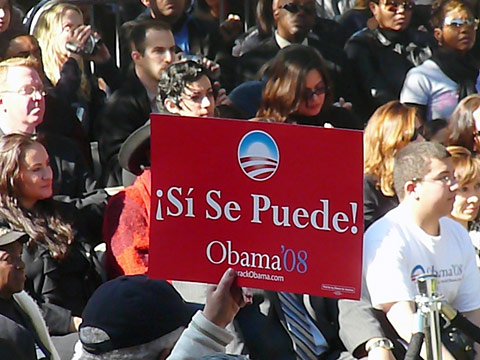
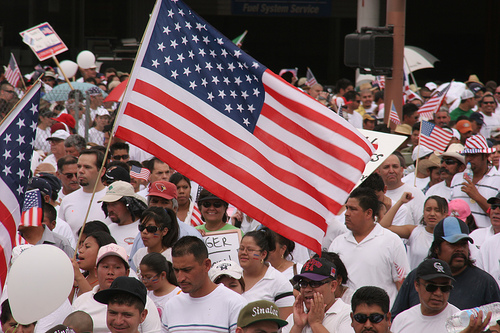
photo source: Dallas Observer blog

The minority vote in 2008 played a decisive role for Mr. Obama both nationally and in several key states. He lost the white vote but outperformed among all other races. In North Carolina, where Mr. Obama won by a mere 14,000 votes, African Americans accounted for nearly a quarter of the electorate, and 95% of them voted for Mr. Obama, according to exit polls. Minority voters also helped push Mr. Obama over the top in Indiana, Virginia and New Mexico, while expanding his margins in big states such as Ohio and Pennsylvania.

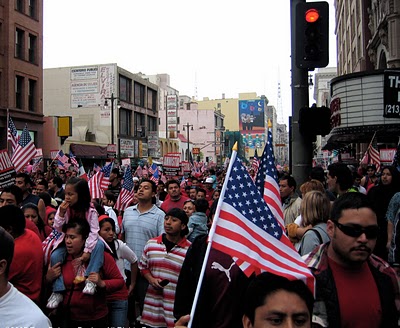
photo source: ThirdCoast Digest

Indeed in 2008, the paper notes, turnout by African Americans, Hispanics and Asian Americans was a few percentage points higher in each group than in 2004 (65% in 2008 vs. 60% in 2004; 50% vs. 47%; and 47% vs. 44% respectively for each group), while white turnout was one point less (66% vs. 67%).

Jae C. Hong AP Photo
Republican presidential candidate, former Massachusetts Gov. Mitt Romney speaks at the RNC State Chairman’s National Meeting in Scottsdale, Ariz., Friday, April 20, 2012.

Also, the margin of votes for the Democrats among minority groups, already sizable in 2004, expanded greatly in 2008. That is, more minorities were voting, and those votes were much more heavily Democratic. For white voters, which lean toward Republicans, the margin narrowed, but was still in the Republican column. In short, white turnout slumped, and whites who did vote voted less Republican than four years earlier.

photo source: AP

With this as background, Mr. Frey poses the question:
As we approach November, minorities will account for a slightly larger share of eligible voters than in 2008. At the same time, white support for the Republican candidate may be greater than in 2008. Which dynamic will prevail?

photo source Reuters

He has three scenarios:

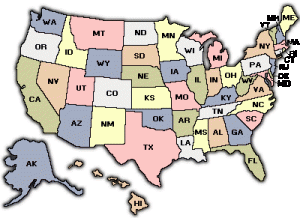
Scenario A assumes that the 2008 turnout and voting patterns again apply to 2012 voters. If that occurs, Obama wins with 29 states and 358 electoral votes. (270 electoral votes are needed to win.)

Scenario B applies 2004 turnout and voting patterns to the 2012 population. In this scenario, Mr. Romney beats Mr. Obama, with 286 electoral votes in 30 states.

Scenario C assumes strong partisan participation for both whites and minorities in 2012. This scenario is perhaps the most likely of the  three, says Mr. Frey. In this scenario, whites in each state are assumed to have more enthusiasm for the GOP nominee (likely Mitt Romney) in 2012 than in 2008 (John McCain) and as a result will mimic their 2004 patterns. Meanwhile, minorities are presumed to follow their strong 2008 turnout and voting margins. In this scenario, Mr. Obama wins, narrowly, with 292 electoral votes spread among 24 states.

Read more: The Wall Street Journal

SUBSCRIBE to The Hispanic Blog to stay on top of the latest latino news, politics and entertainment!

Don’t be shy SUBSCRIBE – COMMENT – LIKE ME -CIRCLE ME AND FOLLOW ME

If you have any questions, concerns or simply would like to get a quote on my Marketing, Public Relations, Social Media and/or Events services, please feel free to contact me.

God Bless and make it a fabulous day!

powered by Influential Access – “Transforming the Ordinary to EXTRAordinary!” – CEO – Jessica Marie Gutierrez – Creator of The Hispanic Blog #thehispanicblog
 

WILL THE SB 1070 SUPREME COURT CASE CHANGE THE ELECTION?

THE HISPANIC BLOG IS THE LATEST HISPANIC NEWS BY JESSICA MARIE GUTIERREZ

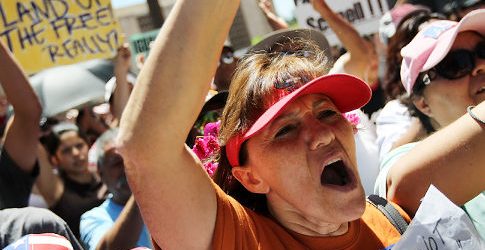
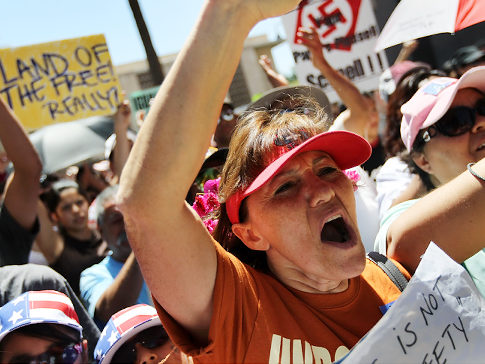
PHOENIX – APRIL 25: Opponents of Arizona‘s new immigration enforcement law protest outside the state capitol building on April 25, 2010 in Phoenix, Arizona. More than 1,000 gathered to protest the passage of Arizona’s tough new law which was signed by the state’s Republican governor Jan Brewer two days before. Critics of the law say that it will encourage racial profiling by law enforcement and endanger civil rights in the state. (Photo by John Moore/Getty Images) Original Filename: GYI0060270245.jpg

With the Supreme Court likely to uphold portions of Arizona’s infamous immigration law, the state will remain front and center in national headlines up until this year’s general election. While Hispanic voters in the state have no control over the Supreme Court’s decision, they will be able to have their voices heard at the Arizona ballot box in November.

SOURCE: AP/Matt York
Immigration-rights demonstrators march to the Arizona state Capitol in April 2006. These immigration protests sent hundreds of thousands of people into the streets this spring and promised to leave behind a surge of new Hispanic voters.

The Obama campaign certainly believes that the agitation of Hispanic and independent voters in Arizona puts the state in play for the general election.  Historical evidence and recent polling indicate that the states may well be up for grabs this year. Putting Arizona’s 11 electoral votes in play would not only shake up the electoral map but also send a clear message that extremist immigration laws are political poison. In 2008 – with minimal investment from the Obama Campaign – the President commanded a large share of the Hispanic vote in Arizona, besting hometown Senator John McCain 56% to 41%. If the President can boost Hispanic turnout, the statewide electorate could become much more Democratic. With recent polling showing Arizona as a toss-up, a solid investment in Hispanic mobilization could make the state very competitive.

A Hispanic youth holds up a sign questioning Latinos’ support for President Barack Obama during a protest outside local Democratic Party headquarters in Charlotte, North Carolina. (EFE)

A recent NBC News/Marist Poll reveals that President Obama is only trailing in Arizona by 5 points. The real eye-popping numbers for the President, however, are the preferences of independent voters. Among independents in Arizona, the President outperforms Romney 45 percent to 36 percent, with 19 percent undecided. Another poll by the Merrill/Morrison Institute puts the race within the margin of error. 42 percent of Arizona registered voters preferred Mitt Romney, while 40 percent supported the President. With a margin of error of plus or minus 4.4 percent, so if the election were held today the contest for Arizona’s 11 electoral votes would be a toss-up.
The real question on everyone’s mind is; can an investment in maximizing the Hispanic vote in Arizona generate enough support to push Obama and down ticket Democrats over the top? Trends in Hispanic turnout from neighboring states with similar demographics suggest that these investments could pay off. Significant efforts to boost turnout in 2008 resulted in substantial increases in Hispanic voter participation.  Colorado, New Mexico, and Nevada saw Hispanic voter participation increase by 33 percent, 62 percent and 32 percent respectively from 2004 to 2008. The overwhelming majority of that increased Hispanic vote went to Obama. The growing voter turnout from Hispanics helped the President carry all three of those states on his way to the White House, and this same dynamic could bring Arizona into the fold later this year.

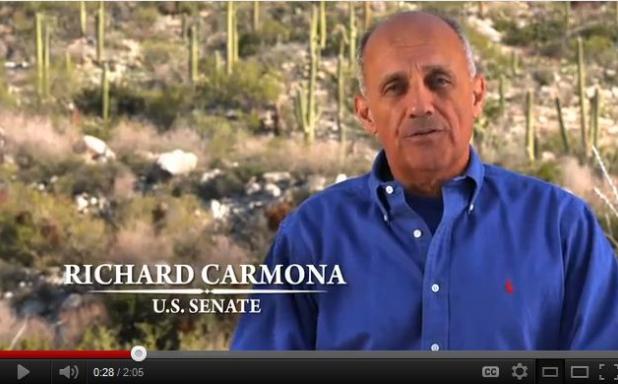
Hispanics nationally are breaking nearly three to one for the President, if this holds true in Arizona increasing the vote of this population could swing the general election vote for more moderate voices in Arizona as well.  For the first time ever there is viable Hispanic Senatorial candidate in former Surgeon General Richard Carmona.

If this former U.S Surgeon General is any example, you can be anything you want to be if you set your mind to it–high school dropouts included. In 1967 Carmona quit Dewitt Clinton High School at age 16 and enlisted in the U.S. Army, where he eventually earned his GED. Carmona graduated at the top of his medical program at University of California, San Francisco in 1979. President George W. Bush appointed Carmona Surgeon General of the United States in 2002.

Carmona, a military veteran, has a huge lead with Hispanic voters. Politico notes that Hispanic voters favor him 61% – 25% percent statewide. Hispanic women are even more supportive, giving him a 70% – 14% advantage over Flake. At this point in the race he is an unknown quantity. Just 22 percent of voters can identify Richard Carmona, including just 19 percent of white voters, giving him room to expand support. The reality is the more Carmona is able to galvanize Hispanic support in Arizona the better off the Obama campaign will do in the state.

Tens of Thousands March in Phoenix, AZ Against SB 1070. (Photo: José Muñoz) 2010

If any segment of the Arizona population should want to change the dynamic of the state’s political apparatus it would be Hispanics. The current political environment in Arizona is toxic for Hispanics, and has been hijacked by political extremists. For those in the state vested in sending a strong message to the country that Arizona is turning a corner on this brand of governance, voting against the likes of Jan Brewer, Joe Arpaio, and Russell Pearce would speak loud and clear. With the Supreme Court likely to uphold parts of SB1070, November will be the earliest that Arizona voters can let the country know where they truly stand on this law.
Read more: Fox News Latino

SUBSCRIBE to The Hispanic Blog to stay on top of the latest latino news, politics and entertainment!

Don’t be shy SUBSCRIBE – COMMENT – LIKE ME -CIRCLE ME AND FOLLOW ME

If you have any questions, concerns or simply would like to get a quote on my Marketing, Public Relations, Social Media and/or Events services, please feel free to contact me.

God Bless and make it a fabulous day!

powered by Influential Access – “Transforming the Ordinary to EXTRAordinary!” – CEO – Jessica Marie Gutierrez – Creator of The Hispanic Blog #thehispanicblog


WHAT IS HOMEBOY INDUSTRIES: LEARN ABOUT THE COUNTRY’S LARGEST GANG-INTERVENTION PROGRAM EMPLOYING FELONS

THE HISPANIC BLOG IS THE LATEST HISPANIC NEWS BY JESSICA MARIE GUTIERREZ

photo by Father Gregory Boyle, the founder and heart of Homeboy Industries, prays with a client. | Photo by Melissa Golden

Fr. Gregory Boyle – best known as Fr. Greg by all who meet him — has been an advocate for at-risk and gang-involved youth in Los Angeles, and around the world, for over 25 years. Father Boyle founded Homeboy Industries, which traces its roots to “Jobs For A Future” (JFF), a program created in 1988 by Fr. Greg at Dolores Mission parish. In an effort to address the escalating problems and unmet needs of gang-involved youth, Fr. Greg and the community developed positive alternatives, including establishing an elementary school, a day care program and finding legitimate employment for young people. JFF’s success demonstrated that many gang members are eager to leave the dangerous and destructive life on the ‘streets.’

In 1992, as a response to the civil unrest in Los Angeles, Fr. Greg launched the first business: Homeboy Bakery, with a mission to create an environment that provided training, work experience, and above all, the opportunity for rival gang members to work side by side. The success of the Bakery created the groundwork for additional businesses, thus prompting JFF to become an independent non-profit organization, Homeboy Industries, in 2001. Today Homeboy Industries’ nonprofit economic development enterprises include Homeboy BakeryHomeboy SilkscreenHomeboy/Homegirl Merchandise, and Homegirl Café.

Started as a jobs program offering alternatives to gang violence in one of the toughest neighborhoods in Los Angeles, Homeboy assists at-risk, recently released, and formerly gang involved youth to become contributing members of their communities through a variety of services in response to their multiple needs. Free programs — including counseling, education, tattoo removal, substance abuse and addiction assistance, job training and job placement — enable young people to redirect their lives. Homeboy provides them with hope for their futures and is the nation’s largest gang-intervention and re-entry program – a model to all. Additionally, one of the many jobs one can get is being an extra on the hit show Southland who works with Homeboy Industries to make the show as real as possible.

Father Greg’s first book, Tattoos on the Heart: The Power of Boundless Compassion, was released on March 9, 2010, which received the 2010 SCIBA (Southern California Indie Booksellers Association) Non-Fiction Book Award and was named as one of the Best Books of 2010 by Publishers Weekly.

Homeboy Industries has made so much progress that on Saturday April 21, 2012 they hosted their 10th Annual Lo Maximo Awards Dinner. The Homeboy hero was awarded to Brian Moon, the Homeboy Community Service Award was  awarded to Bruce Karatz and the Homeboy Media Award was awarded to Southland’s Executive Producers John Wells, Christopher Cuhulack, and Jonathan Lisco. The cast of Southland also showed up and went with producers to accept their award.

MEET BRIAN MOON HOMEBOY’S HERO

SUBSCRIBE to The Hispanic Blog to stay on top of the latest latino news, politics and entertainment!

Don’t be shy SUBSCRIBE – COMMENT – LIKE ME -CIRCLE ME AND FOLLOW ME

If you have any questions, concerns or simply would like to get a quote on my Marketing, Public Relations, Social Media and/or Events services, please feel free to contact me.

God Bless and make it a fabulous day!

powered by Influential Access – “Transforming the Ordinary to EXTRAordinary!” – CEO – Jessica Marie Gutierrez – Creator of The Hispanic Blog #thehispanicblog