THE MYTH OF THE UNDOCUMENTED WORKERS: THEY DO PAY TAXES AND HERE’S WHAT THEY PAID EACH STATE IN 2010

THE HISPANIC BLOG IS THE LATEST HISPANIC NEWS BY JESSICA MARIE GUTIERREZ


It’s a myth that illegal immigrants don’t pay taxes, says Dulce Guerroro, a self-confessed illegal immigrant living in Mableton, Georgia.

Guerrero’s whole family is undocumented, except for her 13-year old younger brother, who was born in the U.S. and is a U.S. citizen. She says that they all work and pay taxes through their Internal Revenue System (IRS) issued Individual Taxpayer Identification Numbers (ITINs).

“People always, always point out that we don’t pay taxes, which is a complete lie,” Guerrero told Business Insider.

“We have a government issued tax ID number. So the government knows very well who we are. They know very well where we live and they have all of our information. I am sure if they ever wanted to pick us up, since they have our tax ID number, they have our information. We pay taxes just like everyone else.” 

Business Insider has interviewed four illegal immigrants in the past few weeks and all have said they have filed and paid taxes through an ITIN. However, the IRS is prohibited by law to share any information regarding the tax payers with other governmental agencies, including the Department of Homeland Security. “The internal revenue code really does not differentiate between legal or illegal status,” IRS representative Patricia Kirk told Fox News.

According to the Associated Press, in 2006 the then IRS Commissioner, Mark Everson, agreed with Guerrero when he told Congress that “the ITIN program is bringing taxpayers into the system.” Furthermore, having ITIN enables immigrants to contribute to the U.S. economy by enabling them to open bank accounts, obtain mortgages and establish a record of residency and taxpaying.

Social Security Administration (SSA) has also taken a positive outlook on immigration in the past. “Overall, any type of immigration is a net positive to Social Security. The more people working and paying into the system, the better,” Mark Hinkle, Deputy Press Officer at SSA told the AP in 2008. “It does help the system remain solvent.”

While the IRS does not have an estimate of how many illegal immigrants pay income tax, it has been issuing ITINs to foreigners without a Social Security number since 1996. Everson told Congress “many illegal aliens, utilizing ITINs, have been reporting tax liability to the tune of almost $50 billion from 1996 to 2003.”

Hinkle told the AP that the Social Security and Medicare taxes from mismatched W2s for the same period was $41.4 billion, adding up to about $90 billion in federal taxes during the eight-year period.

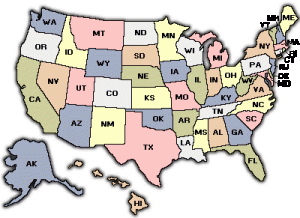
These numbers are fairly similar to those that Institute of Taxation and Economic Policy came up with when calculating taxes paid by undocumented immigrants. Their final figure was $11.2 billion in 2010. Check out the breakdown of this figure by state:


Read more: BUSINESS INSIDER

SUBSCRIBE to The Hispanic Blog to stay on top of the latest latino news, politics and entertainment!

Don’t be shy SUBSCRIBE – COMMENT – LIKE ME -CIRCLE ME AND FOLLOW ME

If you have any questions, concerns or simply would like to get a quote on my Marketing, Public Relations, Social Media and/or Events services, please feel free to contact me at thehispanicblog@gmail.com.

God Bless and may you have a fabulous day!

powered by Influential Access – “Transforming the Ordinary to EXTRAordinary!” – CEO – Jessica Marie Gutierrez – Creator of The Hispanic Blog #thehispanicblog
PODER HISPANIC EMERGE NETWORKING SERIES WILL KICK OFF IN SAN ANTONIO, TX ON MARCH 22nd

THE HISPANIC BLOG IS THE LATEST HISPANIC NEWS BY JESSICA MARIE GUTIERREZ

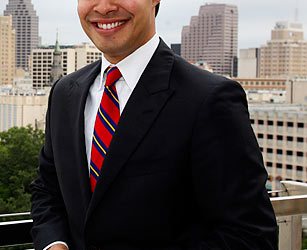
John Davenport / San Antonio Express-News / AP http://www.time.com/time/specials/packages/article/0,28804,2023831_2023829_2025185,00.html #ixzz1plr5hfa1

Poder Magazine Kicks Off Its Annual Emerge Networking Series in San Antonio, Texas

PODER Hispanic magazine, the premier business and lifestyle publication for Hispanic and Latino leaders, kicks off the annual EMERGE business networking series, a unique experience for young Hispanic emerging professionals, in San Antonio, TX on March 22nd. Celebrating its 5th year, the national EMERGE Series will continue to Charlotte (June 14), Chicago (August 16), and Miami (November).  In support of its’ ongoing commitment to empower young emerging Hispanics across the country, Emerge will provide an educational experience with unlimited resources and professional development.

Over 200 San Antonio Hispanic young professionals, entrepreneurs, business and civic leaders are expected to attend the March 22nd EMERGE event. Registration is complimentary and open to the public.  The EMERGE Series in San Antonio, hosted by PODER magazine, will feature a panel discussion by Mayor Julian Castro, the nation’s youngest Hispanic mayor of a Top 50 American City and moderated by Univision’s Brenda Jimenez. The event sponsors include State Farm, Prudential, Cigars International, and supported by ALFHA, SAHCC, as well as Marketwire as the official wire sponsor.

ThursdayMarch 22, 2012 from 6 p.m. to 10 p.m. Registration will start at 6pm followed by a panel discussion from 7-8pm and a cocktail networking reception from 8-10pm at Hotel Valencia Riverwalk located at 150 East Houston Street, San Antonio, Texas 78205

Register to attend San Antonio EMERGE today! (click here)


About the EMERGE Networking Series

EMERGE (http://emerge.poder360.com/) is a national Hispanic networking series for emerging young professionals that breaks down the traditional barriers of similar events and provides an aggressive and interactive approach to networking by featuring an empowering selection of Latino leaders from across the country to share their experience and roadmap to success. EMERGE is hosted by PODER Hispanic magazine published by Televisa Publishing + Digital, a division of Grupo Televisa, the largest Spanish-language media company in the world. Connect with EMERGE on Facebook and EMERGE Twitter.

About Poder Hispanic:

PODER Hispanic (www.poder360.com) magazine is a bi-monthly publication for Latinos in power—and for those who aspire to be. The magazine was conceived as a vehicle to provide the Hispanic corporate and entrepreneurial communities with valuable and reliable information. As a leading business and lifestyle magazine, PODER Hispanic is written for a global audience of influential senior business executives, political decision-makers and entrepreneurs interested in current events. Connect with Poder Hispanic Facebook and Poder Twitter. 

Media Contacts:

Carolina Copello / Logos PR
SUBSCRIBE to The Hispanic Blog to stay on top of the latest latino news, politics and entertainment!

Don’t be shy SUBSCRIBE – COMMENT – LIKE ME -CIRCLE ME AND FOLLOW ME

If you have any questions, concerns or simply would like to get a quote on my Marketing, Public Relations, Social Media and/or Events services, please feel free to contact me at thehispanicblog@gmail.com.

God Bless and may you have a fabulous day!

powered by Influential Access – “Transforming the Ordinary to EXTRAordinary!” – CEO – Jessica Marie Gutierrez – Creator of The Hispanic Blog #thehispanicblog

HOW DID TEXAS REDISTRICTING AFFECT ROMNEY’S CAMPAIGN?

THE HISPANIC BLOG IS THE LATEST HISPANIC NEWS BY JESSICA MARIE GUTIERREZ

Texas should be playing a role in Republican politics this year as big as, well, Texas.

The fast-growing state – the most populous by far in the Republican column – has four new seats in the U.S. House of Representatives, a big U.S. Senate race and more than a 10th of the delegates who will choose the party’s presidential nominee.

But a racially tinged dispute over redrawing its congressional districts has delayed the Texas primary by almost three months, complicated the U.S. Senate and House contests and altered the race for the White House.

A San Antonio court pushed Texas’ primary back to May 29 from March 6 after complaints that a new electoral map drawn by Republicans violated the federal Voting Rights Act by diluting the voting power of blacks and Latinos.

Three of Texas’ four new U.S. House seats were created in areas dominated by whites, even though Hispanics and blacks accounted for 90 percent of Texas’ population growth since 2000.

The battle sets white Republicans, who have firmly established political control in Texas within the past decade, against rising and strongly Democratic Hispanic and black populations, whose leaders argue that they are being unfairly denied an equal voice in state politics.

The stakes are high both for 2012, when the White House and control of the U.S. Congress are up for grabs, and longer term, when a rapidly growing Hispanic population is expected eventually to disadvantage Republicans and benefit Democrats.

“Republicans can work that racial solidarity thing for a while, but in the end, they’ve got to do better than 35 percent of the Hispanic vote or their election prospects are not great,” said Cal Jillson, a political science professor at Southern Methodist University in Dallas.

States with a history of minority voting rights violations must obtain pre-clearance from either the U.S. Department of Justice or the federal court in Washington, D.C., before they can use new maps. The new voter map in Florida, another fast-growing southern state, has also been subject to legal wrangling this year.

ALREADY A MINORITY

Non-Hispanic whites already account for a minority of Texas’ residents, with 45 percent of the population. The state is 38 percent Latino and 12 percent black, numbers expected to continue to rise.

President Barack Obama lost Texas by 11-percentage points in 2008. He got only 26 percent of the white vote, but was backed by 63 percent of Hispanics and 98 percent of blacks, fueling talk that it will not be long before Republican red Texas turns purple, if not Democratic blue.

“We sort of feel like we have the wind at our backs,” said Anthony Gutierrez, deputy executive director of the Texas Democratic Party.

Democrats have won Texas in only three of the last 15 presidential elections. The party has not won a statewide election since 1994, and Republicans cemented their control of the state with huge victories in the 2010 midterms.

But even Republicans acknowledge that changing demographics mean the party must appeal to Hispanics to hold onto power beyond the next few years. Latinos in Texas generally vote Democratic by a 2-to-1 margin, which won’t be helped by a redistricting fight seen as a battle to maintain white control.

“It is obviously a high-risk strategy in a state that is increasingly Hispanic,” said Michael Li, a Dallas-based election law lawyer who runs the blog “Texas Redistricting.” Li is not involved in the redistricting fight.

SUPER TUESDAY NOT SUPER FOR ROMNEY

The redistricting mess has already affected the 2012 presidential race, notably the hopes of Mitt Romney, who may have done well in the Texas primary if it had taken place on Super Tuesday – March 6 – as originally scheduled.

Texas would have been the biggest prize up for grabs on Super Tuesday, when 10 other states held primaries and caucuses.

Romney, with far more money and a bigger campaign organization than rivals Rick Santorum and Newt Gingrich, was best placed to compete in so many states at once. Texas alone has 20 media markets, meaning statewide advertising can cost millions.

Winning or putting in a good showing in Texas would have boosted Romney. The state’s 155 delegates, awarded proportionally, are a huge chunk of the 1,144 needed to become the nominee.

A strong performance on Super Tuesday also would have given Romney a badly needed breakthrough in the heart of southern Republican conservatism, weakening Santorum and perhaps cutting short what has become a protracted nomination fight.

Instead, Romney has been a weak front-runner and Santorum, a former Pennsylvania senator best known for strong religious conservatism, has been winning over the party’s right wing.

“It (a March 6 Texas primary) would have changed a lot of things. It would have changed the entire complexion of Super Tuesday,” said Matt Mackowiak, an Austin-based Republican strategist, especially with Santorum and Gingrich both vying for the support of the most conservative Texans.

“I suspect if the field was split and if Santorum and Gingrich hadn’t had $5 million or $3 million to spend, then Romney probably would have won Texas on March 6,” he said.

With Texas now one of the last states to vote, the nominee could be chosen by May 29. Even if it isn’t, Santorum is now considered more likely to take Texas, thanks to improving fund-raising and his solidified position as the conservative alternative to Romney.

“Romney starts with a significant disadvantage in terms of public opinion,” said Jim Henson, director of the Texas Politics Project at the University of Texas at Austin, although he added that Romney’s big campaign war chest means that he could spend heavily in Texas to target clusters of mainstream conservatives in major media markets.

A Wilson Perkins Allen Opinion Research poll last week showed Santorum eight percentage points ahead of Romney among likely Republican primary voters in Texas. Santorum was at 35 percent to 27 percent for Romney.

Gingrich was at 20 percent and Ron Paul, a Texas congressman lagging in most polls, was at 8 percent.

The redistricting mess is affecting races down the ticket as well, with many voters not sure where they are registered and many candidates unsure of where they should run or raise money while the court fight has continued.

“I can look around the state and see the confusion in the eyes of the average voter,” said Chris Elam, communications director for the state Republican party. Some 100 Republicans alone have applied to run for the 36 House seats, he said.

The interim map is expected to stand, but there is a chance it could be changed again by the Washington court.

The May 29 date is after schools close for the summer, leading to worries that turnout will be low, which often leads to unpredictable results.

The race to replace retiring Republican Senator Kay Bailey Hutchison has been most affected by the upheaval. Lieutenant Governor David Dewhurst has been favored to replace Hutchison, because of his statewide name recognition and fundraising prowess.

But the long delay has given opponents, especially Tea Party favorite Ted Cruz, time to raise money and their profiles. Former Dallas Mayor Tom Leppert and Craig James, a one-time television sports analyst, are also in the race.

If no one wins a majority on May 29, state law mandates a runoff vote on July 31, the heart of the hot Texas summer when an even smaller turnout would be expected.

On Monday, the Republican Party of Texas received a letter from the U.S. Department of Justice thatconfirmed federal pre-clearance of the temporary and emergency changes to the RPT rules that were adopted on February 29 at the emergency meeting of the State Republican Executive Committee.

As was reported in previous redistricting updates, during the February redistricting trial, the three-judge federal panel in San Antonio indicated to Chairman Munisteri that the RPT needed to obtain USDOJ pre-clearance on the party’s convention process. The DOJ attorney at the trial testified that his office would expedite the review of the changes and could reduce the approval time from a couple of months to a couple of weeks. The rules changes made by the SREC were submitted to the USDOJ on March 5, 2012 and this week the RPT received a letter verifying that the pre-clearance had indeed been expedited and approved.

Thus, the final legal obstacle has been overcome in the 2012 Republican Party of Texas convention process. The county and district conventions are moving forward on the dates of April 14 or April 21 (will vary by county), and the State Convention will be held on June 7-9 in Fort Worth. For a full list of RPT Rules governing the 2012 Election Cycle, you can visit www.TexasGOP.org and view the updated document.

READ MORE: REUTERS


HOW HAS ROMNEY’S POSITION CHANGED TOWARD THE LATINO ISSUES: FROM DREAM ACT TO IMMIGRATION

THE HISPANIC BLOG IS THE LATEST HISPANIC NEWS BY JESSICA MARIE GUTIERREZ

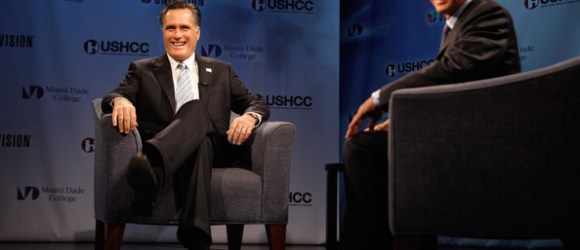
Hispanic Chamber Of Commerce And Univision Hold "Meet The Candidates" Event January 24, 2012 - Photo by Chip Somodevilla/Getty Images North America

Mitt Romney won a landslide victory over Rick Santorum in Puerto Rico last weekend and Santorum is not taking his 75-point defeat lightly.

Santorum, who spent two full days campaigning in the Caribbean island, congratulated Romney on his victory in a press release late Sunday night, but in the same breath accused the former governor of pandering to Puerto Rico’s Latino voters by switching his position on making English the official language of every U.S. state.

“Their decision to put political expedience and political deception ahead of previously held policy positions further erodes their candidate’s credibility and trust,” Santorum spokesman Hogan Gidley said of the Romney campaign in the statement. “We all know Mitt Romney will do and say anything to get votes, and this is just another example of that.”

But just how much of a conservative two-step did Romney dance while courting Puerto Ricans? Here’s a look at some of the positions Romney softened, and those he stood by while attempting to woo Latino voters.

English as the Official Language

After Santorum was skewered for saying Puerto Rico would have to make English their official language in order to become a state, Romney toned down his own position on the issue while campaigning in Puerto Rico last week.

“I don’t have preconditions that I would impose,” Romney said shortly after touching down on the Island Friday. “English has been an official language of Puerto Rico for 100 years and I think selecting the words of your governor, Spanish is the language of Puerto Rico’s heritage, English is the language of opportunity.”

Both languages are currently considered “official” in the island territory and Romney encouraged young people to “learn both.” While he emphasized the importance of learning English, he did not say it should be the sole official language.

But that’s not what he said during debates in January.

“I believe English should be the official language of the United States,” Romney said on the debate stage.

The U.S. currently does not have an “official” language. If English was adopted as the “official” language, no government documents could be printed or written in any language besides English. Many federal documents are currently printed in both Spanish and English.

At another January debate, Romney noted that “English is the language of this nation” and touted his efforts as the governor of Massachusetts to get rid of bilingual education in favor of English emersion programs.

“People need to learn English to be successful to get great jobs,” Romney said at the NBC Debate. “We don’t want to have people to be limited in their ability to achieve the American Dream because they don’t speak English.”

A Romney spokeswoman disputed that Romney’s position had changed, arguing that even though Romney supports making English the official language of the U.S., that would have no bearing on Puerto Rico becoming a state. “These positions are not at odds,” said campaign spokeswoman Andrea Saul in an email. “What the federal government does regarding the official language is separate from what states do.”

The Dream Act

Romney has been firm in his opposition to the Dream Act, which would give undocumented minors a path to legal residency if they attend college or join the military.

While campaigning in Iowa Romney explicitly said he would veto the Dream Act if elected president. As governor of Massachusetts he vetoed the state version of the bill which would have provided in-state tuition to undocumented immigrants.

“The answer is yes,” Romney said of whether he would veto the legislation at the federal level.

Romney later added that giving “special benefits” to “people who come here illegally” was “contrary to the idea of the nation of law.” Romney would, however, support giving legal status to undocumented immigrants who serve in the military.

“I am delighted with the idea that people who come to this country and wish to serve in the military can be given a path to become permanent residents in this country,” he said while campaigning in Iowa. “Those who serve in our military and fulfill those requirements I respect and acknowledge that path.”

Romney has more recently focused on this portion of the Dream Act that he does support.

“I wouldn’t sign the Dream Act as it currently exists, but I would sign the Dream Act if it were focused on military service,” Romney said during a debate in Florida, where 22 percent of the state’s population is Hispanic.

Latino Decisions poll conducted for Univision showed that 84 percent of Latinos nationwide support the Dream Act.

Supreme Court Justice Sonia Sotomayor

While Romney softened his firm opposition to the Dream Act while talking to Latino voters, he stood firm on his condemnation of Supreme Court Justice Sonia Sotomayor, whose parents are from Puerto Rico.

While campaigning in Puerto Rico last week, Romney said he would support a Puerto Rican Supreme Court justice, just not one whose “philosophy is quite different than my own.”

He also dubbed Sotomayor “an activist, a liberal jurist.”

The former governor launched a campaign ad against Santorum, criticizing the former Pennsylvania senator for voting to appoint Sotomayor to the Second Circuit Court of Appeals in 1998, a post that put her on the fast track to the Supreme Court, the ad claims.

Romney has never been a Sotomayor fan. During her bitter confirmation process in 2009 Romney said her nomination to the Supreme Court was “troubling.”

“There are some things she said that are troubling for those of us who believe that the job of a justice is to follow the law and the Constitution, not to create law,” Romney said in 2009, according to CNN.

Self-Deportation of Undocumented Immigrants

Romney has stood firm on his opposition to amnesty for undocumented immigrants, but his views on deporting the millions of illegal immigrants who are already in America took a new twist during this campaign cycle.

At a Florida debate in January, Romney said he supports “self-deportation,” in which conditions would become so unbearable for undocumented immigrants that they would chose to leave the country.

“The answer is self-deportation,” Romney said at an NBC debate. “People decide that they can do better by going home because they can’t find work here because they don’t have legal documentation to allow them to work here.”

Under Romney’s plan, legal immigrants would have a card proving they were eligible to work in the United States. Without a card, Romney said people would not be able to find work.

“If people don’t get work here, they’re going to self-deport to a place they can get work,” he concluded.

But during his 2008 bid for the presidency, Romney said undocumented immigrants should be allowed to stay in the country for a “set period” while applying for legal residency. If that is not granted within the allotted amount of time, he said they should return home.

“Those 12 million who’ve come here illegally should be given the opportunity to sign up to stay here, but they should not be given any advantage in becoming a permanent resident or citizen by virtue of simply coming here illegally,” Romney told with NBC’s Tim Russert during the 2008 campaign.

“For the great majority, they’ll be going home,” Romney added, stopping short of saying those unapproved immigrants would be deported.

READ MORE: ABC NEWS

Matthew Jaffe, who is covering the 2012 campaign for ABC News and Univision, contributed to this report

SUBSCRIBE to The Hispanic Blog to stay on top of the latest latino news, politics and entertainment!

Don’t be shy SUBSCRIBE – COMMENT – LIKE ME -CIRCLE ME AND FOLLOW ME

If you have any questions, concerns or simply would like to get a quote on my Marketing, Public Relations, Social Media and/or Events services, please feel free to contact me at thehispanicblog@gmail.com.

God Bless and may you have a fabulous day!

powered by Influential Access – “Transforming the Ordinary to EXTRAordinary!” – CEO – Jessica Marie Gutierrez – Creator of The Hispanic Blog #thehispanicblog

DID MISSISSIPPI VOTE FOR A CRACKDOWN ON UNDOCUMENTED IMMIGRANTS?

THE HISPANIC BLOG IS THE LATEST HISPANIC NEWS BY JESSICA MARIE GUTIERREZ

Joining a nationwide trend, Mississippi House members voted for a bill Thursday that seeks to crack down on undocumented immigrants.

The bill, which passed with a 70-47 vote, calls for police to check the immigration status of people they arrest.

Leaders stripped more controversial provisions before the vote on House Bill 488. Next, the Republican-controlled state Senate is expected to pass it, and the governor has expressed support for the measure.

After initially failing, opponents of the bill were able on a second attempt to strip a provision requiring schools to count undocumented immigrants, saying it would violate federal law.

House Judiciary B Committee Chairman Andy Gipson, a Braxton Republican, denied opponents’ claims that the measure was racist or immoral, saying it was about enforcing the law. Gipson said he tried to craft a bill that would survive court challenges and allow charity toward migrants.

“It’s about the rule of law,” he told House members. “We want to say you’re welcome here, we just want you to follow the proper procedures, the proper protocols.”

Opponents warned families would be shattered by deportations and that the bill would reinforce outsiders’ stereotypes of Mississippi.

“If we pass this bill, it will set Mississippi back 60 years,” said Rep. Sonya Williams-Barnes, D-Gulfport. “Let us show America we are not the narrow-minded people they say we are.”

No Republicans opposed the bill, while 10 mostly white and rural Democrats voted for it. They crossed party lines despite an appeal from House Agriculture Chairman Preston Sullivan, D-Okolona, a rural white Democrat who warned the bill would hurt farmers.

A provision that allowed law enforcement officers to ask about a person’s immigration status in a traffic stop was removed. That means someone would have to be arrested for another offense before inquiries could be made.

“If they’re stopped, that in itself will not trigger this bill,” Gipson said. “It would require an arrest to be made. If they are found to be unlawful, then they would be deported.”

Among earlier changes was the removal of a clause that said people could be arrested for not carrying identification, a clause that had led opponents to nickname the measure the “papers, please” bill. That portion, like several others removed in committee last month, have been blocked by courts in Arizona, Alabama and elsewhere.

During the debate that ran from late Wednesday into Thursday, Gipson also removed a provision that could have allowed municipal utilities to refuse power, water, sewer and other services to undocumented immigrants. Such a provision was also recently blocked by a federal court in Alabama.

Gipson said he was balancing the need to write a law that will survive court scrutiny versus the desire to remove undocumented immigrants.

“I have tried to bring the best possible product to the body for a vote,” he said.

The changes did little to mollify critics, who continued to question whether the bill was needed. Opponents emphasize that Mississippi doesn’t need to summon any ghosts of its racist past.

Opponents in the House debate zeroed in on the possibility that parents could be arrested, leaving behind children who are U.S. citizens. Those who have fought the Alabama and Arizona measures have highlighted such problems.

“Your bill has nothing in it to show any kind of compassion or any kind of consideration for the children who are left behind,” said Rep. Kelvin Buck, D-Holly Springs.

Gipson admitted that “some separations” were a possibility.

Mississippi has a relatively small undocumented population, although it appears to have grown in recent years. The Pew Hispanic Center estimated that in 2010, the state had about 45,000 undocumented immigrants out of nearly 3 million total residents.

The bill is supported by Gov. Phil Bryant, a Republican who has been campaigning against illegal immigration since his days as state auditor.

Proponents say the state spends more money providing services to immigrants than it reaps in taxes, and claim that undocumented immigrants, if they leave, will vacate jobs that unemployed citizens can take. They say the bill is about legal compliance and that they welcome legal immigrants.

Gipson denied any racist intent, saying he had helped start a Hispanic ministry at a church nearly 20 years ago.

“I have been accused of being a racist,” he said. “I reject that.”

Gipson earlier added an amendment that allows any church or religious organization to minister to “immediate basic and human needs.”

He told a questioner Wednesday that a soup kitchen could feed an undocumented immigrant every day and not run afoul of the proposed bill. But Gipson said that, “if the question is `Can they harbor these people?’ the answer is `No.”‘

The bill now goes to the Senate, which has not advanced its own immigration bill.

Based on reporting by The Associated Press.

Photo: jimmywayne @ Flickr

Read more: LATINO FOX NEWS

SUBSCRIBE to The Hispanic Blog to stay on top of the latest latino news, politics and entertainment!

Don’t be shy SUBSCRIBE – COMMENT – LIKE ME -CIRCLE ME AND FOLLOW ME

If you have any questions, concerns or simply would like to get a quote on my Marketing, Public Relations, Social Media and/or Events services, please feel free to contact me at thehispanicblog@gmail.com.

God Bless and may you have a fabulous day!

powered by Influential Access – “Transforming the Ordinary to EXTRAordinary!” – CEO – Jessica Marie Gutierrez – Creator of The Hispanic Blog #thehispanicblog