WHY DO WE CELEBRATE CINCO DE MAYO – IS IT MEXICAN INDEPENDENCE DAY: THE TRUTH AND HISTORY BEHIND WHAT THIS DAY REALLY MEANS IN THE UNITED STATES AND IN MEXICO

THE HISPANIC BLOG IS THE LATEST HISPANIC NEWS BY JESSICA MARIE GUTIERREZ

GrandProfile.com is your one stop for Myspace Graphics

It’s almost May 5, 2012, so Happy Cinco de Mayo everyone! The day commemorates the Mexican army’s unlikely victory over French forces at the Battle of Puebla on May 5, 1862, under the leadership of Texas born General Ignacio Zaragoza Seguín. Cinco de Mayo is observed in the United States and other locations around the world as a celebration of Mexican heritage and pride.

Cinco de Mayo in Mexico

Within Mexico, Cinco de Mayo is primarily observed in the state of Puebla, where Zaragoza’s unlikely triumph occurred, for many Mexicans, however, May 5 is a day like any other: It is not a federal holiday, so offices, banks and stores remain open.

Cinco de Mayo in the United States

In the United States, Cinco de Mayo is widely interpreted as a celebration of Mexican culture and heritage, particularly in areas with substantial Mexican-American populations.

Chicano activists raised awareness of the holiday in the 1960s because the day commemorates the Mexican army’s unlikely victory over French forces at the Battle of Puebla. They identified with the victory of indigenous Mexicans over European invaders.

Cinco de Mayo: And It’s Fiesta Time (To find out about the Seven Biggest Cinco De Mayo Parties in the US CLICK HERE

Today, revelers mark the occasion with parades, parties, mariachi music, Mexican folk dancing and traditional foods such as tacos and mole poblano. Some of the largest festivals are held in Los Angeles, Chicago and Arizona.


Confusion with Mexican Independence Day

Many people outside Mexico mistakenly believe that Cinco de Mayo is a celebration of Mexican independence, which was declared more than 50 years before the Battle of Puebla. That event is commemorated on September 16, the anniversary of the revolutionary priest Miguel Hidalgo y Costilla’s famous “Grito de Dolores” (“Cry of Dolores”), a call to arms that amounted to a declaration of war against the Spanish colonial government in 1810. The book The Course of Mexican History states “The exact words of this most famous of all Mexican speeches are not known, or, rather, they are reproduced in almost as many variations as there are historians to reproduce them.”The book goes on to claim that “the essential spirit of the message is…

‘My children: a new dispensation comes to us today. Will you receive it? Will you free yourselves? Will you recover the lands stolen three hundred years ago from your forefathers by the hated Spaniards? We must act at once… Will you defend your religion and your rights as true patriots? Long live our Lady of Guadalupe! Death to bad government! Death to the gachupines!’

Hidalgo’s Grito did not condemn the notion of monarchy or criticize the current social order in detail, but his opposition to the events in Spain and the current viceregal government was clearly expressed in his reference to bad government. The Grito also emphasized loyalty to the Catholic religion, a sentiment with which both Creoles and Peninsulares (native Spaniards) could sympathize; however, the strong anti-Spanish cry of “Death to the Gachupines” (Gachupines was a nickname given to Peninsulares) probably had caused horror among Mexico’s elite.

Cinco de Mayo: The History Behind What this Day Truly Means

GrandProfile.com is your one stop for Myspace Graphics

cPhoto: Battle of Puebla

In Mexico, the various factions that fought their civil war had borrowed large sums of money from foreign creditors. The fighting devastated Mexico’s economy, and the country had to suspend payments on its debts. Taking advantage of the relative weakness of the United States during the US Civil War, in December of 1861 the governments of France, Great Britain and Spain landed an allied military force at Vera Cruz to protect their interests in Mexico and to try to collect the debts owed to their citizens. Juárez negotiated with the allies and promised to resume payments, and the British and Spanish troops began to withdraw from Mexico in April, 1862.

source unknown

The French, however, did not withdraw and instead sent reinforcements to their troops in Mexico. At the time France was ruled by Louis Napoleon, the nephew of Napoleon Bonaparte. Louis Napoleon was elected President of France, but after the election he proclaimed himself Napoleon III, Emperor of the French (the British referred to him as “the nephew of the uncle”). While negotiations for the Mexican government to repay its debts were ongoing, the French commander, General Charles Ferdinand Latrille, comte (Count) de Lorencez, advanced on Mexico City from Vera Cruz, occupying the mountain passes which led down into the Valley of Mexico. At this point it became clear that Napoleon III planned to turn Mexico into a colony. The French advance was along a route that had been used several times in the past to conquer Mexico, first by the conquistador Hernan Cortes and most recently by US General Winfield Scott during the Mexican War.

Napoleon III

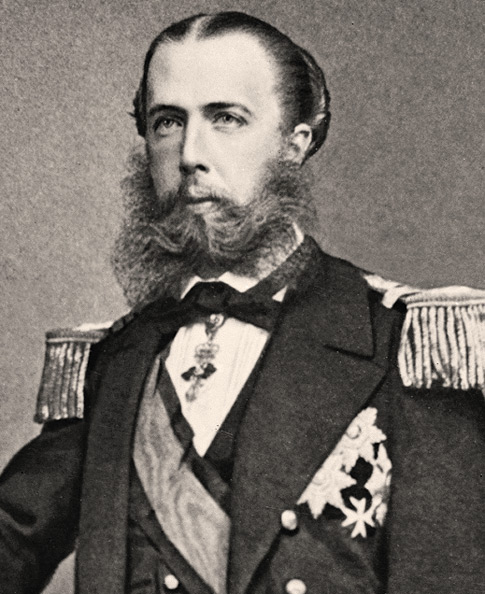
France declared war on Mexico, and called on those Mexicans who had fought on the side of the Conservative Party in the civil war to join them. Napoleon III planned to turn Mexico into an empire ruled by Archduke Ferdinand Maximilian Josef von Habsburg, the younger brother of the Emperor of Austria-Hungary.

Archduke Ferdinand Maximilian Josef von Habsburg

General Charles Ferdinand Latrille, Count de Lorencez, was the leader of the French forces – the Corps Expéditionnaire – which numbered about 7,300 men. He had been their commander for about two months. He was confident of victory. He boldly proclaimed, “we are so superior to the Mexicans in race, organization, morality, and elevated sentiments that as the head of 6,000 soldiers I am already master of Mexico.” He knew that less than 6,000 US troops – considered poorly trained and disciplined by European officers – had defeated a Mexican Army of 30,000 men under President General Antonio de Santa Anna (Antonio López de Santa Anna y Pérez de Lebrón) and taken Mexico City in 1847. General Count de Lorencez had over 1,000 more men than US General Winfield Scott, and the Mexican Army facing the French at Puebla numbered about 6,000 men (the French would later say 12,000) – far less than the army General Scott had defeated.
Left: Napoleon III, Emperor of the French (Chateau de Versailles); Right: Díaz at Puebla - This painting shows one of the critical moments of the Cinco de Mayo battle.  The French assault has begun to break up under the deadly fire of Mexican marksmen from Fort Loreto and the fortified monastery of Guadalupe.  Just then, General Porfirio Díaz appears, leading a detachment of Mexican cavalry in a charge against the dispirited French troops.

Left: Napoleon III, Emperor of the French (Chateau de Versailles); Right: Díaz at Puebla – This painting shows one of the critical moments of the Cinco de Mayo battle. The French assault has begun to break up under the deadly fire of Mexican marksmen from Fort Loreto and the fortified monastery of Guadalupe. Just then, General Porfirio Díaz appears, leading a detachment of Mexican cavalry in a charge against the dispirited French troops.

Furthermore, de Lorencez considered his own French troops far better trained and disciplined than the troops fielded by either the United States or Mexico. In order to make his entry into Puebla as impressive as possible, General Count de Lorencez ordered his troops to apply fresh whitening to their gaiters before the attack.

Texas born General Ignacio Zaragoza on Mexico’s 500 Pesos

The Mexican Army of the East (Ejército de Oriente), under the command of Texas-born General Ignacio Zaragoza (1829-1862), the vastly outnumbered and poorly supplied Mexicans fortified the town and prepared for the French assault. General Ignacio Zaragoza, took up positions at the town of Puebla (Puebla de los Angeles). This maneuver blocked the French advance on Mexico City. General Ignacio Zaragoza addressed his troops, telling them, “Your enemies are the first soldiers in the world, but you are the first sons of Mexico. They have come to take your country away from you.” Zaragoza ordered his commanders – Generals Felipe B. Berriozabal, Porfirio Díaz (José de la Cruz Porfirio Díaz Mori), Félix Díaz, Miguel Negrete and Francisco de Lamadrid, to occupy the Cerro de Guadalupe, a ridge of high ground dominating the entrance to Puebla, and the five forts which surrounded the town.

Of the forts, the two most prominent were situated on the Cerro de Guadalupe on either side of the road to Mexico City — the fort of Loretto to the right, and the fortified monastery of Guadalupe to the left. These were the positions that General Count de Lorencez ordered the Corps. After a brief artillery bombardment the French began their assault. Caught in a devastating crossfire from the Mexican troops manning the loopholes of the two forts, the French line faltered and then broke. The soldiers of the Corps Expéditionnaire charged the Mexican positions two more times, but each attack was repulsed by the withering musket fire of the Mexican troops. As the beaten French began their retreat, Mexican General Porfirio Díaz, at the head of a troop of cavalry, attacked them. Though badly shot up, the Corps Expéditionnaire was able to retreat in good order. They spent the evening of Cinco de Mayo waiting for an attack which never came. The next day, they began to withdraw back down the road towards Vera Cruz.

When word of the defeat reached Napoleon III, he replaced General Count de Lorencez as commander of the Corps Expéditionnaire with General Elias Frederic Forey, and sent 30,000 troops as reinforcements. The French reaction did little to lessen the shock of the defeat in Europe, and particularly in France. The Mexican Army had proved itself capable of standing up to a first-class European army, and defeating it. The victory of the Cinco de Mayo at Puebla is still celebrated today.

SUBSCRIBE to The Hispanic Blog to stay on top of the latest latino news, politics and entertainment!

Don’t be shy SUBSCRIBE – COMMENT – LIKE ME -CIRCLE ME AND FOLLOW ME

If you have any questions, concerns or simply would like to get a quote on my Marketing, Public Relations, Social Media and/or Events services, please feel free to contact me.

God Bless and make it a fabulous day!

powered by Influential Access – “Transforming the Ordinary to EXTRAordinary!” – CEO – Jessica Marie Gutierrez – Creator of The Hispanic Blog #thehispanicblog

WHAT DID SUPREME COURT JUSTICE SONIA SOTOMAYOR SAY ABOUT SB 1070?

THE HISPANIC BLOG IS THE LATEST HISPANIC NEWS BY JESSICA MARIE GUTIERREZ

“You are involving the federal government in your prosecution,” the justice said, according to the hearing’s transcript, drawing attention to one class of non-citizens who may not appear in available databases of documented residents.”

(Photo credit should read SAUL LOEB/AFP/Getty Images)

The U.S. Supreme Court’s first Hispanic justice took a lead role in criticizing oral arguments over Arizona’s controversial immigration law. The liberal Sotomayor, President Barack Obama’s first Supreme Court appointee, was most widely quoted for her stinging criticism of the government’s argument that Arizona’s law preempts federal authority over immigration. But her lines of questioning and criticism of Arizona’s rebuttal also indicated skepticism about the most contentious provisions of the state law.

CLICK ON SCREEN BELOW TO WATCH INTERVIEW WITH GOVERNOR JAN BREWER

The questions Sotomayor posed to Paul Clement, the attorney representing Arizona, hinged on what would happen to people detained under SB 1070, as the law is known, who did not readily appear in databases. She noted that some people, like political asylum applicants, may not be registered with the federal government because the process requires them to keep their status private.

AP

“What’s going to happen now is that if there is no statement by the federal agency of legality, the person is arrested, and now we’re going to have federal resources spent on trying to figure out whether they have that, whether they are exempted for this reason, whether the failure to carry was accidental or not,” Sotomayor said. Sotomayor was the only justice to pose questions during Clement’s rebuttal.

AP

The Latina justice also jumped in with the first line of questioning, parsing out how detention processes under suspended provisions of the Arizona law would differ from current practice, and she posed questions highlighting the limitations of current federal databases to check people’s immigration status efficiently after being stopped.

photo Diane Ovalle / Puente Arizona

There is no federal database of authorized residents, only a passport registry, according to U.S. Solicitor General Donald Verrilli, who is arguing on behalf of the Obama administration. The federal government also checks reports of undocumented immigrants against another eight to10 federal databases, Verrilli said. Hypothetically, then, under the Arizona law a person stopped for an offense and held on suspicion of unlawful residence could wind up in custody for long periods of time, Sotomayor posited. While Sotomayor’s line of questioning indicated skepticism of parts of Arizona’s case, it was her biting criticism of Verrilli’s argument that Arizona’s enforcement of immigration undermined federal authority that caught the most attention.

photo by Diane Ovalle / Puente Arizona

“You can see it’s not selling very well,” Sotomayor said, commenting on a series of both tough questions and outright assertions made by the country’s highest court, where conservatives hold a majority.

Justice Antonin Scalia. Image from Legal Geekery

“Arizona is not trying to kick out anybody that the federal government has not already said do not belong here,” said Justice Antonin Scalia.

Chief Justice Roberts SOURCE: AP/Evan Vucci

The most forceful argument in favor of the controversial immigration law’s provision requiring police to check the immigration status of those they stop came from Chief Justice Roberts.

U.S. Solicitor General Donald Verrilli
Photo by Mark Wilson/Getty Images

“It is still your decision,” Roberts told Verrilli. “And if you don’t want to know who is in this country illegally, you don’t have to.”

Read more: FOX NEWS LATINO

SUBSCRIBE to The Hispanic Blog to stay on top of the latest latino news, politics and entertainment!

Don’t be shy SUBSCRIBE – COMMENT – LIKE ME -CIRCLE ME AND FOLLOW ME

If you have any questions, concerns or simply would like to get a quote on my Marketing, Public Relations, Social Media and/or Events services, please feel free to contact me.

God Bless and make it a fabulous day!

powered by Influential Access – “Transforming the Ordinary to EXTRAordinary!” – CEO – Jessica Marie Gutierrez – Creator of The Hispanic Blog #thehispanicblog

THE SINKING OF THE TITANIC 100 YEARS LATER: WHO WERE THE HISPANICS ABOARD (MAJORITY WERE 1ST CLASS PASSENGERS)

THE HISPANIC BLOG IS THE LATEST HISPANIC NEWS BY JESSICA MARIE GUTIERREZ

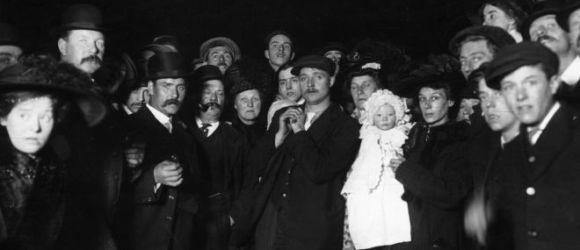
29th April 1912: A crowd await the return of survivors of the ‘Titanic‘ disaster, at Southampton. (Photo by Topical Press Agency/Getty Images) and FOX News Latino

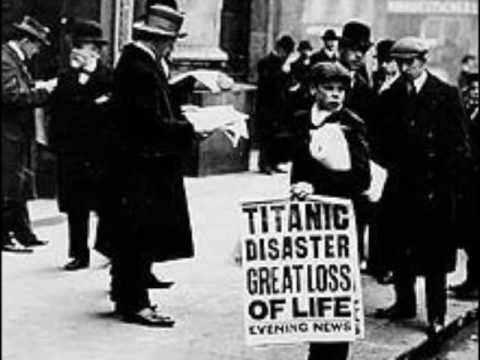
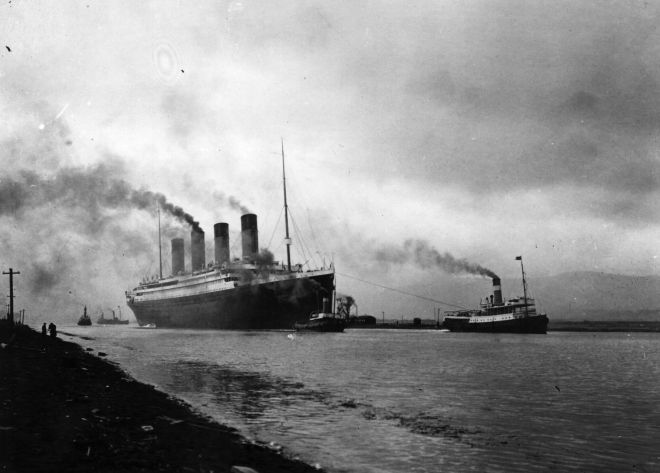
The ill-fated trip aboard the Titanic, which sank in the North Atlantic Ocean 100 years ago today, included a well-to-do Mexican man who had high-level political connections, a rich businessman from Cuba and at least eight passengers from Spain. Some were willing to shell out big bucks to be part of the historic journey, others were onboard because they were servants for the very wealthy. Some survived and even found love amid the wreckage. Others were not so lucky. What strings their lives together is that each of them were passengers of the most famous cruise line in history.

HERE ARE THEIR STORIES:

Mexico

The only Mexican on the Titanic voyage was 39-year-old lawyer, Don. Manuel Ramirez Uruchurtu. Although Uruchurtu was lucky enough to be in first class on the ship, he did not make it out alive. Uruchurtu was part of a well-to-do Mexican family, which allowed him the luxury of studying law in México City where he met and married fellow student Gertrudis Caraza y Landero, a Mexican lady of high social standing. Settling down in México City to establish his law practice, the couple had 7 children. During the time of the Mexican revolution in 1910, Uruchurtu had already established himself in the national political scene of the dictatorship of President Porfirio Díaz which, along with his wealth, made him an automatic target for the revolutionaries. When the former dictator and other former government officials were exiled to France a year following the revolution, Uruchurtu decided to visit his friend General Ramón Corral, who was vice president of Mexico before his exile.

URUCHURTU, Don. Manuel Ramirez
(Lawyer)
Age: 39
Class: 1st Class passenger, boarded in Cherbourg
Hometown: Mexico City, Mexico, Mexico
Destination: Mexico City, Mexico
Ticket number: 17601
Travel fare: £27 14s 5d
Died during the sinking, his body —

After visiting with his political friends, Uruchurtu decided to return home to his family. Guillermo Obregón, the son-in-law of Corral, persuaded Uruchurtu to take his ticket on the Titanic’s maiden voyage to return to México. Boarding the ship at Cherbourg in the Normandy region of France on April 10th, Uruchurtu communicated with his family for the last time, sending his brother a telegraph that read “embarcome” (going on board).

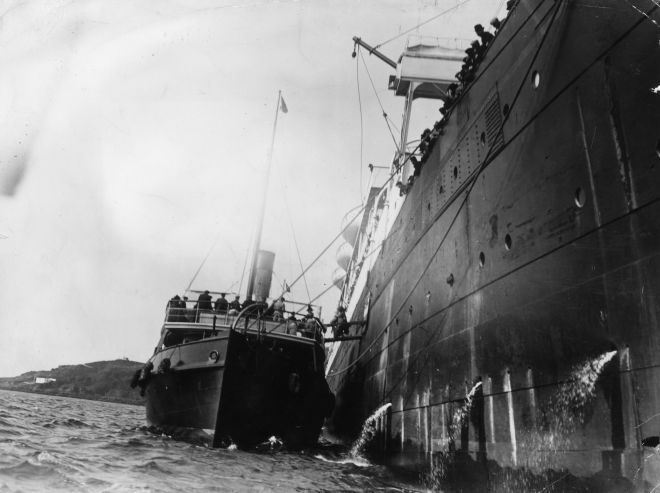
April 1912: Survivors of the Titanic disaster boarding a tug from the liner which rescued them. (Photo by Hulton Archive/Getty Images) and FOX News Latino

In the fatal night that followed, Uruchurtu , a first class passenger, gave up his seat in a lifeboat to an English lady from the second class who was pleading to be let into the boat because her family was waiting for her.In what he knew would be his last moments, Uruchurtu gave up his seat but not before asking the woman to visit his wife in Veracruz, Mexico.

Uruguay

Two passengers from Uruguay were relatives Francisco M. Carrau and José Pedro Carrau, whose relationship, as to if they were uncle and nephew or cousins, is unknown. Francisco was 28 at the time of his death and an active member of the board of directors of one of Carrau & Co., a food distribution company that is one of Uruguay’s largest businesses. Francisco, along with his 17-year-old relative and traveling companion Jose, boarded the Titanic in Southampton England on April 10, 1912. Both men died in the crash although their bodies were never recovered. Other than family legends, little is known about the men and the happenings on their ill-fated voyage.

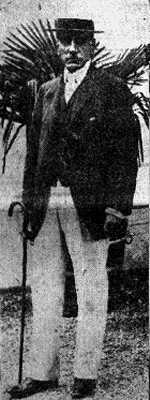
Name: Mr Ramon Artagaveytia
Born: July 1840
Age: 71 years 9 months
Last Residence: in Buenos Aires Pampas Argentina
Occupation: Businessman
1st Class passenger
First Embarked: Cherbourg on Wednesday 10th April 1912
Ticket No. 17609 , £49 10s 1d
Died in the sinking.
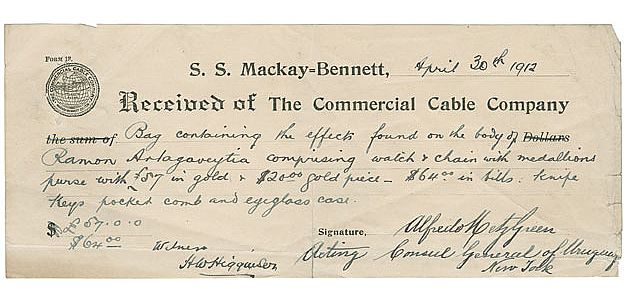
Body recovered by: Mackay-Bennett (No. 22)
Buried: Cemeterio Central Montevideo Uruguay on Tuesday 18th June 1912. photo source: encyclopedia titanica

Ramon Artagaveytia came from a family whose life was the sea. Born in July 1840 in Montevideo, Uruguay, the Titanic was not Artagaveytia’s first experience aboard a sinking ship. In 1871, Artagaveytia survived the fire and sinking of the ship America near the shore of Punta Espinillo, Uruguay. Of the 164 passengers, only 65 survived. The experience left Artagaveytia emotionally scarred. However, that did not stop him from traveling. After settling down in Argentina, Artagaveytia traveled to Europe to visit his nephew who was the head of the Uruguayan Consulate in Berlin. But before returning home, Artagaveytia decide to visit the U.S.
Two months before setting sail on the Titanic, Artagaveytia wrote in a letter to his cousin, “At last I will be able to travel and, above all, I will be able to sleep calmly. The sinking of the America was terrible!… Nightmares keep tormenting me. Even in the most quiet trips, I wake up in the middle of the night with terrible nightmares and always hearing the same fateful word: Fire! Fire! Fire!…I have even gotten to the point where I find myself standing in the deck with my lifebelt on…’” The second time, he was not as lucky.

The night of the sinking Titanic, both Artagaveytia and his fellow Uruguayan passengers, Francisco and Jose Pedro Carrau, died. A week later, Artagaveytia’s body was recovered by the MacKay-Bennett. After being transferred to New York, his body was finally laid to rest in Cemeterio Central, in Montevideo on June 18, 1912.

Spain: The Spanish represented the largest percentage of Latino’s on the Titanic voyage

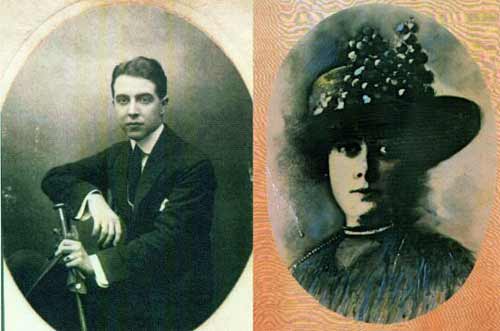
Sisters Asuncion Duran y More, 27, and Florentina Duran y More, 30, boarded the ship in Cherbourg in the Normandy region of France. Both sisters were lucky enough to survive the sinking, rescued by the Carpathia in lifeboat 12. After arriving in New York City, the sisters immediately embarked on a voyage to Cuba. While Asuncion’s life after the Titanic is vague, the voyage for her sister proved to be life changing in more ways than one.

photo source: Titanic-Titanic

Florentina found love through the unfortunate event, marrying fellow second class passenger, 26-year-old Chauffeur Julian Padron Manent. The couple lived together in Cuba until Florentina’s death in 1959 at the age of 70. Following Manent’s death in 1968, the couple were buried side by side in an elaborate mausoleum in Colon Cemetery in Havana.

Chauffeur Julian Padron Manent

Speculated traveling companion to Julian Padro Manent and the Duran y More sisters, Emilio Pallas y Castello was a 29-year-old American citizen heading for Cuba. Like his friends, Castello was rescued and lived a long life until his death in 1940.

photo source: encyclopedia titanica John William Thompson, William McIntyre, Emilio Pallas y Castillo are shown in New York after the sinking. Thomas Whiteley was being treated at St. Vincent’s Hospital for a leg injury sustained during the sinking.

Spanish domestic Encarnacion Reynaldo, 28, boarded the Titanic to visit her sister in New York City. And luckily for Reynaldo, she eventually reunited with her sister after being rescued by the Carpathia in lifeboat 9.

Victor Peñasco died and was newly wed to María Josefa Pérez de Soto photo source: Gente del Pueblo

Of all 8 Spaniards aboard the titanic, only one, Victor Peñasco y Castellana, did not make it out alive. Left by himself on the ship, Castellana died in the sinking. Victor Peñasco y Castellana, along with his wife Maria Josefa Perez de Soto y Vallejo and her maid Doña Fermina Oliva y Ocana , boarded the Titanic the same day as the Duran y More sisters in Cherbourg. While all were first class passengers, only Maria and her maid were rescued as they were able to be go ashore in lifeboat 8.

Argentina

Brothers Ahmed and William Ali boarded the Titanic in Southampton England. Laborers from Buenos Aires, the two purchased third-class tickets for the voyage. While both lost their lives, only William’s body was recovered. He was buried in the Mount Olivet Cemetry in Halifx, Nova Scotia on May 10, 1912.

photo source: A UMNS web-only photo collage by Kathleen Barry.
All photos are public domain.

Another Argentine, Edgar Samuel Andrew, never intended on boarding the Titanic. Originally from Córdoba, Argentina, Andrew came to the U.S. in 1911 to visit his brother. After traveling to Bournemouth, England to study, Andrew was lured back to the states for his brother’s wedding and the promise of a job at the Harriet White Fisher company in New York. However, when the coal strike forced Andrew to change his ticket from the Oceanic to the Titanic, his future fate was sealed.

photo source: Titanic Project

In a letter to his friend Josey Cowan in Argentina, on April 8, 1912 Andrew wrote, “I am boarding the greatest steamship in the world, but I don’t really feel proud of it at all, right now I wish the ‘Titanic’ were lying at the bottom of the ocean.” Along with a suitcase that was recovered from the wreckage in 2001, Andrew’s letter to Cowan has remained in the family. Somehow foreboding the ship’s fate, Andrew died in the sinking.

Cuba

Servando Jose Florentino Ovies y Rodríguez

Servando Jose Florentino Ovies y Rodríguez, was the sole Cuban aboard the Titanic. The 36-year-old worked in the import business in Havana where he lived with his wife, Eva Lopez del Vallardo and son, Ramon Servando. Although a first-class passenger, Rodríguez was not able to make it out of the sinking alive. After his body was buried at Mount Olivet Cemetery in Nova Scotia on May 15, 1912, his wife filed a claim for $75,000 for the loss of his life and $2,800 for the loss of property.

DID FAITH DRIVE TITANIC MUSICIANS

Read more: FOX News Latino

SUBSCRIBE to The Hispanic Blog to stay on top of the latest latino news, politics and entertainment!

Don’t be shy SUBSCRIBE – COMMENT – LIKE ME -CIRCLE ME AND FOLLOW ME

If you have any questions, concerns or simply would like to get a quote on my Marketing, Public Relations, Social Media and/or Events services, please feel free to contact me.

God Bless and make it a fabulous day!

powered by Influential Access – “Transforming the Ordinary to EXTRAordinary!” – CEO – Jessica Marie Gutierrez – Creator of The Hispanic Blog #thehispanicblog


HOW LONG UNTIL DRUG CARTELS TAKE OVER MEXICO: LOS ZETAS AND GUATEMALAN ORGANIZED CRIME

THE HISPANIC BLOG IS THE LATEST HISPANIC NEWS BY JESSICA MARIE GUTIERREZ

Mexican President Felipe Calderon (L) and his Guatemalan counterpart Alvaro Colom arrive at a joint press conference at the official residence Los Pinos, in Mexico City, capital of Mexico, on July 27, 2011. (Xinhua/David de la Paz)

Los Zetas and Guatemalan Organized Crime 

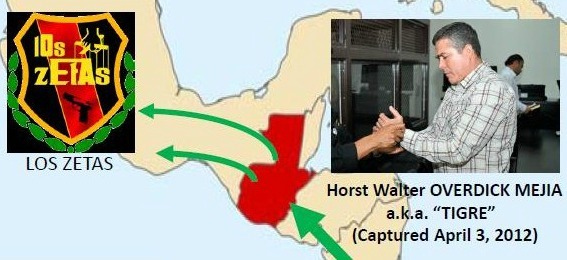
Guatemalan authorities arrested Horst Walther Overdick-Mejia, a Guatemalan drug distributor working with Los Zetas, on April 3 in San Lucas Sacatepequez, Guatemala, near Guatemala City. According to a U.S. indictment, Overdick was responsible for trafficking illicit drugs, including cocaine, via land and maritime routes into Mexico since at least 1999 and played a significant role in the establishment of trafficking routes through Guatemala for Los Zetas.

Several Mexican transnational criminal organizations, including the Gulf cartel, Sinaloa Federation and Los Zetas, employ people in Guatemala like Overdick to transport illicit drugs through the Central American country. For Mexican organized crime, these liaisons are crucial for moving illicit drugs through Guatemala. Logistical liaisons, such as Overdick, allow foreign groups to establish a presence in unfamiliar terrain and facilitate communications with Guatemalan contacts. However, for at least the last five years, Los Zetas have placed an increasing focus on expanding their operations into Guatemala. The group thus likely has alternative plans to prevent operations depending on a single point of contact.

Members of Los Zetas pose with their drugs and weapons following their arrests by Mexican special ops police. Photo credit: DEA/DoJ File Photo 04/12/12

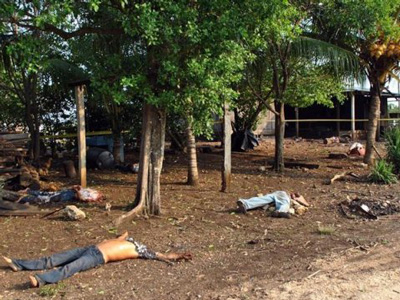
Unlike other Mexican organized criminal groups such as the Gulf cartel and the Sinaloa Federation, Los Zetas use their characteristic violent tactics to exert influence in Guatemala. On May 15, 2011, in the Peten department of Guatemala, gunmen murdered 27 farm workers on a ranch owned by Guatemalan drug distributor Otto Salguero. A week later in Quetzaltenango, Quetzaltenango department, three Guatemalans were arrested after posting narcomantas signed Z-200 that claimed Otto Salguero was one of “the most important suppliers of cocaine” to the Gulf cartel. Los Zetas have targeted other drug trafficking organizations, which family organizations largely control in Guatemala. Los Zetas attacked one such group, Los Leones, on March 25, 2008, with gunmen killing 11 of its members including Juan Jose “Juancho” Leon, a leader in the organization.

Guatemala Blames Mexico’s Most Brutal Drug Gang For Killing And Decapitating 27 People (05-17-2011) photo source el narco blog

Given Los Zetas’ established ability to assault rival criminal groups in Guatemala and its increasingly public presence (through narcomantas appearing in Guatemala’s largest cities), it is unlikely that Overdick’s arrest would significantly hinder Los Zetas influence in, and ability to traffic drugs through, Guatemala. Los Zetas are likely to adjust to Overdick’s arrest to continue operations in Guatemala.

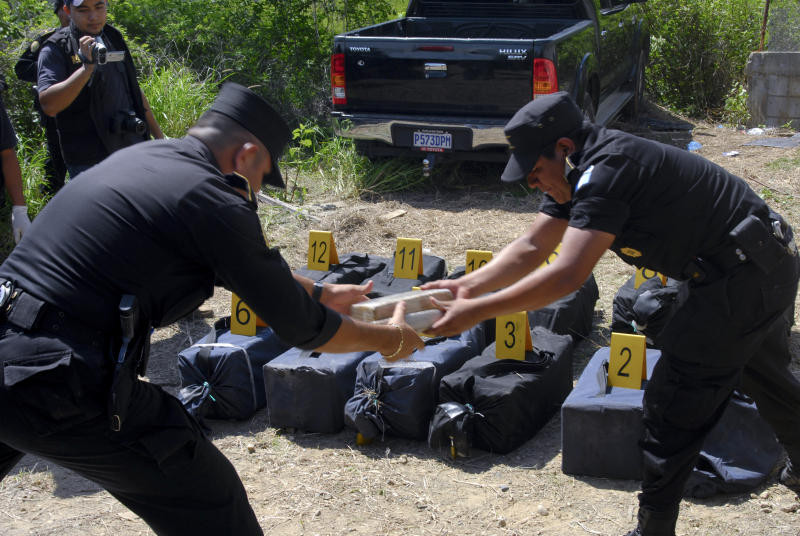
July 6, 2011 – Guatemala, Guatemala – FILE: A picture dated 31 may 2011 shows Agents of the National Civil Police of Guatemala seizes 336 kilos of cocaine after a fight against drug traffickers in Rancho de Progreso, 80 kilometers north of Guatemala city. The group Los Zetas, one of the most violent organizations of organized crime, supplied drug from Guatemala and not direcly in Colombia, as revealed by number three in the group, jesus Enrique Rejon arrested in Mexico on July 3, 2011. Photo: Jesus Alfonso/dpa.

Turf War Hits Cancun

Spring Break in Cancun, in the narco era, via FP. March 2009

Gunmen shot and killed a 21-year-old man in front of the Hotel Ibis in Cancun, Quintana Roo state, on March 27. Authorities said they were looking for a missing taxi driver in connection with the murder. On April 2, authorities discovered the bodies of three males along the Cancun-Leona Vicario highway with two vehicles, one of which was registered as a taxi vehicle. According to authorities, the murders probably were linked to the March 27 killing. Two days later, authorities arrested seven members of the Los Pelones gang in Cancun in connection with the murders. After interrogating the suspects, authorities said the March 27 victim was killed for belonging to Los Zetas. Five members of Los Zetas were arrested April 5 in the district where the March 27 murder happened. Those arrested said they had arrived in Cancun 10 days before to carry out several assassinations.

The hotel is located in a high commercial traffic area at the intersection of Tulum and la Nichupté avenues.

Though Cancun does not typically see violence related to the drug war, violence may erupt without notice in any part of Mexico. At present Los Zetas and Los Pelones, a name historically associated with the Sinaloa Federation but not necessarily the same gang in Cancun, are attacking each another in Cancun. How far the violence could escalate remains unknown, but travelers to the resort town should pay attention to the security situation given the March 27 killing, which occurred in the area where numerous travelers will stay. Collateral damage easily could result from violence between the organizations.

April 3

  • Authorities discovered three bodies — two male and one female — at a ranch in Brisenas, Michoacan state, near the Jalisco state border.

April 4

  • Four gunmen were killed in Ario de Rosales, Michoacan state, when they opened fire on a military patrol. No military casualties were reported.
  • Authorities discovered the bodies of four executed individuals, two of whom were decapitated, in three different municipalities of Morelos state.
  • Francisco Medina Mejia “El Comandante Quemado,” the reported mastermind of the Casino Royale fire that killed 52 individuals in Monterrey, Nuevo Leon state, was killed by Mexican military in a firefight on the Nuevo Laredo-Piedra Negras highway. Three other gunmen were also killed.

April 5

  • At least seven individuals were murdered in separate incidences in Acapulco, Guerrero state.

April 6

  • Gunmen arrived at a residence in a vehicle and kidnapped four police officers before shooting and killing them in Monterrey, Nuevo Leon state.

April 7

  • Authorities discovered the body of a woman in Monterrey, Nuevo Leon state. The victim’s eyes were taped shut and there were signs of torture on the body.
  • Three individuals were killed in Acapulco, Guerrero state. Two of the victims were decapitated, and their heads were left in an ice cooler inside a vehicle. The third victim was a taxi driver, and his body was left in a taxicab.
  • In Arriaga, Chiapas state, two narcomantas were placed along bridges. The first stated that “Los Z” has arrived and warned that 100 people would die. The other stated that “La Familia” did not kill women, children or innocent and that justice begins.

April 8

  • The Mexican army with municipal police seized 844 kilograms (1,860 pounds) of marijuana from a residence in Tijuana, Baja California state.
  • Authorities discovered four decomposing bodies in a well in Rioverde, San Luis Potosi state.
  • Gunmen killed three men who had arrived at a car wash in Chihuahua city, Chihuahua state.

April 9

  • Gunmen kidnapped a man in La Trinidad, Sinaloa state. Authorities later discovered the decapitated body with the hand placed in the mouth.
  • Gunmen opened fire in a bar in the center of Monterrey, Nuevo Leon state, killing a waiter and a patron.
Read more: Stratfor

SUBSCRIBE to The Hispanic Blog to stay on top of the latest latino news, politics and entertainment!

Don’t be shy SUBSCRIBE – COMMENT – LIKE ME -CIRCLE ME AND FOLLOW ME

If you have any questions, concerns or simply would like to get a quote on my Marketing, Public Relations, Social Media and/or Events services, please feel free to contact me.

God Bless and make it a fabulous day!

powered by Influential Access – “Transforming the Ordinary to EXTRAordinary!” – CEO – Jessica Marie Gutierrez – Creator of The Hispanic Blog #thehispanicblog

WHEN DID POLITICIANS BEGIN TO CAMPAIGN TO HISPANIC VOTERS?

THE HISPANIC BLOG IS THE LATEST HISPANIC NEWS BY JESSICA MARIE GUTIERREZ

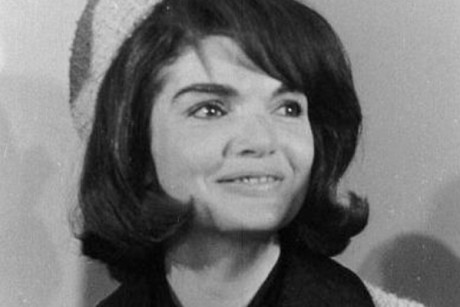
One of the earliest Spanish-language political ads dates back to 1960, when a young Jackie Kennedy spoke into the camera in Spanish, urging voters to elect her husband, then-Senator John F. Kennedy.
Voten ustedes por el partido Demócrata el día 8 de noviembre,” she said, adding “Que viva Kennedy.” Her husband’s “Viva Kennedy” clubs were some of the first efforts to energize Latino voters in a presidential race.

These days, courting that voting bloc is a must for anyone running for president, or any office in the Southwest. But syndicated columnist Ruben Navarrette, Jr., says too many political operatives are still clueless about this country’s diverse Latino population.

“They feel now obligated to learn about it,” Navarrette said. “But we really are sort of this foreign entity to them, and they are just like walking on the moon trying to figure it out.”

So to get their bearings, campaigns and candidates have historically reached for a few familiar props to help them connect with these voters. The most obvious prop? Mexican food. Though Navarrette says he is sick of campaign events that come with a side of salsa.

“There are a lot of different ways you can relate to me, things we may have in common,” Navarrette said. “You don’t necessarily have to break it down to — ‘you know, you like tacos, I like tacos, let’s have a conversation about tacos’.”

In fact, that brand of superficial campaigning is known as “taco politics.” That is according to Stephen Nuño, a professor of politics and international affairs at Northern Arizona University.

But taco politics can backfire.

“One of the most famous moments was when Gerald Ford ate tamales,” Nuño said. Ford was in front of a Texas crowd in 1976, during the Republican primary. But he didn’t know the tamale’s corn husk wrapping isn’t edible. “So he took a bite out of the tamale with the husk still on it,” Nuño said. “And of course that doesn’t look good, it doesn’t taste good, and it only shows just how distant President Ford was to the Hispanic culture.”

Nearly a half-century later, the current Republican presidential contenders have their share of gaffes under their belts.
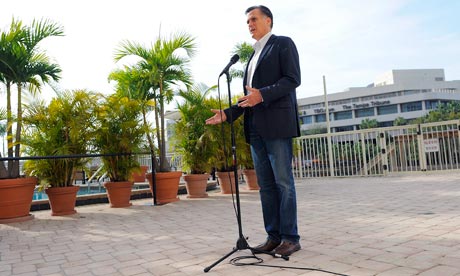
Mitt Romney used Fidel Castro’s slogan in a speech to a Cuban American crowd in Miami. Rick Santorum told Puerto Ricans they should speak English if they want to be a state. And there was the time Newt Gingrich seemed to call Spanish the language of the ghetto. “The words I chose to express myself weren’t the best ones,” Gingrich said afterward in a video message delivered in Spanish with a heavy American accent. He explained that he meant to say that English is necessary for progress and success in this country.

”]While criticizing Spanish speakers may be a sure way to lose Latino votes, it’s not clear how effective reaching out to voters in Spanish really is. Stanford University political scientist Gary Segura estimates that around 70 percent of the Hispanic electorate uses English as their main language.

“Even if you advertise in Spanish, that doesn’t necessarily mean you are reaching the preponderance of voters,” Segura said.

Plus, producing ads in Spanish can be risky if campaigns don’t get the wording just right. Because of regional language differences, certain Spanish words can sound innocent to one audience, but obscene to another. Take this ad from Shelley Berkley, a Nevada Democratic congresswoman running for the U.S. Senate. The ad, in Spanish, attacked her Republican opponent, Sen. Dean Heller, on his immigration record.

Her ad said Heller opposed immigration reform and would even deport grandparents and separate children from their mothers—or “hijos de sus madres.” It is subtle, but that phrase unintentionally sounds the same as the Spanish equivalent of ‘S.O.B.’s.’

In a way, most of these examples could be chalked up as cosmetic missteps. But Ruben Navarrette says there is a fundamental problem with how presidential campaigns are reaching out to Latinos.

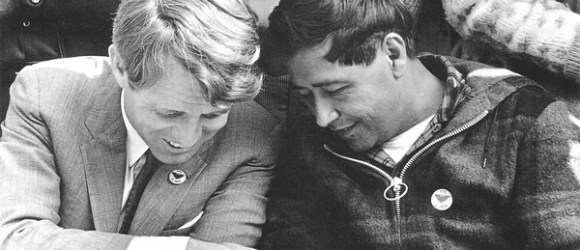
“The number one reason campaigns are struggling is they need to shut up and listen,” Navarrette said. His advice circles back to the Kennedy family, the pioneers of Latino voter outreach. “Famously in 1968, Bobby Kennedy went before the Mexican-American community and he asked two questions, ‘What do you want, and how can I help?’” Navarrette said. “Think about that for a second. Nobody does that anymore.”

This LA Times photo captures a moment of
friendship between Bobby Kennedy and Chavez
during Chavez's 25-day fast in 1960.

READ MORE: FRONTERA DESK

SUBSCRIBE to The Hispanic Blog to stay on top of the latest latino news, politics and entertainment!
Don’t be shy SUBSCRIBE – COMMENT – LIKE ME -CIRCLE ME AND FOLLOW ME

If you have any questions, concerns or simply would like to get a quote on my Marketing, Public Relations, Social Media and/or Events services, please feel free to contact me at thehispanicblog@gmail.com.

God Bless and may you have a fabulous day!

powered by Influential Access – “Transforming the Ordinary to EXTRAordinary!” – CEO – Jessica Marie Gutierrez – Creator of The Hispanic Blog #thehispanicblog