PRESIDENT OBAMA JOINS THE MEETING OF NORTH AND SOUTH AMERICAN LEADERS AT THE SUMMIT OF THE AMERICAS

THE HISPANIC BLOG IS THE LATEST HISPANIC NEWS BY JESSICA MARIE GUTIERREZ

President Barack Obama leaves today for a trip to a summit in Latin America that may have as much resonance in domestic politics as in hemispheric economics. Discussions at the meeting of North and South American leaders in the resort city of Cartagena, Colombia, will cover trade, economic growth and the battle against drug trafficking. Yet the White House is mindful that about 16 percent of U.S. residents trace their roots to the region, and that group may play an outsized role in the November presidential election.

photo source AP

“The president desperately needs high voter turnout among Hispanic Americans,” said Douglas Brinkley, a presidential historian at Rice University in Houston. “It doesn’t hurt for him to be in Colombia, and being seen with Latino leaders of the hemisphere is not a bad photo-op in an election year.”

Obama’s campaign is gearing up for a close election fight against Republican Mitt Romney, putting a premium on gaining an edge with any voting group. Obama is actively courting Hispanics — who gave him 67 percent of their votes in 2008 — with a Spanish-language website and by recruiting Spanish-speaking volunteers and using Spanish-language voter registration forms and phone banks.

President Barack Obama addresses the Congressional Hispanic Caucus Institute’s 34th Annual Awards Gala in Washington, Wednesday, Sept. 14, 2011. (AP Photo/Cliff Owen)

“Key swing states that have large Hispanic populations will be extremely attentive” to the trip, said Susan MacManus, professor of political science at the University of South Florida in Tampa. “Many feel that Latin and South America has been ignored.”

Swing State

One of those states is Florida, with 29 of the 270 electoral votes needed to win the presidency and where Hispanics make up 22.5 percent of the population. Before Obama meets with the other 32 leaders at the Summit of the Americas he’s scheduled to stop at the Port of Tampa.The theme for that visit, as at the summit, will be expanding U.S. exports and gaining greater access to Latin markets for small businesses. About 40 percent of all exports from Tampa go to Latin America, and the port means 100,000 jobs and generates almost $8 billion in annual economic impact, according to its website.

President Obama waves as he arrives to speak at the Port of Tampa in Tampa, Fla., Friday April 13, 2012. (AP Photo/Chris O’Meara) CHRIS O’MEARA — AP

Total U.S. exports in the Americas amount to $700 billion a year out of $1.5 trillion worldwide, according to Commerce Department figures. Among the summit participants, Canada is the biggest U.S. trading partner, Mexico is the third largest and Brazil ranks ninth.

Hemispheric Trade

U.S. President Barack Obama speaks during a visit to the Port of Tampa on April 13, 2012 in Tampa, Florida. The President, on his way to the Summit of the Americas in Colombia, used the visit to emphasis small business trade with countries in Latin America.
(April 12, 2012 – Photo by Joe Raedle/Getty Images North America)

“The U.S. economy benefits substantially from our trade in the Americas, and over 40 percent of our exports currently go to the Americas,” Ben Rhodes, Obama’s deputy national security adviser for strategic communications, told reporters in an April 11 briefing. “Those exports are growing faster than our trade with the rest of the world.”

US President Barack Obama with Brazil’s President Dilma Rousseff Photo: Reuters

Latin America managed to largely escape the financial crisis of 2008-2009. Brazil (BZGDYOY%) is the world’s sixth largest economy, and the ranks of the middle class have swelled. The World Bank classifies most countries in the region as middle- income or higher. As countries in the region have grown more prosperous, they are less reliant on the U.S., the world’s biggest economy. That growth also comes as the Obama administration has made a deliberate pivot to focus more on Asia.

Diminished Role

Obama is “quite comfortable with the diminished role of the United States in the hemisphere” and that it’s “the natural order of things,” said Andrew Selee, director of the Mexico Institute at the Wilson Center. “The U.S. is going to continue to be engaged but no longer has the domineering authority it once did.”

President Obama arrives in Cartagena, Colombia, on April 13 for the Summit of the Americas

The summit host, Colombian President Juan Manuel Santos, has an agenda focusing on boosting advances in technology, finalizing the free-trade deal between the U.S. and Colombia, lessening income inequality and improving responses to natural disasters, such as earthquakes.

Obama remains popular in Central and South America, though promises to rebuild cooperation at the last summit, in 2009 in Trinidad, may have fallen short, according to the Inter-American Dialogue, a Washington-based policy group that focuses on the Western Hemisphere.

“The U.S. must regain its credibility in the region by dealing seriously with an unfinished agenda of problems — including immigration, drugs and Cuba — that stands in the way of a real partnership,” according to a policy report issued yesterday.

Illicit Drugs

Bigger issues that aren’t on the official agenda are legalization or decriminalization of illicit drugs and whether Cuba should be allowed at the next summit. Selee said that while he doesn’t expect “dramatic outcomes” from the summit, one area where “sparks” might fly would be the debate raging in Latin America over drugs. The presidents of Colombia and Mexico have called for a discussion about easing penalties for drug use. Obama’s aides say the U.S. will resist such proposals.

Mexico’s President Felipe Calderon (R) speaks to journalists as Colombia’s President Alvaro Uribe listens during a news conference at the presidential residence Los Pinos, in Mexico City November 10, 2008. REUTERS/Henry Romero (MEXICO)

“The president doesn’t support decriminalization,” Dan Restrepo, Obama’s senior director for Western Hemisphere Affairs, told reporters.

There is friction between the U.S. and some summit leaders over restrictive U.S. policies toward Cuba. Ecuador’s President Rafael Correa is boycotting the summit because of Cuba’s absence. The region’s sole dictatorship is the only nation excluded from the gathering of heads of state from the Western Hemisphere.

Brazilian President

Brazilian President Dilma Rousseff told Obama during a White House meeting April 9 that this should be the last such regional meeting without Cuba in attendance. In an e-mail interview with a group of Latin American newspapers, Obama said his administration has done more than any in decades to improve U.S. relations with Cuba and blamed the communist regime for the nation’s exclusion from the summit.

SOURCE: AP/ Pablo Martinez Monsivais
President Barack Obama meets with Brazilian President Dilma Rousseff at the United Nations in September 2011.

“We’re looking for a new era in the relationship between our two countries,” Obama said, according to a transcript of the interview published in Spanish by Bogota’s El Tiempo newspaper. “History shows that the longing for liberty and human dignity can’t be ignored forever. No authoritarian regime lasts forever. The day will arrive when the Cuban people will be free to determine their own destiny.”

While Obama moved to ease travel restrictions earlier in his presidency, the U.S. wants Cuba to release political prisoners, increase political freedoms and adopt democratic principles.

File: Barack Obama attends Cuban Independence Day celebrations in Miami in May during his run for president.
Read more: FOX NEWS

“Cuba authorities continue to deny the Cuban people their universal rights and the president will continue to stand up for those rights,” Restrepo said.

The policy is in keeping with those of past U.S. presidents from both parties, said MacManus, the Florida professor. As with other issues at the summit, Obama’s position on Cuba has political implications.

“If Obama can keep some of the Cubans who voted for him last time, appease them with that kind of stance, then that could be the difference” in winning Florida, MacManus said.

Read More: Bloomberg 

SUBSCRIBE to The Hispanic Blog to stay on top of the latest latino news, politics and entertainment!

Don’t be shy SUBSCRIBE – COMMENT – LIKE ME -CIRCLE ME AND FOLLOW ME

If you have any questions, concerns or simply would like to get a quote on my Marketing, Public Relations, Social Media and/or Events services, please feel free to contact me.

God Bless and make it a fabulous day!

powered by Influential Access – “Transforming the Ordinary to EXTRAordinary!” – CEO – Jessica Marie Gutierrez – Creator of The Hispanic Blog #thehispanicblog

 

DOES HISPANIC EDUCATION HAVE A STRONG IMPACT ON ECONOMIC DEVELOPMENT?

THE HISPANIC BLOG IS THE LATEST HISPANIC NEWS BY JESSICA MARIE GUTIERREZ

photo source: Fox News Latino

The level of Hispanic education, skills and capabilities will have a strong impact on the economic development and competitiveness of the U.S. The level of education among the Hispanic community is not only a social issue but is also a vital economic concern.

There are currently 50 million Hispanics living in the United States, a figure that represents 16 percent of the country’s total population. Hispanic children between five and 17 years of age often face educational challenges, usually scoring lower than the average student in annual reading and mathematics standardized tests. In this context, there are three main aspects to consider in the debate on educational public policy for Hispanics: the increase in their school enrollment rates in the last decade, their low level of educational attainment and the educational gap between whites and Hispanics in the U.S.

Credit: © 2007 JupiterImages Corporation

Compared to other ethnic groups in the country, Hispanics lend a higher degree of importance to education, according to a 2009 Pew Research Center study. This fact, in addition to the effect of public policies and the increased influx of immigrants in the country, contributes to the growing enrollment rates among the Hispanic community. According to the White House Initiative on Educational Excellence for Hispanic Americans, the average enrollment of K-12 Hispanic students is higher than the average for the general population.

However, reports have shown that the schools that Hispanics are enrolled in are typically lower quality school systems. In addition, the dropout rate in high school is 17.6 percent among Hispanics, as compared to 5.2 percent among the white population and 8.1 percent among the entire U.S. population, according to the National Center for Education Statistics.

Quality continues to be an elusive goal. Although there is a reduction in the gap between the white population and Hispanics in the National Assessment of Educational Progress (NAEP) mathematics average scores from 1973 to 2008, this change is not sufficient evidence to show a decrease in the overall educational gap of Hispanics. Regarding SAT scores, Hispanics are scoring lower in mathematics and critical reading than the average U.S. student.

Elements that are prompting the problems associated with the characteristics described above include:

(i) Factors that influence educational achievement.

According to the U.S. Department of Education, there are four factors that affect student achievement: Having a mother who has less than a high school education, being a member of a family on welfare or receiving food stamps, living in a single-parent family, and having parents whose primary language is one other than English. By the end of the 20th century, “about seven out of 10 entering kindergarten from Hispanic or Black families have one or more of these risk factors, compared to about three out of 10 of those from white families.

(ii) Low quality of the schools that they attend.

Hispanics are more likely to attend minority-heavy public schools that are often low performing.

(iii) Constraints to parents when it comes to the possibility of choosing their children’s schools.

The White House Initiative for Hispanics highlights how the challenge of the low educational achievement that Hispanics suffer from represents a problem not only for the community, but also for the entire country, given the importance of this minority within American society. Addressing the challenges that Hispanics face in the U.S. has become quite serious and their growing importance in number and participation in social, economic and political life gives greater credence to their growing demands to live in a more fair and prosperous society.

Read more: Fox News Latino

SUBSCRIBE to The Hispanic Blog to stay on top of the latest latino news, politics and entertainment!

Don’t be shy SUBSCRIBE – COMMENT – LIKE ME -CIRCLE ME AND FOLLOW ME

If you have any questions, concerns or simply would like to get a quote on my Marketing, Public Relations, Social Media and/or Events services, please feel free to contact me.

God Bless and make it a fabulous day!

powered by Influential Access – “Transforming the Ordinary to EXTRAordinary!” – CEO – Jessica Marie Gutierrez – Creator of The Hispanic Blog #thehispanicblog

 

WHO IS LAVINIA LIMON: MEET THE CEO OF THE U.S. COMMITTEE FOR REFUGEES & IMMIGRANTS

THE HISPANIC BLOG IS THE LATEST HISPANIC NEWS BY JESSICA MARIE GUTIERREZ

photo source FOX NEWS LATINO

Lavinia Limón has dedicated her career to helping people in trouble, especially immigrants, and is today president and CEO of the U.S. Committee for Refugees and Immigrants.

“The USCRI, a citizens’ committee in Washington that tries to influence immigrant and refugee policies, recently celebrated the 100th anniversary of its founding, and our responsibilities are to work on behalf of undocumented children who come alone to this country, the victims of human trafficking and refugees from all over the world,” Limón told Efe.

photo source USCRI

“In the 1980s I was executive director of the International Institute of Los Angeles, and after the immigration reform law was enacted in 1986, founded together with other organizations the Coalition for Humane Immigrant Rights of Los Angeles, CHIRLA,” she said.

Born March 5, 1950, in Compton, California, Limón is the daughter of a Mexican-American father and a mother of German descent. She graduated in sociology from the University of California, Berkeley.

Lavinia Limon, President and chief executive of the U.S. Committee for Refugees & Immigrants photo source Friends of Refugees website

“After studying sociology I realized that my passion is to work with people and help them secure a better life,” Limón said. At the start of her career, she began working with refugees from the Vietnam war and then “I went to serve overseas helping people in Thailand, Indonesia and Saudi Arabia, among other countries,” she recalled.

During the administration of President Bill Clinton, Limón was director of the Office of Refugee Resettlement where she developed programs that helped people in shelters get jobs so they could fully integrate themselves into American life.

Limón said she has personally experienced having what she knows and is capable of doing underestimated because of stereotypes about Hispanics.

“But what I do is, when people don’t consider me capable of doing certain tasks, I do them anyway and surprise them,” Limón said. “I’ve never argued with anyone who thinks in stereotypes, but what I do is show them they’re wrong,” she said.

Read more: Fox News Latino

SUBSCRIBE to The Hispanic Blog to stay on top of the latest latino news, politics and entertainment!

Don’t be shy SUBSCRIBE – COMMENT – LIKE ME -CIRCLE ME AND FOLLOW ME

If you have any questions, concerns or simply would like to get a quote on my Marketing, Public Relations, Social Media and/or Events services, please feel free to contact me.

God Bless and make it a fabulous day!

powered by Influential Access – “Transforming the Ordinary to EXTRAordinary!” – CEO – Jessica Marie Gutierrez – Creator of The Hispanic Blog #thehispanicblog

WILL SENATOR MARCO RUBIO BE THE NEXT VICE PRESIDENT: HE SAYS HE CAN’T DELIVER, “YOU’VE GOT TO EARN THE HISPANIC VOTE”

THE HISPANIC BLOG IS THE LATEST HISPANIC NEWS BY JESSICA MARIE GUTIERREZ

Sen. Marco Rubio of Florida, widely speculated to be a top pick for the Republican presidential running mate, once again firmly denied he would join the GOP ticket.

“I’m not going to be the vice president,” Rubio said Friday in an interview with CNN en Español‘s Ismael Cala. “I’m not.”

photo source AP

“I’ll tell you, the Hispanic vote has to be earned,” he said. “You can’t just put somebody on there and say, ‘This is gonna deliver it.’ You’ve got to earn it, and primarily I think you earn it through economic policies.”

Last month, Rubio rolled out a big endorsement for Mitt Romney, adding fuel to the fire in talks over whether Rubio, whose parents emigrated from Cuba, would possibly be tapped for the Republican veep spot. Rubio, however, has repeatedly shot down the notion. With Latino-Americans becoming a more influential voting bloc, politicians are increasingly growing more aggressive in their efforts to court their votes. But the junior senator argued Friday that choosing him as a running mate would not do the trick.

In Florida, Republican Marco Rubio won the senate seat convincingly, with a strong turnout from Latino voters. Photograph: Gary Rothstein/EPA

“I think a better approach is the one I’ve talked about, and that is providing these kids some sort of non-immigrant visa status so they can continue to study and then work in the U.S.,” Rubio said. “Then at some point in the future they would be able to get in line, same line as everybody else in the world.”

Elected in 2010, Rubio was dubbed early on a rising star in GOP. He’s known for bucking popular policies within the Latino community, such as the DREAM Act, a proposal that would grant a path to citizenship for minors in the country illegally, providing they served in the armed forces or attended college. Instead, he sides with positions more inline with the Republican platform on immigration.

Asked if he was setting aside a vice presidential spot in hopes of aiming for higher office in the future, Rubio said:

Republican Sen. Marco Rubio, of Florida, works in his Washington office. (EFE)

“Well I haven’t thought about that in that way. I don’t know what the future holds. I want to do a good job as a U.S. senator. “I think if I do that, I’ll have opportunities to do different things in future.”

READ MORE: KTBS

SUBSCRIBE to The Hispanic Blog to stay on top of the latest latino news, politics and entertainment!

Don’t be shy SUBSCRIBE – COMMENT – LIKE ME -CIRCLE ME AND FOLLOW ME

If you have any questions, concerns or simply would like to get a quote on my Marketing, Public Relations, Social Media and/or Events services, please feel free to contact me.

God Bless and make it a fabulous day!

powered by Influential Access – “Transforming the Ordinary to EXTRAordinary!” – CEO – Jessica Marie Gutierrez – Creator of The Hispanic Blog #thehispanicblog


DID OBAMA DECLARE HE WILL PUSH IMMIGRATION THE FIRST YEAR OF HIS NEXT TERM?

THE HISPANIC BLOG IS THE LATEST HISPANIC NEWS BY JESSICA MARIE GUTIERREZ

Univision interviewed Obama in connection with this weekend’s Summit of the Americas

Topics included democracy promotion, drug trafficking, and race relations.

A protester in Los Angeles, May 1, 2011. photo source Eric Thayer/Getty Images

President Obama says he will push for major immigration legislation if he is re-elected. Obama told Univision he would like to do immigration this year, but Republican opposition is too intense.

“I can promise that I will try to do it in the first year of my second term,” Obama said. “I want to try this year,” he added. “The challenge we’ve got on immigration reform is very simple. I’ve got a majority of Democrats who are prepared to vote for it, and I’ve got no Republicans who are prepared to vote for it.”

 By SAUL LOEB, AFP/Getty Images

Obama supports what he calls a “comprehensive” immigration bill. It involves both tougher border security as well as a pathway to citizenship for illegal immigrants who are already in the U.S. Republicans say the emphasis should be on border protection, and liken citizenship plans to amnesty for lawbreakers. In the Univision interview, Obama took a swipe at one of those Republicans, likely election opponent Mitt Romney.

Said Obama: “We now have a Republican nominee who said that the Arizona laws are a model for the country … these are laws that potentially would allow someone to be stopped and picked up and asked where their citizenship papers are based on an assumption.”

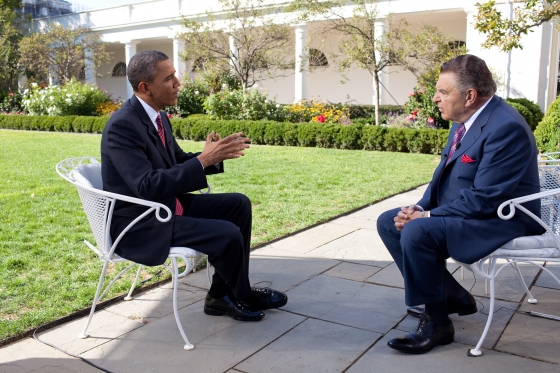
President Barack Obama gestures during an interview with Mario “Don Francisco” Kreutzberger for Univision’s Sabado Gigante in the Rose Garden of the White House, Sept. 21, 2010. (Official White House Photo by Pete Souza)

Republican Party spokesperson Kirsten Kukowski said Obama “promised to tackle immigration reform in his first year and failed.””From immigration to creating jobs and cutting the deficit, President Obama has failed to follow through on his promises to the American people showing his words are more about winning elections than anything else,” she said.

Read More: USA TODAY

SUBSCRIBE to The Hispanic Blog to stay on top of the latest latino news, politics and entertainment!

Don’t be shy SUBSCRIBE – COMMENT – LIKE ME -CIRCLE ME AND FOLLOW ME

If you have any questions, concerns or simply would like to get a quote on my Marketing, Public Relations, Social Media and/or Events services, please feel free to contact me.

God Bless and make it a fabulous day!

powered by Influential Access – “Transforming the Ordinary to EXTRAordinary!” – CEO – Jessica Marie Gutierrez – Creator of The Hispanic Blog #thehispanicblog