THE “BOOK SMUGGLERS” PROTEST ARIZONA’S CONTROVERSIAL BAN ON ETHNIC STUDIES CLASSES: MEET THE LIBROTRAFICANTES

Arizona Ethnic-Studies Ban’s Unintended Result: Underground Libraries

Meet the Librotraficantes—the “book smugglers” protesting the state’s controversial ban on ethnic-studies classes—and putting Mexican-American works in students’ hands.

Some 30 students, teachers, and activists emerged from the bus carrying boxes of books. As they stepped onto the pavement Saturday and into the bright Tucson sun, they chanted in unison, “What do we want? Books! When do we want them? Now! Who are we? Librostraficantes!”
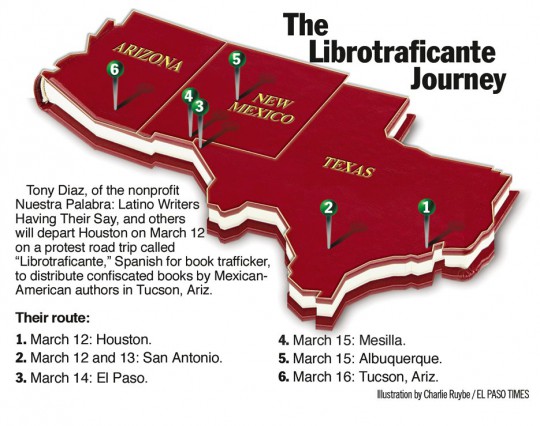
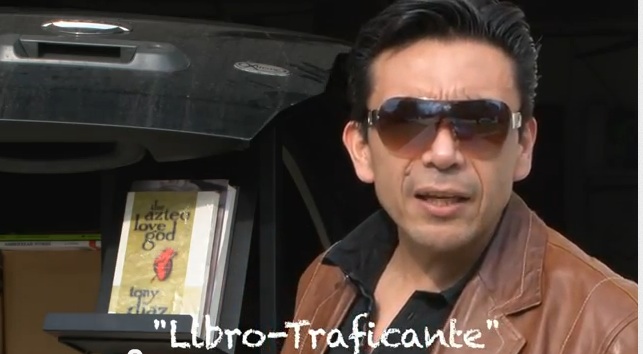
The Spanish term, which means “book smugglers,” is the brainchild of Houston Community College professor and author Tony Diaz, who with a few dozen supporters set out March 12 for Arizona to protest a 2010 state law that prohibits certain types of ethnic studies in public schools. In January officials shut down the Tucson Unified School District’s Mexican-American-studies curriculum. The Librotraficante Caravan traveled through Texas and New Mexico, stopping in cities along the way to hold literary readings, collect donated books, and establish “underground libraries” filled with titles from Tucson’s banned courses. Several authors whose works were discontinued participated—Rudolfo Anaya, widely considered the godfather of Latino literature in the Southwest, even invited the caravan into his Albuquerque home for posole, traditional pork stew.
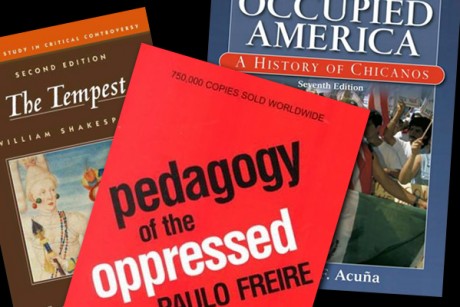
“I’m much obliged to the Tucson Unified School District for creating this little book club,” Diaz said after arriving at a youth center that will be the site of Tucson’s “underground library,” home to copies of some 80 books taught in the now-defunct program, including The House on Mango Street by bestselling author Sandra Cisneros, Rethinking Columbus: The Next 500 Years, and The Devil’s Highway by Luis Alberto Urrea. “When Arizona legislators decided to erase our history, we decided to make more!” The law originated amid Arizona’s heated debates over the immigration crackdown spearheaded by Republican legislators, Maricopa County Sheriff Joe Arpaio, and Gov. Jan Brewer. The governor signed the ethnic-studies measure in May 2010, just weeks after signing into law the country’s toughest immigration bill in generations. (That measure, S.B. 1070, is heading to the Supreme Court in April.) Soon after, officials declared the Tucson program illegal, and a group of teachers sued the state in federal court. In January an administrative judge approved the courses’ elimination, and the classes’ books were boxed up and taken to storage facilities and school libraries. A district-court judge is scheduled to hear motions in the case today.
                                                                                                                                                                       Megan Feldman
Arizona Attorney General Tom Horne wrote the ethnic-studies law while he was the state’s superintendent of public instruction. Banning courses that promote the overthrow of the U.S. government, encourage resentment against a group of people, or are created specifically for one group, the law was aimed squarely at the Tucson Mexican-American-studies program. Its teachers, Horne claims, taught Chicano history and literature through a racist and politicized filter that wrongly informed students that they’re oppressed by white people. (He says he began looking into the program in 2007 after labor leader Dolores Huerta told Tucson students that Republicans hated Latinos, and when he sent a Latina Republican aide to the school to counter that view, some students turned their backs and raised their fists in the air.)

“It’s a fundamental American value that what matters about us is what we know, what we can do, and what is our character—and that what race we were born into is irrelevant,” Horne says. “This program is teaching students the opposite—that what matters about people is their race.” In a recent court brief, he cites former district teachers who claim students became resentful and mistrustful of authorities after taking the classes, as well as a white student who said Hispanic students ceased speaking to her because of her race. The program’s teachers and many of its students dismiss such accusations. Alfonso Chavez, 20, says the classes helped him understand his culture and history while getting an education that included the state-mandated core curriculum. “These classes are very relevant, especially here in the Southwest,” he said at a Librotraficante breakfast hosted by a Tucson gallery. “It helped me grow as a person, and my grades started improving.”
“THE BIG CULTURAL AFFRONT TO ME IS THAT THEY WALKED IN THE CLASSROOMS AND BOXED UP THE BOOKS IN FRONT OF THE LATINO STUDENTS. THAT WAS THE SINGLE ACT THAT GALVANIZED US AND THIS WHOLE MOVEMENT!”

Erin Cain-Hodge, a 19-year-old University of Arizona student, says being one of three white pupils in one of the now prohibited courses was valuable. “I took the classes because I was constantly hearing from the same white male authors,” she says. “I thought, ‘There has to be more.’” Horne says the state’s standard courses include Chicano authors and even instances of historical oppression, but Mexican-American-studies supporters say Latino history and literature are underrepresented.
“Many of my students would come in and say they’d never read any Chicano literature before,” said Curtis Acosta, a plaintiff in the case who has taught in the Tucson schools since 2003. In a district that’s more than 60 percent Latino, teaching Chicano history and literature is crucial for students’ sense of belonging and academic development, he said. As for claims that he taught students to resent white people? “I think Horne needs to take credit for his own work,” Acosta said. “If he feels that anger, we definitely didn’t have to teach it, because he’s teaching it to them.”
READ MORE: THE DAILY BEAST

SUBSCRIBE to The Hispanic Blog to stay on top of the latest latino news, politics and entertainment!

Don’t be shy SUBSCRIBE – COMMENT – LIKE ME -CIRCLE ME AND FOLLOW ME

If you have any questions, concerns or simply would like to get a quote on my Marketing, Public Relations, Social Media and/or Events services, please feel free to contact me at thehispanicblog@gmail.com.

God Bless and may you have a fabulous day!

powered by Influential Access – “Transforming the Ordinary to EXTRAordinary!” – CEO – Jessica Marie Gutierrez – Creator of The Hispanic Blog #thehispanicblog

UNITED AIRLINES RENEWS PARTNERSHIP WITH NAT’L ASSOCIATION OF HISPANIC JOURNALISTS

THE HISPANIC BLOG IS THE LATEST HISPANIC NEWS BY JESSICA MARIE GUTIERREZ

United Airlines announced that it has renewed its partnership with the National Association of Hispanic Journalists (NAHJ). United will be the official airline of special events for the organization in 2012.

“United is proud to continue its support of the NAHJ,” said John Slater, United’s vice president of sales – Americas. “We applaud the NAHJ’s dedication to the recognition and professional advancement of Hispanics in the news industry and are pleased to facilitate the organization’s events around the country.”

The United-NAHJ partnership includes support for seven events: the 2012 NAHJ Hall of Fame Gala during the UNITY Convention, August 1-4, in Las Vegas – the nation’s largest gathering of minority journalists; the NAHJ 23rd Annual Scholarship Benefit in the fall; and five NAHJ regional events to take place in Albuquerque, Los Angeles, New York, Chicago and Washington, D.C.

Postcard from event that happened September 2011

“We are grateful to United for its generous support of NAHJ at a time when news coverage of the growing Latino community has never been more crucial,” said Michele Salcedo, NAHJ president. “Although many companies are rethinking their commitment to diversity, United has chosen to continue our longstanding relationship that began with Continental Airlines. We not only thank them, we applaud them.”

Continental began its support of the NAHJ in 2005.

SOURCE United Continental Holdings, Inc.

SUBSCRIBE to The Hispanic Blog to stay on top of the latest latino news, politics and entertainment!

Don’t be shy SUBSCRIBE – COMMENT – LIKE ME -CIRCLE ME AND FOLLOW ME

If you have any questions, concerns or simply would like to get a quote on my Marketing, Public Relations, Social Media and/or Events services, please feel free to contact me at thehispanicblog@gmail.com.

God Bless and may you have a fabulous day!

powered by Influential Access – “Transforming the Ordinary to EXTRAordinary!” – CEO – Jessica Marie Gutierrez – Creator of The Hispanic Blog #thehispanicblog

DID WILL FERRELL’S ‘CASA DE MI PADRE’ GROSS IN THE TOP 10 DURING A TEST RUN OF 382 THEATERS: CASHING IT AT #9 GROSSING $2.2 MILL

THE HISPANIC BLOG IS THE LATEST HISPANIC NEWS BY JESSICA MARIE GUTIERREZ

The film, also starring Genesis Rodriguez, Diego Luna and Gael Garcia Bernal, played primarily to Hispanic audiences

Will Ferrell‘s quirky subtitled indie comedy Casa de Mi Padre made a strong showing among Hispanic moviegoers as it opened in select markets across the country, grossing an estimated $2.2 million from 382 theaters to crack the top 10 chart and come in No. 9. The film’s location average was $5,759.

photo source: Lionsgate, Inc. Diego Luna

The Spanish-language film, also starring Genesis Rodriguez, Diego Luna and Gael Garcia Bernal, was released by Lionsgate under its Pantelion Films label, a joint-venture between the studio and Televisa. While most Pantelion titles open only in Hispanic markets, Casa de Mi Padre also debuted in such cities as Boston and Seattle, hoping to capitalize on Ferrell’s star status. According to exit data, 68 percent of the overall audience was Hispanic, while 51 percent were male.

photo source Lionsgate, Inc Genesis Rodriguez and Will Ferrell

“This movie is unique and different,” said Lionsgate’s distribution honcho David Spitz. “It’s a modern-day spaghetti Western.” Nala Films and Ferrell’s Gary Sanchez production banner made Casa de Mi Padre for roughly $6 million; the pic was later acquired by Lionsgate. Written by Funny or Die’s Andrew Steele, the comedy was directed by former Saturday Night Live writer Matt Piedmont. In the film, Ferrell goes to war with a drug lord in order to save his father’s Mexican ranch.

photo source Lionsgate, Inc. Gael Garcia Bernal

CASA DE MI PADRE SOUNDTRACK BY CHRISTINA AGUILERA

SOUNDTRACK FROM CHRISTINA AGUILERA

READ MORE: THE HOLLYWOOD REPORTER

SUBSCRIBE to The Hispanic Blog to stay on top of the latest latino news, politics and entertainment!

Don’t be shy SUBSCRIBE – COMMENT – LIKE ME -CIRCLE ME AND FOLLOW ME

If you have any questions, concerns or simply would like to get a quote on my Marketing, Public Relations, Social Media and/or Events services, please feel free to contact me at thehispanicblog@gmail.com.

God Bless and may you have a fabulous day!

powered by Influential Access – “Transforming the Ordinary to EXTRAordinary!” – CEO – Jessica Marie Gutierrez – Creator of The Hispanic Blog #thehispanicblog

DID ANY MEXICANS MAKE FORBES 2012 LIST OF BILLIONAIRES: CARLOS SLIM TAKES FIRST PLACE AND 10 OTHERS FOLLOW

THE HISPANIC BLOG IS THE LATEST HISPANIC NEWS BY JESSICA MARIE GUTIERREZ

The richest man in the world is Mexican telecoms magnate Carlos Slim at the equivalent of $69 billion U.S. dollars.  In second place is Bill Gates with $61 billion, followed by Warren Buffet at $44 billion.  Europe’s richest man, Frenchman Bernard Arnault is #4 with $41 billion, while Amancio Ortega of Spain has $37.5 billion.  Larry Ellison has $36 billion, while Brazil’s Eike Batista has $30 billion.  In the #8 position is Sweden’s Stefan Persson with $26 billion.  Li Ka-Shing of Hong Kong has $25.5 billion, and #10 is Karl Albrecht of Germany with $25.4 billion. Carlos Slim and family are worth $69 billion. The man, known as “King Midas” or “The Engineer,” really made it into the big leagues back in 1990 when he bought Telmex, which now controls about 80% of Mexico’s landlines. Slim also has Telcel which controls about 70% of the Mexican cellular phone market and América Móvil, Latin America’s biggest wireless provider, with over 200 million customers. Last year he started Minera Frisco, a mining company. Slim has a bank, an airline, department stores, restaurants and music outlets. Slim sells insurance, auto parts, and ceramic tile. The Mexican government pays Slim to construct roads, water treatment plants, petroleum platforms, etc. Slim also owns part of the New York Times. And, his latest high-profile venture is the launching of an Internet TV network featuring his friend Larry King, known as Ora.tv.

Henry Romero / Reuters

  • Ricardo Salinas Pliego and family are worth $17.4 billion. Salinas Pliego runs the Grupo Elektra retailer (which he inherited) and TV Azteca network (which he started). Banco Azteca, part of the Elektra chain, serves mostly low-income clients. Ricardo Salinas Pliego controls Mexico’s second largest broadcaster, TV Azteca. But by far the largest chunk of his fortune–$15.3 billion worth– lies with home electronics retailer Grupo Elektra, which has a finance arm that makes loans to customers, including very low-income ones. Elektra’s stock has more than doubled in the past year, pushing Salinas’ fortune up by $9.2 billion; Elektra revenue grew 19% in peso terms in 2011 to $4.1 billion. Analysts point to a very small float as one reason for the large increase in value of Elektra’s share price; an equity swap with UBS and a new place on the benchmark IPC Mexican stock index further reduced supply and drove share prices higher. In mid 2010, Salinas took his financially troubled Mexican wireless carrier Iusacell private; he owned 75%. He struck a deal in 2011 to sell a 50% stake of Iusacell to competing Mexican TV broadcaster Televisa for $1.6 billion, but in February 2012 the Mexican national competition commission vetoed the plan. Televisa and Iusacell are appealing. It’s all part of the ongoing telecom battle with Carlos Slim, whose company Telcel controls 70% of the Mexican mobile market; Iusacell has a mere 4% market share. Salinas’ Azteca Foundation is active in promoting youth orchestras across Mexico.

  • Alberto Bailleres and family are worth $16.5 billion. Bailleres is chairman of metallurgical giant Industrias Peñoles, Bailleres has stock in the luxury department store El Palacio de Hierro, Grupo Nacional Provincial insurance company, investment firm Grupo Profuturo, and serves on the board of bottling company Femsa. Bailleres also has a 100-yard long yacht called The Mayan Queen IV. Alberto Bailleres chairs Mexico’s second largest mining company, Industrias Penoles, one of the world’s largest silver miners. Thanks in part to higher prices for precious metals, as well as to the opening of his El Saucito silver and gold mine in Zacatecas, Bailleres’s fortune is up $4.6 billion since last year on a steep rise in the share price of Industrias Penoles; his 69% stake in the company accounts for $13.4 billion of his fortune. He also chairs department store chain Grupo Palacio de Hierro, insurance company Grupo Nacional Provincial, and pension fund manager Grupo Profuturo. Plus Bailleres owns a stake in Coke bottler Femsa. He is reportedly a patron of bullfighting.

    Alberto Bailleres presidente grupo BAL, durante la inaguraci n de la mina Saucito, en Fresnillo, Zacatecas. (NOTIMEX/FOTO/JOS LUIS SALMER N/JLS/POL/Newscom)

  •  Mining and lumber magnate German Larea Motta Velasco  is CEO of mining company Grupo México. Larea and family have a net worth of $14.2 billion dollars. Grupo Mexico also includes Mexico’s biggest railroad company Ferromex. Larea is also owner of the Cinemex movie chain. German Larrea still reigns as Mexico’s media-shy copper king. Mexico’s largest copper producer, Grupo Mexico, had another stellar year, revenue-wise. But with stock prices slightly down, Larrea and his family, who control 51% of the mining conglomerate–saw their fortune drop by $1.8 billion. Grupo Mexico is currently fighting a Delaware court decision that it overvalued shares of its copper subsidiary in a 2005 merger deal. The conglomerate has had trouble with labor at its Mexican mines; the former Cananea mine, now called Buenavista, near the U.S. border was shut for nearly four years by a strike. Meanwhile, President and Chairman of the Board German Larrea remains elusive, avoiding journalists and photographers.
  • Jeronimo Arango and family  are worth $4 billion. Arango’s family business was the Bodega Aurrera supermarket chain, part of Grupo Cifra, which sold out to Wal-Mart and became Wal-Mart de México (Walmex), netting the family a couple of billion. The Arangos also own real estate. Jeronimo Arango’s art collection includes pieces by El Greco and Goya, some of which he has donated to the Prado Museum in Madrid. Arango also serves on the Prado board of trustees. Jeronimo Arango, with brothers Manuel and Placido, shares a fortune gained from selling their stake in retailer Cifra to Wal-Mart’s Mexican arm in 1997. Jeronimo is said to live a quiet life in Los Angeles. Manuel, a real estate developer, also founded the Mexican Center for Philanthropy and, in 2011, called on businesses to donate at least one percent of their profits to charity. Placido collects art and has owned a chain of restaurants
  • Emilio Azcarraga Jean is worth $2 billion. Azcarraga runs Grupo Televisa, with its TV channel, telenovela production, radio, satellite, Internet, publishing, gambling and discount airline. Emilio Azcarraga is the chief executive of powerhouse Mexican TV broadcaster Televisa, which has recently begun producing English-language programming. Azcarraga and his would-be business partner Ricardo Salinas Pliego, of TV Azteca, continue an ongoing Mexican media battle with Carlos Slim Helu, Mexico’s richest man. Last year Azcarraga’s Televisa struck a deal to buy a 50% stake in Salinas’ mobile phone company, Iusacell, for $1.6 billion. In early February Mexico’s Federal Competition Commission vetoed the deal, a move widely viewed as stinking of politics; Televisa and Iusacell are appealing. Slim’s phone companies Telmex and Telcel as well as retailers belonging to Grupo Carso pulled their advertising from Televisa in 2011 after Televisa increased ad rates by 20%. Televisa said the increase came because the Slim companies did not participate in “upfront” ad buying for the year. Meanwhile, Azcarraga is nudging into Slim’s hold on telephony in Mexico by offering bundled Internet, phone and cable TV through Televisa’s cable TV unit.
  • Roberto Gonzalez Barrera is founder and executive of Gruma, which is the world’s biggest maker of tortillas. (Gruma brands include Mission and Maseca.) Most of his money, though, is from his part of the Banorte. The bank’s stock went up in 2011, putting Gonzalez Barrera back on the billionaires’ list after being off it for more than a decade. This magnate is worth $1.9 billion, and that is from his stock alone, not that of his family as are many of these valuations. Roberto Gonzalez Barrera founded and runs Gruma, the world’s largest tortilla maker; brand names include Mission, Guerrero and Maseca. U.S. agricultural commodities powerhouse Archer Daniels Midland is a 23% shareholder. The majority of Gonzalez Barrera’s wealth, however, comes from his stake in Banorte, a successful Mexican bank that earlier in its history was owned by the Mexican government. In 2011, he returned to the billionaires list after a hiatus of more than a decade, based on the strength of Banorte’s stock. This valuation includes his shares alone, and not those of his children.

    Roberto González Barrera, presidente de GRUMA.

  • Carlos Hank Rhon and family  in the world and are worth $1.4 billion and on the Forbes billionaires list for the first time. His family owns over 90% of Grupo Financiero Interacciones, which in turn controls Banco Interacciones. The Hank family also has Grupo Hermes (which includes Hermes Infraestructura) and a transportation company. Carlos Hank Rhon makes the billionaires list for the first time, thanks in large part to his family’s 93.4% holding of Grupo Financiero Interacciones, currently worth close to $800 million. The group controls Banco Interacciones, an integrated financial services firm and investment bank in Mexico. The Hank family also fully controls Grupo Hermes; its Hermes Infraestructura arm builds just about every type of major infrastructure: bridges, roads, hydroelectric plants. In the past several years, the Hank family has been developing Playa Mujeres, a new luxury tourist destination in Cancun. The family also has a transportation business.
  • Roberto Hernandez Ramirez is worth $1.3 billion. Hernandez was CEO of Banamex when that bank sold out to Citigroup, and he remained on Citigroup’s board until 2009. Now he’s on the board of Televisa and owns part of a Brazilian company. Roberto Hernandez Ramirez, the former chief executive of Banamex, reaped an estimated $2 billion windfall when Citigroup bought the Mexican bank in 2001. Hernandez remained on the Citigroup board until 2009; he is currently a board member of Mexican broadcaster Televisa. He has a small investment in Brazilian consumer goods company Hypermarcas (run by billionaire Joao Alves de Queiroz Filho). Hernandez has created two foundations intended to preserve the environment and Mayan cultural heritage and is on the board of the Nature Conservancy.

    (Foto: Gilberto Contreras)

  • Joaquin Guzman Loera, known as “el Chapo” (Shorty), is the chief of the Sinaloa drug cartel. The estimated net worth of this narco baron is $1 billion. The inclusion of Guzman on the list has been criticized, but he is a billionaire. Joaquin Guzman, known as “El Chapo,” is a criminal and the leader of the illegal drug smuggling Sinaloa cartel, responsible for an estimated 25% of the illegal drugs trafficked from Mexico into the U.S. Guzman is believed by drug experts to be spending more money to defend the cartel than in previous years due to stepped up enforcement efforts by the Mexican government, and has expanded cartel operations to Central America, particularly Guatemala. But authorities are closing in: December 2011 brought the arrest of a top Sinaloa lieutenant, quickly followed in February by the capture of the leader of the cartel’s armed wing. Circumstances must be less than cozy in the mountains where El Chapo hides out; in August, the drug lord reportedly sent his 22-year-old wife to Los Angeles County to give birth to the couple’s twin daughters. 

    STR/AFP/Getty Images

  • Alfredo Harp Helu is Carlos Slim’s first cousin. Harp and family are worth $1 billion. Harp was running Banamex when the company cashed in by selling out to Citigroup in 2001, and now owns the Diablos Rojos baseball team in Mexico City, and he is the principal shareholder of the Grupo Marti gym and sporting goods store. The bulk of Alfredo Harp Helu’s fortune comes from the 2001 sale of Mexican bank Banamex to Citigroup. Harp was the bank’s former head and a significant shareholder. He currently chairs publicly traded Grupo Marti, which owns a chain of sporting goods retailers. Harp is the principal shareholder. He is also a cousin of Carlos Slim Helu, Mexico’s richest man. A baseball fan, he owns the Diablos Rojos (Red Devils) Mexican team. In 1994, Harp Helu was kidnapped and held for several months.

SUBSCRIBE to The Hispanic Blog to stay on top of the latest latino news, politics and entertainment!

Don’t be shy SUBSCRIBE – COMMENT – LIKE ME -CIRCLE ME AND FOLLOW ME

If you have any questions, concerns or simply would like to get a quote on my Marketing, Public Relations, Social Media and/or Events services, please feel free to contact me at thehispanicblog@gmail.com.

God Bless and may you have a fabulous day!

powered by Influential Access – “Transforming the Ordinary to EXTRAordinary!” – CEO – Jessica Marie Gutierrez – Creator of The Hispanic Blog #thehispanicblog


WHO IS GENESIS RODRIGUEZ FROM WILL FERRELL’S “CASA DE MI PADRE?”

THE HISPANIC BLOG IS THE LATEST HISPANIC NEWS BY JESSICA MARIE GUTIERREZ

March 14, 2012: Actress Genesis Rodríguez arrives at the premiere of Pantelion Films “Casa de mi Padre” at the Chinese Theater in Hollywood, Calif. (Getty)

By the time she turned 21, Genesis Rodriguez had already starred in several highly-rated telenovelas and could have easily settled into a long and comfortable career. But instead, when the Miami-born actress had fulfilled her contract with Telemundo, she did what countless other actresses had done before her: moved to Los Angeles to break into movies.

photo source Genesis Rodriguez :: Todd Williamson/WireImage

“I took a huge risk by walking away from a steady paycheck to chase a dream,” she says. “But I had always wanted to act in Hollywood films. I didn’t care if I was going to be stuck playing Girl No. 2. Apart from being Hispanic, I’m also bi-cultural. I consider myself as American as a cheeseburger. So I wanted to give it a shot.”

Three years and one guest-stint on HBO’s “Entourage” later, Rodriguez fulfilled her dream. In January, she appeared as an acrobatic thief alongside Jamie Bell in the thriller “Man on a Ledge.” Now she’s starring in the comedy “Casa de mi Padre” as Sonia, the young beauty who wins the heart of a noble Mexican played by Will Ferrell.

Photo by Myles Aronowitz – © 2011 Summit Entertainment, LLC.

“I heard about the movie during a meeting with my agent, and I thought it was a brilliant idea: Will playing a Mexican in a Spanish-language movie? It was genius!” she says. Although she didn’t really think she had any chance of landing the role, she snagged an audition and had the part a week later.“During the audition, Will kept laughing when played our scenes, and I didn’t know if that was good or bad, because I was trying to be dead-serious,” she says. “And he literally couldn’t get his lines out because he was laughing so hard. It’s very surreal when you’re starting out as an actor and someone like Will Ferrell validates you. It’s the best stamp of approval I could hope for.”

photo source Lionsgate, Inc.

“Casa de mi Padre” – which opens Friday and also features a hilarious cameo by her famous father, singer Jose Luis “El Puma” Rodriguez – is the first of three major films the actress has completed. In May, she will be part of the ensemble cast of “What to Expect When You’re Expecting,” a comedy about pregnancy starring Jennifer Lopez, Cameron Diaz and Anna Kendrick. Next year comes “Last Stand,” in which she plays an FBI agent who teams up with a small-town sheriff (played by Arnold Schwarzenegger) to hunt down a drug kingpin.

photo source Lionsgate, Inc.

Not bad for an actress who was initially told she would get nowhere without changing her name.
“Everyone had a problem with ‘Genesis,'” she says. “They said it made me sound like a stripper! And they didn’t like the Rodriguez, either. But you know what? This is the name I was born with, and I want to keep it. And I’m so happy that so far, it’s been working.”
Read more here: BND

SUBSCRIBE to The Hispanic Blog to stay on top of the latest latino news, politics and entertainment!

Don’t be shy SUBSCRIBE – COMMENT – LIKE ME -CIRCLE ME AND FOLLOW ME

If you have any questions, concerns or simply would like to get a quote on my Marketing, Public Relations, Social Media and/or Events services, please feel free to contact me.

God Bless and may you have a fabulous day!

powered by Influential Access – “Transforming the Ordinary to EXTRAordinary!” – CEO – Jessica Marie Gutierrez – Creator of The Hispanic Blog #thehispanicblog