DID FEDERAL JUDGES FINALLY APPROVE TX REDISTRICTING MAPS?

20120229-085038.jpg photo from Texas Tribune

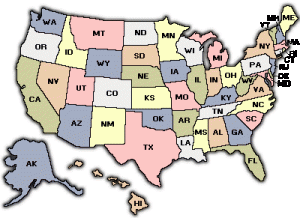
A federal three-judge panel in San Antonio on Tuesday issued the last remaining sets of Texas political maps that had been at the center of a redistricting dispute, appearing to end uncertainty over the state’s long-delayed primary elections.

The judges released new interim maps for Congressional and State House districts. It had issued a State Senate district map this month.

The legal wrangling over the three sets of maps had thrown much of the state’s political machinery into limbo, as the judges twice pushed back the date of the primary and lawmakers and candidates struggled to campaign without viable electoral maps.

20120229-084612.jpg Joe Cardenas III Former TX State Director of LULAC and one of the main leaders of the Latino Task Force

Minority groups and Democratic lawmakers sued the state in federal court over the maps drawn by the Republican-controlled Legislature, arguing that they discriminated against blacks and Hispanics. Lawyers for Greg Abbott, the Texas attorney general, who is representing the state, have argued that the maps were drawn to help Republicans maintain power, not to discriminate.

At a hearing earlier this month, one of the judges said the primary, which had been set for March 6 and then April 3, would most likely be on May 29. Jacquelyn F. Callanen, the elections administrator for Bexar County, told the judges that elections officials statewide would need the maps by March 3. With all of the maps having been issued before March 3, May 29 appears to be the primary date, though the judges have yet to make the date official.

The court’s new Congressional map is based in large part on a compromise map that the state and lawyers for some of the minority groups had recently agreed to. The court’s map gives blacks and Hispanics three of the state’s four new Congressional seats, but it also appears to weaken the minority voting strength in three other seats that blacks and Hispanics had been competitive in, experts said.

“It clearly is better than the state’s map, but arguably it doesn’t go as far for minorities,” said Michael Li, an election law attorney in Dallas who has followed the case’s developments on his Web site, Txredistricting.org.

20120229-084112.jpg Texas Attorney General Greg Abbott has served as the 50th Attorney General of Texas since December 2, 2002. Prior to his election as Attorney General, he was a Justice on the Texas Supreme Court and a State District Judge in Harris County.

The attorney general said in a statement that the new maps reflect the intent of the Legislature, and he applauded the court for leaving numerous districts as they were drawn by the state and rejecting “the demands by some plaintiffs to draw drastic and overreaching interim maps.”

The federal judges had previously drawn a set of maps that differed from the Legislature’s maps and benefited minorities, but the attorney general asked the Supreme Court to intervene. The Supreme Court ruled in January that the San Antonio judges had not paid enough deference to the Legislature’s maps and sent the case back to the lower court.

Read More: Story from The New York Times

SUBSCRIBE to The Hispanic Blog and stay on top of the latest Latino news, politics and entertainment!

Don’t be shy SUBSCRIBE – COMMENT – LIKE ME -CIRCLE ME AND FOLLOW ME

If you have any questions, concerns or simply would like to get a quote on my Marketing, Public Relations, Social Media and/or Events services, please feel free to contact me at thehispanicblog@gmail.com.

God Bless and may you have a fabulous day!

powered by Influential Access – “Transforming the Ordinary to EXTRAordinary!” – CEO – Jessica Marie Gutierrez – Creator of The Hispanic Blog #thehispanicblog


 

IS ALABAMA “LIGHTENING UP” ON HISPANICS?

THE HISPANIC BLOG BY JESSICA MARIE GUTIERREZ

20120228-170254.jpg

On March 1, the ACLU will be in court challenging the constitutionality of both Alabama and Georgia’s discriminatory anti-immigrant laws. Of the five Arizona-inspired laws to pass, only Alabama’s has had significant provisions go into effect. The result: divided communities and devastation to the State’s economy and reputation.

Five months have now passed since those parts of Alabama’s law, H.B. 56, went into effect, and Alabama’s immigrant and Latino communities remain in a state of terror. Although tens of thousands fled Alabama in those first few days and weeks, others have committed to staying in their communities, hoping the legal challenges and basic human decency would prevail. People have held out hoping they would not have to uproot their families and leave their homes, notwithstanding the clear message that they were no longer welcome, at least by those in charge of the State government.Creator of The Hispanic Blog

20120228-171850.jpg

Several realities are missed or ignored by those in favor of coercive policies like H.B. 56, that are meant to force immigrants to “self-deport.” One is the incredible resourcefulness of the community they have targeted. People don’t leave their home countries and travel thousands of miles to escape violence, repression, and grinding poverty without a willingness to endure hardship and to overcome obstacles that would persuade those of less resolute spirit to turn back. Having put down roots in Alabama and made contributions to their local communities, many immigrants are therefore willing to take a wait-and-see approach, and tolerate — at least for a while — outrages that are far out of place in 21st-century America.

Alabama is fertile ground for outrage for anyone with a conscience. Although arrests and detentions of foreign auto executives make headlines, the everyday lived experience of H.B. 56 involves far more commonplace affronts to human dignity. Indignities like being denied water service for six weeks, even while your 9-year-old U.S.-citizen child falls ill for lack of running water in the home; or being told that without a valid Social Security number, you can’t have electricity at your home, receive emergency dental care, take classes at the local community college, or renew your lease — even though you are willing and able to pay just like the next person. Other frequent affronts to human dignity include being told that even though your family qualifies for federal food stamps or emergency medical care, you can’t have those services because the state has decided otherwise; or being warned that if you offer a neighbor a hand by providing a meal or a ride, you could be prosecuted for the new state crime of harboring; or being arrested by local police, not for any crime, but because the officer wants to check your immigration status — and besides, you were standing on the sidewalk for too long anyway.

Not all of these consequences are actually mandated by H.B. 56, but such things happen when you enact a broadly worded law that, in the words of Rep. Micky Hammon, one of its sponsors, “attacks every aspect” of the lives of an entire community, in the hopes that “they will deport themselves.” It signals and gives license to those who think they either can or are now required to discriminate (and it doesn’t help when Rep. Hammon openly uses “Hispanic” and “illegal immigrant” interchangeably).
And so those who look or sound “foreign,” even though they are U.S. citizens, are collateral casualties, looked upon with suspicion and harassed — asked if they have “papers” — when they buy groceries, go to school or a restaurant, or attempt to return a blouse to the local department store.br />
20120228-171127.jpg photo of beyond anti-immigrant Gov Brewer of AZ & Gov Bentley of AL

Some recent reports have noted that amongst the thousands who fled Alabama last fall, some have returned. And it’s true: there has been a slight rebound in some places. Some have decided that even though life is far more difficult in Alabama than other places, it’s still their home. And so they will have faith that the State will come to its collective senses and remedy what has become a colossal self-inflicted injury; we’ve seen some state lawmakers calling for repeal, while others are considering measures that would try and mitigate the law’s widespread harms. Many families are counting on the courts and the compassion of their neighbors (immigrant, Latino, or otherwise) so that they can carry on with the lives they have built in Alabama. In short, despite all evidence to the contrary, some immigrants in Alabama continue to have faith in the American values they have come to respect and love as their own. I just hope their faith is not misplaced.

Read More: ACLU BLOG BY JUSTIN COX

SUBSCRIBE to The Hispanic Blog and stay on top of the latest Latino news, politics and entertainment!

Don’t be shy SUBSCRIBE – COMMENT – LIKE ME -CIRCLE ME AND FOLLOW ME

If you have any questions, concerns or simply would like to get a quote on my Marketing, Public Relations, Social Media and/or Events services, please feel free to contact me at thehispanicblog@gmail.com.

God Bless and may you have a fabulous day!

powered by Influential Access – “Transforming the Ordinary to EXTRAordinary!” – CEO – Jessica Marie Gutierrez – Creator of The Hispanic Blog #thehispanicblog

DO HISPANICS HAVE ANY POLITICAL POWER IN ARIZONA?

THE HISPANIC BLOG BY JESSICA MARIE GUTIERREZ

20120228-164416.jpg
Credit AP photo above by Julie Jacobson

Mr. Manuel Ramírez Chávez was born in Michoacán, Mexico, but arrived in the United States when he was eight years old. Fifty-six years later, at the age of 64, he’s finally becoming a citizen. He didn’t do it earlier, he said, “because I’d never seen as much discrimination as (I see) now, so much racism, so much persecution against Hispanics.”

He wants to vote “to make changes here in the state of Arizona.” “If we don’t vote, nothing will change,” Manuel told me at a citizenship drive organized by Mi Familia Vota this past Saturday in Guadalupe, Arizona.

Meanwhile, in Phoenix, the ONE Arizona coalition, made up of eleven nonpartisan organizations dedicated to voter registration, education and mobilization, was training young Latino citizens who aspire to hold public office. The attendees are motivated in large part by the anti-immigrant and generally anti-Hispanic atmosphere seen in Arizona in the wake of the state law SB 1070, attacks on ethnic studies, and the abuses of Sheriff Joe Arpaio.

Norma Alicia Meléndez Arámbula, born in San Francisco, came to Phoenix when she was eight. Now 22, she hopes to become an immigration lawyer, and eventually climb the ladder of public office — with an eye toward an eventual seat in the U.S. Senate.

One of her strongest motivators has been the anti-immigrant climate in Arizona and other parts of the country.
“I’m motivated because many of my relatives are undocumented, many of my friends. I see how they live with the fear of not being able to leave the house, how some people take advantage of their fear. I want to show them that I can represent them, in one way or another, that even though they don’t have papers, there’s a way to resolve things without them having to skulk around like criminals,” Meléndez said.

The New America Leaders Project was founded to be a workshop in leadership for these young people. The project’s founding director, Sayu Bhojwani, told me that there’s a need not just to have immigrants in public office, but immigrants “who reflect the needs and interests of our communities” and who come from the same communities they hope to represent. Since 2010, she said, immigrants are not viewed just as voters who should be mobilized to vote for others, “but as direct participants with a seat at the decision-making table.”

As the Republican primary campaign continues and the candidates continue their march to the far right on immigration, here in Arizona numerous organizations are focusing their efforts on making sure that eligible Hispanics become citizens; that those who are already citizens sign up to vote; and that, in general, Hispanics get involved in the political process at all levels, including as candidates.

20120228-164819.jpg
Take, for example, the Mi Familia Vota citizenship drive held last Saturday in the town of Guadalupe. (Guadalupe is located between Tempe and Phoenix, and is one of the towns under the jurisdiction of Sheriff Joe Arpaio.)
Abigail Duarte, state coordinator for Mi Familia Vota, explained that since 2010, amidst the clamor over SB 1070, she’s certainly seen interest in naturalization spike. Mi Familia Vota has had to conduct more citizenship drives than they’d originally scheduled.

“There’s always been a lot of interest in these events, but we’ve definitely seen that this year it’s gone up, since January, and people have started to call us more often.”

The anti-immigrant climate has been a factor. “Many people disagree with what they’re seeing, they feel personally attacked, and they want to make it clear that they’re part of this country, and they’re taking the final step of becoming citizens and voting,” Duarte added.

Osvaldo Ulises Sierra was naturalized last January 27th, and said that his decision had “a lot to do with anti-immigrant politics, because as a citizen you can demand more of your representatives in government, and it gives more security to you and your family.”

He said he won’t be able to vote for any Republican in November because the current frontrunner for the presidential nomination, Mitt Romney, “says one thing one day and another the next.” While President Barack Obama hasn’t kept his promise to promote immigration reform, he’s planning to vote for him “because at least there was a promise, and you hope that he can come around to keeping it. On the other (Republican) side, there’s nothing.”

20120228-164618.jpg

Since 2010, in the wake of SB 1070’s passage, ONE Arizona (whose members include Mi Familia Vota, Voto Latino, NALEO, and Promise Arizona) has led efforts to ensure that as many Latinos who are eligible to vote as possible get registered-and that once registered, they turn out to vote, especially “low-propensity” sectors of the Latino voter pool. They succeeded in mobilizing these “low-propensity” Latino voters in the midterm elections in 2010 and in Phoenix’s municipal elections in 2011, which resulted in the election of a Democratic mayor and a second Hispanic, Daniel Valenzuela, on the city council.

“And we’ll keep it up this year. It’s a sustainable process. Phoenix has been a microcosm of what we can achieve and we hope to expand it (to the rest of the state),” said Leticia de la Vara, director of ONE Arizona.

Manuel, for his part, said that all around Arizona people are talking about the need to vote. “They’ve heard the attacks that (Republicans) are making against Hispanics, about putting an electric fence (on the border) and that Romney wants to let the police round everybody up and kick them out.”

He said of Obama that even though he hasn’t kept his promise of reform, “we have to give him another chance because the others (the Republicans) are just attacking us too much.”

Read more: HUFFINGTON POST BY MARIBEL HASTINGS

SUBSCRIBE to The Hispanic Blog and stay on top of the latest Latino news, politics and entertainment!

Don’t be shy SUBSCRIBE – COMMENT – LIKE ME -CIRCLE ME AND FOLLOW ME

If you have any questions, concerns or simply would like to get a quote on my Marketing, Public Relations, Social Media and/or Events services, please feel free to contact me at thehispanicblog@gmail.com.

God Bless and may you have a fabulous day!

powered by Influential Access – “Transforming the Ordinary to EXTRAordinary!” – CEO – Jessica Marie Gutierrez – Creator of The Hispanic Blog #thehispanicblog


HOW VERIZON SCORED A MOVIE CHANNEL TO LURE HISPANICS ASAP

THE HISPANIC BLOG BY JESSICA MARIE GUTIERREZ

20120228-161606.jpg
Verizon (NYSE: VZ) has turned up the pressure on its hunt for a piece of the fast-growing U.S. Hispanic audience, adding Spanish-language movie channel Cine Estelar to its FiOS TV lineup. The deal for the channel expands the FiOS TV Spanish-language offering to more than 175 of the most popular channels available.

The addition of Cine Estelar specifically targets the growing Mexican population in the United States, Verizon said. Cine Estelar, along with Cine Nostalgia, which FiOS added last November, is part of FiOS TV’s La Conexion package–which is now available in all FiOS TV markets.

“New additions to the FiOS TV channel lineup like Cine Estelar help to deliver even more value to our Spanish-language packages, providing consumers with one of the most robust offerings in the market today,” said Michelle Webb, director of content strategy and acquisition for Verizon.

Cine Estelar, a 24-hour-a-day, color movie channel, features box office hits from the Mexican film industry from the ‘60s to date, with 260 premieres a year, 12 different titles every day and 5 new releases each week. Between it and Cine Nostalgia offer more than 3,000 exclusive titles, the largest library of Mexican movies in the world, and a significant feather in Verizon’s cap.
Verizon, of course, isn’t alone in the chase. Pay-TV providers, over-the-top sites Hulu and Netflix, device manufacturers Boxee and Roku, and a swarm of content providers have steadily been increasing their plays to the Hispanic audience.

And, it makes sense. The Hispanic population was the fastest growing segment of the U.S. population during the past decade, accounting for more than half of U.S. population growth between 2000 and 2010, according to the Census Bureau.

It’s grown more than 43 percent to 50.5 million in 2010, and now accounts for nearly one in four people under 18, the Census Bureau reports.

Hulu scored a coup with Univision, for example, in October. It signed the top-five network to a multi-year deal that included hundreds of hours of Spanish-language novelas, variety shows, comedies and reality series from the Univision family of networks to run on Hulu and Hulu Plus.

“We’re really excited about working with Univision to serve the broad Hispanic audience in the U.S., enabling our advertisers to connect with a young, very fast growing part of the population who haven’t yet been able to access a substantial offering of culturally relevant premium Spanish language content online,” said Andy Forssell, SVP of Content Acquisition for Hulu, at the time.

The deal infused Hulu with content and created a new advertising vehicle at the same time.

“The demand for Univision’s content is tremendous and this will be the first time our most popular programming will be available on the Internet,” said Tonia O’Connor, president of distribution sales & marketing at Univision Communications.

Univision Communications’ assets include Univision Network, the most-watched Spanish-language broadcast television network in the country reaching 97 percent of U.S. Hispanic households, as well as an array of other programmers.

Hulu also signed a deal in December with 11 additional Spanish-language content partners for its Hulu Latino programming service. Content from Hulu’s new partners– Azteca America, Butaca, Caracol Televisión, Comarex, Estrella TV, Imagina US, Laguna Productions, Maya Entertainment, RCTV, Todobebe and Venevision–will start appearing on Hulu and Hulu Plus this year.

AT&T (NYSE: T) since August has offered a multiview option for its Paquete Español offering that allows users to chose from 53 channels, and to watch up to four at once. The programming was the second Spanish-language app made available on U-verse TV.

Time Warner Cable (NYSE: TWC) in November added 37 Spanish-language channels to its app for Apple (Nasdaq: AAPL)’s iPad; Cablevision (NYSE: CVC) in October launched a package that contains 45 Spanish-language channels and more content from Puerto Rico, Cuba and Peru; and YouTube rolled out programming targeting Hispanics with the November launch of three of its first 100-plus promised original channels.
But it’s not just the growth of the Hispanic population that has service providers drooling; it’s the fact, as one recent study points out, that the Hispanic middle class has grown by 80 percent over that past 20 years. Discretionary income among Latinos has almost doubled in the past decade alone to some $72 billion dollars, according to a report from the Tomás Rivera Policy Institute.

That’s a heck of a potential audience for advertisers, especially in a time of increasing viewer fragmentation.

“On average a Spanish channel line-up in any pay-TV platform is of 35 to 45 Spanish channels, and Cine Estelar consistently ranked every week of last year as the No. 1 channel right after main TV networks Univision, Telemundo, Telefutura and Galavision; and Cine Nostalgia ranked among the top 10 Spanish channels,” said Carlos Vasallo, president and CEO of Cine Nostalgia and Cine Estelar. “U.S. Hispanics have direct access to his movie library thanks to multichannel operators Verizon and DirecTV and the distribution continues growing.”

Read more: http://www.fierceiptv.com/story/verizon-ups-ante-woo-hispanic-audience-new-movie-channel-deal/2012-02-28#ixzz1niUoFV

SUBSCRIBE to The Hispanic Blog and stay on top of the latest Latino news, politics and entertainment!

Don’t be shy SUBSCRIBE – COMMENT – LIKE ME -CIRCLE ME AND FOLLOW ME

If you have any questions, concerns or simply would like to get a quote on my Marketing, Public Relations, Social Media and/or Events services, please feel free to contact me at thehispanicblog@gmail.com.

God Bless and may you have a fabulous day!

powered by Influential Access – “Transforming the Ordinary to EXTRAordinary!” – CEO – Jessica Marie Gutierrez – Creator of The Hispanic Blog #thehispanicblog

IS THERE A SCHOOL DISTRICT FORCING LATINOS TO SIGN CONTRACTS STATING THEY ARE IN GANGS?

20120228-110919.jpg photo of Enrique Avila, 14, and 16-year-old brother Mario say school authorities in Gaston County forced them to sign contracts identifying themselves as gang members. (EFE) Photo from Latino FOX News

Gastonia, North Carolina – The U.S. Education Department is investigating a school district in North Carolina for allegedly forcing Hispanic students to sign contracts admitting that they belong to gangs.

At least three Hispanic families confirmed that the local school authorities had accused their kids of being gang members.

Enrique Avila, while a sixth-grader at Bessemer City Middle School, was suspended for 10 days for wearing a rosary that his mother gave him.
Evidently, rosaries are identifying symbols used by certain local gangs.
His brother Mario, then in 10th grade, was also accused by school authorities of having links with the 18 Street gang, and they forced him to sign a contract admitting he was a gang member.

Enrique, now 14, recalled that school authorities said that he had to sign or “we’re going to deport your mom or dad.”

Both students signed the contract without their parents being present.
“How is it possible that they didn’t call and warn me. They forced my sons to sign something without the consent of their parents. They have never had problems and are not gangmembers,” Mario Avila, the boys’ father, told Efe.
A similar situation occurred with the son of Silvia Calixto, Edgar Valentin, whom school authorities also supposed to be a gangmember when last year, at the age of 11, he brought a rosary that his mother had given him to school.

“They took me out of class and the school officials insisted that I belonged to a gang, and said if I didn’t sign the contract they were going to find my mother and deport her to Mexico. I have a little sister and I didn’t want anything to happen to her, and so I agreed and signed it,” Valentin told Efe.
The student said that now the police have him under surveillance, and they continuously check him seeking drugs or weapons, and they blame him for any incident of lack of discipline at the school.

Edgar’s mother, who came to Gastonia seven years ago, said that she feels indignant, since her son was forced to agree that he was a gangmember “when it’s not so” and his situation at school has been “very difficult.”

Byron Martínez, who for the past year has been helping these Hispanic families, told Efe that he learned about the abnormalities when he agreed to be a volunteer for a program and helps young people get out of gangs. That was how he came to know the Ventura family, who is of Honduran origin, in October 2011, when brothers Henry and Bryan faced difficulties at school because of their alleged links with gangs.

Alexandra Ventura, the boys’ mother, who brought her sons to the United States to get them away from gangs in Honduras, told Efe that the problems began when Bryan began going to Bessemer City High School.

“They told me he had to sign the contract or my son could not return to school just because he wore red clothing and gloves. In any case, they expelled him and that day he had to walk five hours to get home,” Ventura told Efe.

She said she did not understand what he signed because the document was in English and although later she was given a copy in Spanish, she did not have an interpreter present, or time to examine it because she got very nervous.

With her other son, Henry, he was marked as a gangmember because he was Bryan’s brother and wore a t-shirt with the signatures of several of his schoolmates.

“I didn’t want Henry to lose a whole year of school like his brother and the contract would serve to help him. I remember that the principal filled in all the information after I signed it and even selected the gang my son (supposedly) belonged to,” Ventura said.

Read more: Story by FOX News Latino

SUBSCRIBE to The Hispanic Blog and stay on top of the latest Latino news, politics and entertainment!

Don’t be shy SUBSCRIBE – COMMENT – LIKE ME -CIRCLE ME AND FOLLOW ME

If you have any questions, concerns or simply would like to get a quote on my Marketing, Public Relations, Social Media and/or Events services, please feel free to contact me at thehispanicblog@gmail.com.

God Bless and may you have a fabulous day!

powered by Influential Access – “Transforming the Ordinary to EXTRAordinary!” – CEO – Jessica Marie Gutierrez – Creator of The Hispanic Blog #thehispanicblog