MEXICO’S PRESIDENTIAL ELECTION 2012: WHO WILL WIN, WHAT WILL CHANGE & WILL THERE BE DIRTY POLITICS ON ELECTION DAY?

THE HISPANIC BLOG IS THE LATEST HISPANIC NEWS BY JESSICA MARIE GUTIERREZ

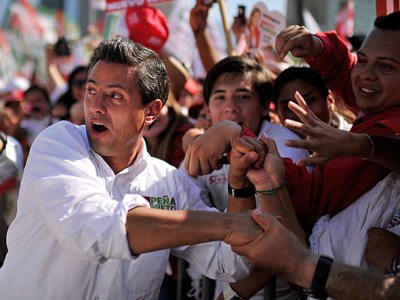
Meet the Candidates: Enrique Peña Nieto, the Mexican presidential candidate for the Institutional Revolutionary Party (PRI), Josefina Vazquez Mota, presidential candidate for the ruling National Action Party (PAN), Andres Manuel Lopez Obrador, presidential candidate for the Party of the Democratic Revolution (PRD)

What will the change in “leadership” do for Mexico?

Will there be dirty politics in Mexico’s Presidential Election?

An employee of the Electoral Federal Institute (IFE) classifies and sorts votes casted by Mexicans living outside Mexico, on June 29, in Mexico city. Mexico will hold presidential elections July 1. Ronaldo Schemidt/AFP/GettyImages
Sunday’s presidential election represents a difficult test for Mexico’s wobbly democracy: Can it hold a fraud-free national vote in the midst of a raging drug war? The country’s top election official conceded recently that violence in parts of the country prevented election officials from completing some preparations. But the official, Leonardo Valdes, insisted that safeguards are firmly in place to prevent the kind of brazen electoral fraud once notorious in Mexico. And, he said, most of the strong-arming, threats and payoffs by drug traffickers remain limited to local politics and less influential in the national race.
June 10, 2012 A student from the anti-PRI youth opposition movement “Yo soy132” (“I am 132”) holds up a placard before the presidential candidates’ televised debate in Guadalajara. Tomas Bravo/Reuters
“Mexican presidential elections today are armored against fraud,” Valdes said. More than 1 million trained poll workers will be deployed in 143,151 voting stations, nearly all of which will also have monitors from at least three political parties. The specter of fraud looms especially large this year because the party that perfected the buying of votes and rigging of elections, the Institutional Revolutionary Party (PRI), is favored to return to the presidency with its telegenic candidate Enrique Peña Nieto. The PRI held on to power for seven decades through repression, coercion and co-opting opponents, until it was ousted in 2000. It is staging a hard-fought comeback.
“It will be the biggest march of your life” a comrade of La Izquierda Socialista (Marxist wing of Morena) said Wednesday, 27th of June, when leftist Andres Manuel Lopez Obrador (AMLO), like other candidates in the coming Mexican presidential elections, was to hold his final election rally or ‘cierre de campaña’ (campaign closing) as it is called here.
One of the largest demonstrations in the history of Mexico
AMLO directly mentioned the “I am 132” movement and the role it has played in energizing the population to defeat the bourgeois candidates. Also, when mentioning the organizations that back him he put an emphasis on MORENA (“Movement for National Regeneration), which is not an ‘official’ party yet but acts as a mass movement of more than 3 million members, many of whom youth and students, who are organized in brigades and committees all across the country. Tellingly, the mention of MORENA also got the loudest applause, possibly to the chagrin of some of the PRD bureaucrats present.
Despite tighter oversight and strengthened laws to ensure clean elections, analysts say Mexico remains vulnerable to many of the dirty tricks that flourished during PRI rule. Voter credentials make it easier to confirm a person’s identity, for example, but candidates and parties have turned to handing out discount cards to win influence with voters. Taking a page from the PRI’s old playbook, all three parties now bus voters to the polls on election day, giving them meals or other perks along the way. Another reported ploy is for voters to take a picture of their marked ballot with a cellphone and later show it to party operatives in return for cash.
“We continue to have elections that have serious problems in terms of legality, equality of access,” said John M. Ackerman, a law professor in Mexico City who has written about the country’s election laws.

While the PRI has opposed reform, Peña Nieto has run a campaign openly calling for structural changes in energy, tax, social security, education, labor etc, which is promising according to Fuente. “For others, though, a resounding victory by the PRI conjures up images of a return to one party-rule in Mexico, with the centralism and cronyism that characterized much of the PRI’s 70 year hold on power until 2000.” photo source: Danny Aguilar/Getty Images

Even before the first ballot was cast, leftist candidate Andres Manuel Lopez Obrador, Peña Nieto’s closest rival, warned of a fraud that would rob him “once again,” as he puts it, of the presidency.
To see how bad political posturing can get, rewind to 2006, when Lopez Obrador lost to Felipe Calderon by less than 1% of the vote. Lopez Obrador refused to recognize Calderon’s victory, unleashing a wave of paralyzing street protests. The following year, Congress passed electoral reforms that regulate air time by parties, prohibit attack ads and shorten to 90 days the amount of time presidential candidates may campaign. A big concern among Lopez Obrador supporters is the PRI’s strong grass-roots presence across most of Mexico’s 31 states and long history of vote-tampering during its rule. Leftists worry that the same well-oiled machinery could be used to inflate the vote on Peña Nieto’s behalf. But the odds for post-election controversy could hinge on the vote tally. A large margin would weaken potential charges of fraud, one reason why the Peña Nieto campaign hopes polls suggesting a blowout prove accurate.

photo source: The grandmother of police officer Jose Ramirez grieves over his body after he was killed by unidentified gunmen while on patrol in Las Joyas neighborhood of Acapulco, Mexico, in July 2010. Ramirez’s grandmother did not give her name, citing security reasons. Three other officers in the vehicle were also killed in the attack. AP/Bernardino Hernandez

Despite a drug war that has claimed more than 50,000 lives in almost six years, and traffickers’ penetration of many levels of Mexican life, most experts agree that the fertile field for narco-influence in politics remains at the local level. Traffickers are keen to control local police forces and city halls so that they can produce, sell and transport their drugs unimpeded. In elections in the state of Michoacan late last year, for example, cartels published ads in newspapers and made phone calls to regional officials with instructions on how to vote. In 2010, the ultra-violent city of Ciudad Juarez elected a mayor alleged to have had ties to a cartel, while in the state of Sinaloa, historic heartland of Mexican drug-trafficking, the compadre of one of the country’s top drug lords only narrowly lost the race for governor.

Starting in the mid-1990’s, different drug gangs increasingly became more violent, fighting to be on top, and gain more control and territory. After Gallardo was arrested, his lieutenant, Joaquin Guzman, started a war with other drug-lords that has since claimed over 50,000 lives.(Kellner) Little was done about the violence, and for a while, there were not even stories in the papers about these horrific and gruesome murders.

“We have had to recognize, especially locally, the presence and actions of criminal groups in the realm of elections,” Interior Minister Alejandro Poire said last week. “We are acting to prevent it … to guarantee that citizens be able to go out and vote in peace…. We cannot call this an election of fear.” The election has forced Mexicans to ponder the progress of democracy in their nation. Most celebrated the defeat of the authoritarian PRI in 2000 and welcomed a new party, Calderon’s National Action Party (PAN). But 12 years later, many feel, rightly or wrongly, that the experiment failed. Fundamental reforms of the educational system or of the monopolies that dominate and strangle the economy were not undertaken. Instead, Mexicans are saddled with a bloody war, a gnawing sense of terror and insecurity, and, now, the return of the very party they ousted.

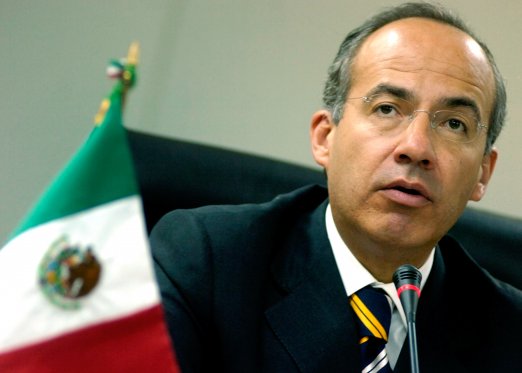
President Felipe Calderon (PAN)

“Millions of Mexican people thought that, almost magically, alternation [one party handing off to another] would bring about profound changes in Mexico,” said Alfonso Zarate, a political analyst in Mexico City. But a PRI victory, he said, “would mean the censure and disapproval of the PAN governments. It means disillusionment.” At the same time, the flow of power to the state governors since the centralized PRI regime was ousted has created powerful fiefdoms where governors can rule without the checks and balances of a healthy democracy. “On the state level, we have gone backward,” Zarate said.

May 13, 2012 Josefina Vazquez Mota, presidential candidate for the ruling National Action Party (PAN), waves Mexico’s flag during a rally in Veracruz. Oscar Martinez/Reuters

As even more mature democracies have shown, an open multi-party system does not necessarily produce stellar candidates. Numerous Mexicans have expressed near-existential dismay over the choices they have in this election; they chafe at the prospect of the PRI’s return, can’t stomach more of the current, discredited government, and see Lopez Obrador as an unreformed erratic. “This is a democratic process,” Mexican historian Enrique Krauze said. But “the democratic voter — the voter who in Mexico believes deeply in democracy — has a difficult choice to make.”

Read More: LA Times

SUBSCRIBE to The Hispanic Blog to stay on top of the latest latino news, politics and entertainment!

Don’t be shy SUBSCRIBE – COMMENT – LIKE ME -CIRCLE ME AND FOLLOW ME

If you have any questions, concerns or simply would like to get a quote on my Marketing, Public Relations, Social Media and/or Events services, please feel free to contact me.

God Bless and make it a fabulous day!

powered by Influential Access – “Transforming the Ordinary to EXTRAordinary!” – CEO – Jessica Marie Gutierrez – Creator of The Hispanic Blog #thehispanicblog
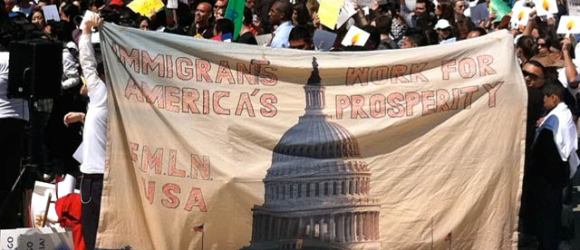
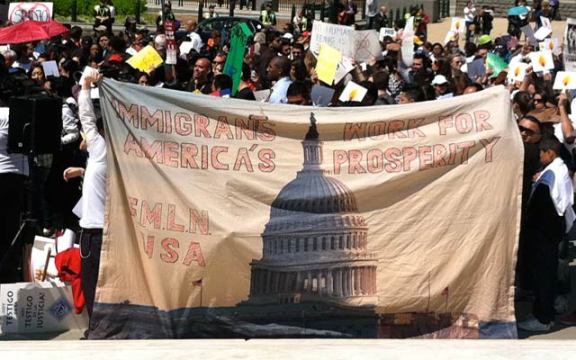
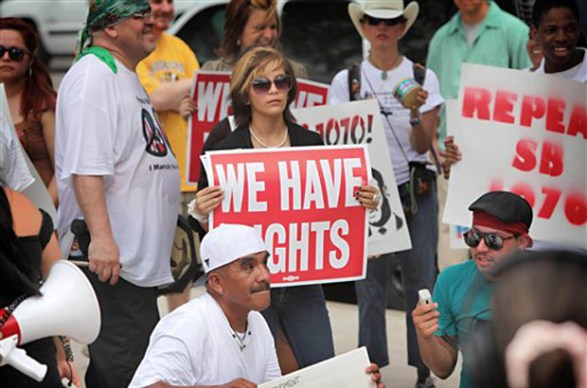
SUPREME COURT SHARED ITS DECISION ON SB1070: “THEY ARE ASKING FOR OUR PAPERS, SO LET’S SHOW THEM OUR VOTER REGISTRATION CARDS!”

THE HISPANIC BLOG IS THE LATEST HISPANIC NEWS BY JESSICA MARIE GUTIERREZ

Photo: Creative Commons/Talk Radio News Service

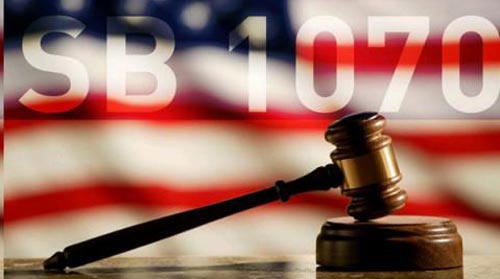
The Supreme Court struck down much of Arizona’s anti-illegal immigration S.B. 1070 law saying states have little authority to set immigration rules against the wishes of the president or Congress. But the states’ remaining authority is enough to deter prospective illegal immigrants, say reform advocates.

SOURCE: AP Photo / Matt York

The judges did allow state law enforcement officials some ability to quiz people about their legal status during traffic stops or arrests. The court had earlier OK’d state rules requiring employers to check the residency of prospective hires.
“States now have broad latitude to carry out a policy of attrition through enforcement,” said Dan Stein, president of the Federation for American Immigration Reform. “It is now up to [state governments] to choose whether to protect the interests of illegal aliens or the interests of citizens,” he said.

“Today’s ruling from the United States Supreme Court in the Arizona immigration case contains a major victory for law enforcement in South Carolina,” said that state’s attorney general, Alan Wilson. “The most important element of South Carolina’s [immigration] law, the ability of law enforcement to verify a suspected illegal alien’s status upon an ‘authorized lawful detention,’ was found to be Constitutional on its face,” he said in a June 25 statement.

The court’s decision said the Constitution gives Congress the power to set immigration laws. Existing federal immigration laws supersede Arizona’s laws, said the court, whose decision bars laws requiring non-citizen residents to carry documents showing they are legal residents and curbs laws that allow the arrest of illegal immigrants.

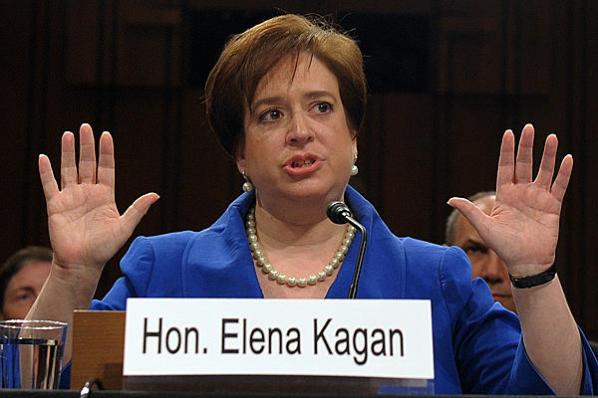
Kagan recused herself because she had been Obama’s Solicitor General when the federal government led the lawsuit against the state of Arizona.

Supreme Court Justice Elena Kagan recused herself from the decision, leaving 8 judges to settle the case. The decision was made by a five-to-three vote, with Justices Antonin Scalia, Clarence Thomas and Samuel Alito dissenting. “Because Congress has occupied the field, even complementary state regulation is impermissible,” said Justice Anthony Kennedy, who wrote the June 25 decision. Kennedy was nominated by President Ronald Reagan. But Scalia slammed his colleagues’ failure to guard states’ ability to govern themselves.

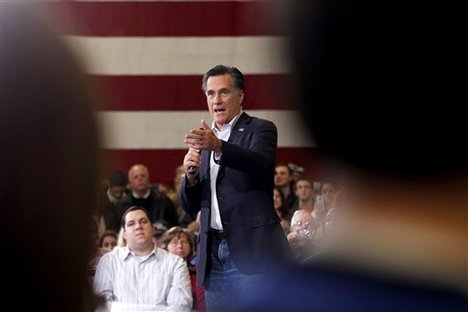
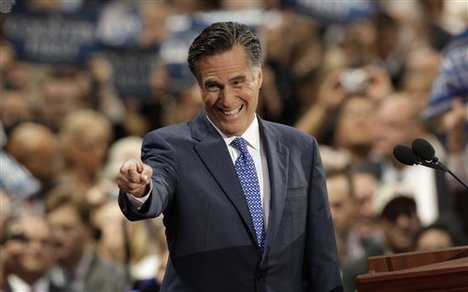
“I believe that each state has the duty — and the right — to secure our borders and preserve the rule of law,” Romney said. Republican presidential candidate seemed to ally himself with Scalia and state legislators. “Arizona is entitled to have ‘its own immigration policy’ — including a more rigorous enforcement policy — so long as that does not conflict with federal law… [and] it is beyond question that a State may make violation of federal law a violation of state law as well,” Scalia wrote in a biting dissent.
“Today’s opinion… deprives States of what most would consider the defining characteristic of sovereignty: the power to exclude from the sovereign’s territory people who have no right to be there,” he wrote. “Neither the Constitution itself nor even any law passed by Congress supports this result.”

                                                                             photo source: Jonathan Gibby/Getty Images

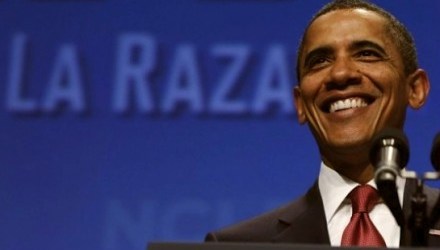
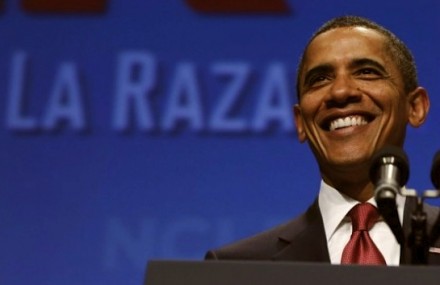
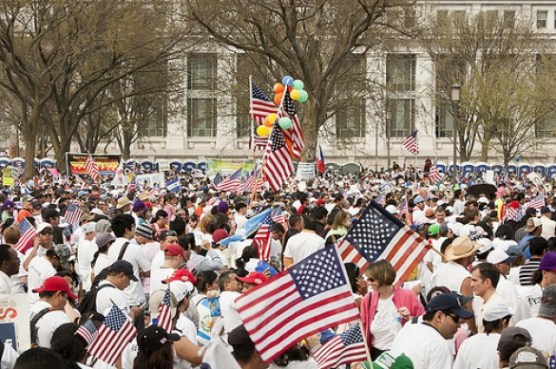
Progressives-allied groups, such as La Raza, had argued that Arizona’s law is unconstitutional because the federal government should have the sole authority to enforce immigration rules. They also argued that police enforcement would tend to focus on subgroups, such as Latinos or Asians. The court approved the residency checks of suspected illegal immigrants who are arrested or stopped for suspected non-immigration violations, but said the checks would be subject to continued review and approval by federal judges.

2009 Getty Images

“If the law only requires state officers to conduct a status check during the course of an authorized, lawful detention or after a detainee has been released, the provision would likely survive,” said the court. “This opinion does not foreclose other preemption and constitutional challenges to the law as interpreted and applied after it goes into effect,” said the court.

SUBSCRIBE to The Hispanic Blog to stay on top of the latest latino news, politics and entertainment!

Don’t be shy SUBSCRIBE – COMMENT – LIKE ME -CIRCLE ME AND FOLLOW ME

If you have any questions, concerns or simply would like to get a quote on my Marketing, Public Relations, Social Media and/or Events services, please feel free to contact me.

God Bless and make it a fabulous day!

powered by Influential Access – “Transforming the Ordinary to EXTRAordinary!” – CEO – Jessica Marie Gutierrez – Creator of The Hispanic Blog #thehispanicblog
PRESIDENT OBAMA LEADS THE HISPANIC VOTE

THE HISPANIC BLOG IS THE LATEST HISPANIC NEWS BY JESSICA MARIE GUTIERREZ

Photo: Poll: Obama Favored Over Romney Among Hispanic Voters

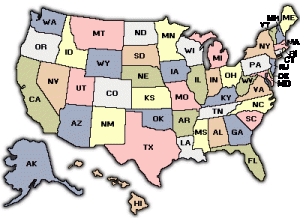
 President Barack Obama is leading likely Republican opponent Mitt Romney  among Hispanic voters in the key electoral states of Arizona, Colorado, Florida,  Nevada y Virginia, according to a survey released Friday. The poll taken by Latino Decisions shows Obama with 53 percent support in  Florida among Hispanics against 37 percent for Romney. In the other states Obama’s lead is even greater: 74 percent against 18  percent in Arizona, 70 percent against 22 percent in Colorado, 69 percent  against 20 percent in Nevada, and 59 percent against 28 percent in Virginia.

Averaging the results from all five states shows Obama in front of Romney  among Hispanics by 63 percent to 27 percent, according to the survey, which was  taken between June 12-21 among 2,000 Latino voters and has a margin of error of  plus/minus 2.2 percent. Part of the Democratic incumbent’s advantage “appears related” to his recent  announcement temporarily suspending the deportations of hundreds of thousands of  young undocumented immigrants, a measure that will particularly benefit  Hispanics, according to Latino Decisions.

hispanic voters

The survey also asked Latinos to quantify their level of enthusiasm about the  upcoming November elections. Sixty percent said they were “very enthusiastic” about the vote compared with  just 47 percent in November 2011.

Read more: Fox News Latino

SUBSCRIBE to The Hispanic Blog to stay on top of the latest latino news, politics and entertainment!

Don’t be shy SUBSCRIBE – COMMENT – LIKE ME -CIRCLE ME AND FOLLOW ME

If you have any questions, concerns or simply would like to get a quote on my Marketing, Public Relations, Social Media and/or Events services, please feel free to contact me.

God Bless and make it a fabulous day!

powered by Influential Access – “Transforming the Ordinary to EXTRAordinary!” – CEO – Jessica Marie Gutierrez – Creator of The Hispanic Blog #thehispanicblog

IMMIGRATION DEBATE TAKES CENTER STAGE

THE HISPANIC BLOG IS THE LATEST HISPANIC NEWS BY JESSICA MARIE GUTIERREZ

(Credit: AP Photo/Getty Images)

No longer a backburner issue, immigration is roiling the presidential contest as President Barack Obama and Republican Mitt Romney seek to court the nation’s swelling Hispanic population. The outcome could influence political battle lines and shape American politics for generations.

 The Supreme Court is about to render judgment on a get-tough Arizona law, and just last week the Democratic president announced plans to ease deportation rules for some children of illegal immigrants. With Election Day less than five months away, Hispanic voters are energized and paying close attention.

photo source: flickr

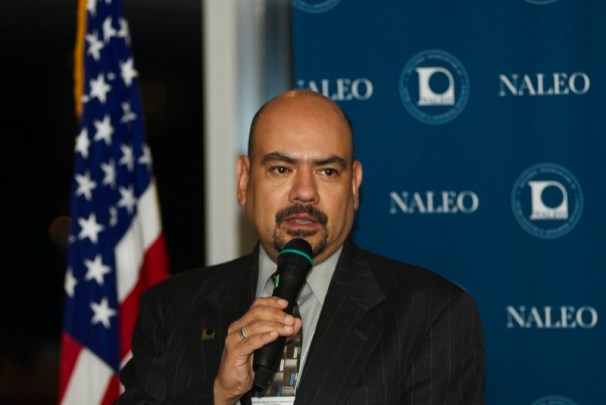
“There’s a lot at stake. We’re talking about a significant share of the American electorate that could well decide this election,” said Arturo Vargas, executive director of the National Association of Latino Elected and Appointed Officials. “It’s only now that both candidates are turning their attention to the Latino vote.”

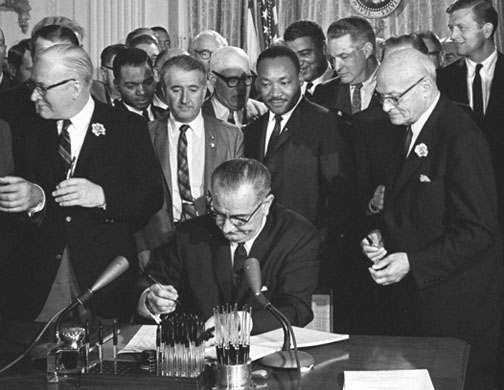
LBJ signing the Civil Rights Act of 1964

Indeed, both sides are crafting aggressive strategies to appeal to a demographic that is by no means monolithic but has supported Democrats in recent elections. Some Republicans fear — and Democrats hope — that Obama could capitalize on this moment to help solidify Hispanic voters as predominantly Democratic this fall and for years to come, much as President Lyndon Johnson hardened the black vote for Democrats as he pushed the Civil Rights Act of 1964.

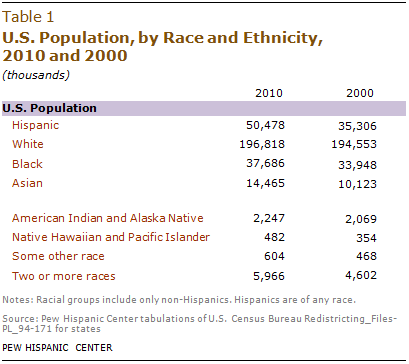
The stakes are high not only for states with larger Hispanic populations such as Florida, Nevada and Colorado, but for a growing number of other battlegrounds — Ohio, North Carolina and Virginia, among them — where even a modest shift among Latino voters could be significant. The United States‘ Latino population surged from about 35 million in 2000 to 50 million in 2010, according to the Census Bureau.

Obama is riding a wave of Latino enthusiasm over his decision to allow hundreds of thousands of illegal immigrants to stay in the country and work. Under the administration plan, illegal immigrants can avoid deportation if they can prove they were brought to the United States before they turned 16 and are younger than 30, have been in the country for at least five continuous years, have no criminal history, graduated from a U.S. high school or earned a GED or served in the military. The new policy could help anywhere from 800,000 young immigrants — the administration’s estimate — to the Pew Hispanic Center‘s estimate of 1.4 million.

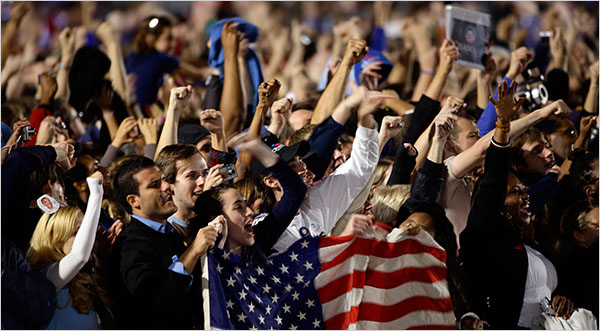
The move was politically timely, in the heat of the campaign and with Obama needing to energize a key part of his base of supporters — many of whom had grown disenchanted over the past three years. While the direct beneficiaries of the directive can’t vote for Obama, his action has widespread support among American Latinos. In fact, Obama has long enjoyed support among Hispanics — he won 67 percent of the Latino vote in 2008.

But he risked losing their enthusiasm, partly because Hispanics have been among the hardest hit by the economic slowdown. Obama also lost some support because he hasn’t fulfilled promises of a comprehensive overhaul of the immigration system and because his administration has been aggressively deporting illegal immigrants. A December poll by the Pew Hispanic Center showed that 59 percent of Latinos disapproved of the president’s handling of deportations.

Obama supporters 2008 photo source: Doug Mills/The New York Times

Obama senior adviser David Axelrod predicts that the president could exceed his 2008 performance with Hispanics this year, noting that his opponent then was Sen. John McCain, who had initially pushed for an overhaul of the immigration system. Axelrod contends that Romney is “hopelessly twisted up on this issue.” Obama had troubles of his own before the administration announced the recent initiative. Supporters of many illegal immigrants — students as well as workers— had been mounting protests at Obama campaign headquarters this month in places such as Denver and Los Angeles.

Marco Saavedra, a Dream Act protester, participates in a sit-in Friday at President Barack Obama’s Walnut Hills campaign headquarters. The office has been closed since Saavedra and other protesters arrived Wednesday. / The Enquirer/Cara Owsley

 The Romney campaign has struggled to offer a consistent response to the president’s move. Romney has assailed Obama’s “broken promises” on immigration in recent days but has focused on the new policy’s temporary status as his prime criticism.

photo: photo: AP / Stephan Savoia

“These people deserve to understand what their status will be long term, not just four and a half months,” Romney said on Fox News Radio this week. “And that’s why I think it’s important for me and for Congress to come together to put together a plan that secures the border, that insists that we have an employment verification system and that deals with the children of those who have come here illegally on a long-term basis, not a stopgap measure.”

photo: photo: AP / Gerald Herbert

As is typical, Romney intends to focus on the economy when he faces the Latino convention on Thursday. The former Massachusetts governor argues that his economic credentials would benefit all people who have struggled under Obama’s leadership in recent years — women, younger voters and Hispanics among them. Still, Romney’s own immigration policy is unclear as he works to distance himself from harsh conservative rhetoric that was common during the extended GOP primary season earlier in the year.

photo source: AP / Paul Sancya

Facing a Rhode Island audience in April, for example, Romney drew large cheers when he said, “We want people to come here legally. And we like it when they come here speaking English.” He did not support the Obama administration’s lawsuit challenging Arizona’s hardline immigration law. And he said that he would veto the DREAM Act that would have given legal status to some children of illegal immigrants. Romney has refused so far to say whether he would reverse Obama’s new policy that does much the same thing, albeit on a temporary basis.

A Spanish language ad from the Obama campaign targeting Latino voters.

Even before he announced the new rules, Obama was looking to build his support among Latinos, vastly outspending Romney on Spanish-language television and radio. But Romney has released targeted TV and radio ads in Spanish, including some that feature one of Romney’s sons who is a fluent Spanish speaker. Simon Rosenberg, who follows immigration matters as head of the liberal-leaning group NDN, said the president’s move on immigration not only helps him energize Latino voters, it also helps cast him as a president willing to take bold steps. For a Latino community that worried that neither party was doing enough, “they now have a champion,” he said. But, he added, “There will be a resonance beyond the Latino community.”

Besides the new immigration initiative, the Obama camp has been using the new health care law to appeal to Hispanic voters, a rare use of the signature Obama measure in the campaign. An ad campaign this week in Nevada, Colorado and Florida focuses on the benefits of the health care law for Hispanics and features Cristina Saralegui, a popular Spanish-language television personality who endorsed Obama this week. She says in the ad that Obama’s health care law guarantees that “the great majority of Hispanics” will have access to doctors and hospitals.

Read More: Christian Science Monitor

SUBSCRIBE to The Hispanic Blog to stay on top of the latest latino news, politics and entertainment!

Don’t be shy SUBSCRIBE – COMMENT – LIKE ME -CIRCLE ME AND FOLLOW ME

If you have any questions, concerns or simply would like to get a quote on my Marketing, Public Relations, Social Media and/or Events services, please feel free to contact me.

God Bless and make it a fabulous day!

powered by Influential Access – “Transforming the Ordinary to EXTRAordinary!” – CEO – Jessica Marie Gutierrez – Creator of The Hispanic Blog #thehispanicblog

MITT ROMNEY’S SUPPORTERS BLAST OBAMA’S SPEECH TO HISPANICS

THE HISPANIC BLOG IS THE LATEST HISPANIC NEWS BY JESSICA MARIE GUTIERREZ

photo source: Gerardo Mora, Getty Images

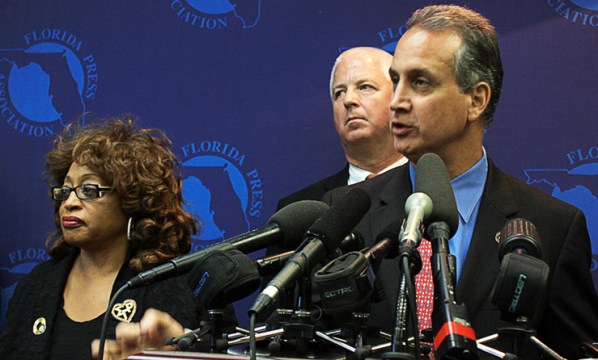
 Mitt Romney‘s supporters today blasted President Obama’s speech to Hispanic leaders, charging the Democrat with failing Latinos with his policies. “We won’t be fooled by the shell games and the last minute political gimmickry President Obama is playing to distract from his record,” said Rep. Mario Diaz-Balart, R-Fla.

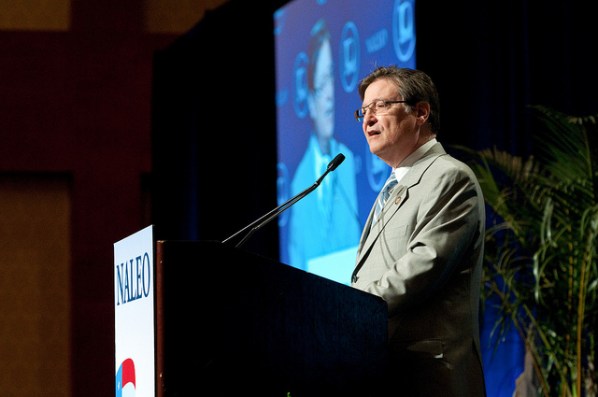
Obama vowed he would continue fighting for a “comprehensive” immigration bill to come out of Congress and talked about ways to improve the economy in his remarks this afternoon at the NALEO conference. Romney spoke to the Hispanic elected and appointed officials, sounding a less-strident tone on immigration than he did during the GOP primaries. Rep. Quico Canseco, R-Texas, said Hispanics have been set back by Obama’s policies. He cited a double-digit unemployment rate and what he called a “staggering” child poverty rate for Latinos as examples.

photo source: flickr

 “The Hispanic community cannot stand for four more years under the current administration in Washington. By electing Mitt Romney in November, we can instead choose a different path and begin the work of turning the economy around for all Americans, especially Hispanics.”

Read More: USA Today

SUBSCRIBE to The Hispanic Blog to stay on top of the latest latino news, politics and entertainment!

Don’t be shy SUBSCRIBE – COMMENT – LIKE ME -CIRCLE ME AND FOLLOW ME

If you have any questions, concerns or simply would like to get a quote on my Marketing, Public Relations, Social Media and/or Events services, please feel free to contact me.

God Bless and make it a fabulous day!

powered by Influential Access – “Transforming the Ordinary to EXTRAordinary!” – CEO – Jessica Marie Gutierrez – Creator of The Hispanic Blog #thehispanicblog