CAN SOMEONE EXPLAIN THE THE SCOTUS RULING ON TX REDISTRICTING?

THE HISPANIC BLOG IS THE LATEST HISPANIC NEWS BY JESSICA MARIE GUTIERREZ

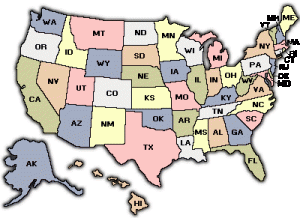
Basically, the Supreme Court sent the case back to the three-judge court in Texas to redraw congressional and legislative lines using Texas’s own plans as a starting point. The Court held that the three-judge court should deviate from Texas’s maps only if it is likely that parts of the maps violate the Voting Rights Act.

“On the contrary,” the opinion continued, “the state plan serves as a starting point for the district court. It provides important guidance that helps ensure that the district court appropriately confines itself to drawing interim maps that comply with the Constitution and the Voting Rights Act, without displacing legitimate state policy judgments with the court’s own preferences.”
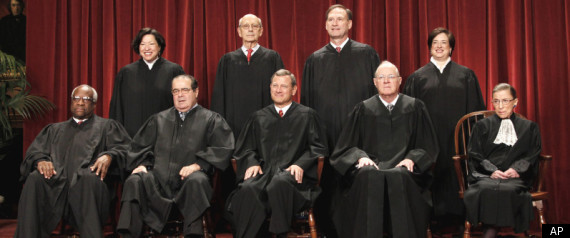
SCOTUS — cited its 1996 decision in Lopez v. Monterey County — said that a District Court may not adopt “as its own” a state plan that needs Washington clearance but does not yet have it. However, the precedents “say nothing about whether a district court may take guidance from the lawful policies incorporated in such a plan for aid in drawing an interim map.” Turning then to its 1982 decision in Upham v. Seamon, the Court said that a district court has a duty to “defer to the unobjectionable aspects of a state’s plan” even in a situation where clearance was sought but had been denied.

The Justices flatly rejected the declaration of the San Antonio court that it was “not required to give any deference” to what the legislature had crafted. The lower court was wrong, the Court added, “to the extent” it “exceeded its mission to draw interim maps that do not violate the Constitution or the Voting Rights Act, and substituted its own concept of ‘the collective public good’ for the Texas legislature’s determination of which policies serve ‘the interests of the citizens of Texas.’ ”Further, the Court wrote, “because the District Court here had the benefit of a recently enacted plan to assist it, the court had neither the need nor the license to cast aside that vital aid.”

As far as Section 5, requiring some states and local governments to get Washington legal approval before they may put into effect any change in their election laws; Justice Thomas spoke for himself citing his belief that it is unconstitutional.

What does this mean? The opinion favors the state’s maps. This decision only affects the interim maps and this is not necessarily a defeat for the redistricting plaintiffs.

SUBSCRIBE to The Hispanic Blog and stay on top of the latest Latino news, politics and entertainment!

Don’t be shy SUBSCRIBE – COMMENT – LIKE ME -CIRCLE ME AND FOLLOW ME

If you have any questions, concerns or simply would like to get a quote on my Marketing, Public Relations, Social Media and/or Events services, please feel free to contact me at thehispanicblog@gmail.com.

God Bless and may you have a fabulous day!

powered by Influential Access – “Transforming the Ordinary to EXTRAordinary!” – CEO – Jessica Marie Gutierrez – Creator of The Hispanic Blog #thehispanicblog

GET EDUCATED: DO YOU UNDERSTAND WHAT ALL THIS SOPA/PIPA IS ABOUT?

SOPA Resistance Day!

SOPA Resistance Day! (Photo credit: ~C4Chaos)

THE HISPANIC BLOG BY JESSICA MARIE GUTIERREZ

Everyone needs to be informed on the Protect IP Act (PIPA) in the Senate and the Stop Online Piracy Act (SOPA) in the House, which would censor the Web. My blog post informs the people of what SOPA / PIPA really are, which in a nutshell is HOLLYWOOD VS the TECHNOLOGY INDUSTRY:

Who supports SOPA/PIPA? The US Chamber of Commerce, the Motion Picture Association of America and the Recording Industry Association of America all have unyielding support of this legislation. SOPA would allow the Justice Department to seek a court order to be served on search engines, Internet providers, and other companies that would force them to make a suspected piratical Web site effectively vanish from the Internet.

The support for SOPA and an earlier version in the Senate called Protect IP is broader than Hollywood. A list of supporters includes the Association of Magazine Media, the National District Attorneys Association, the Romance Writers of America, Eli Lilly and Company, Kate Spade, Pfizer, Ralph Lauren, and a number of labor unions.That list appears on FightOnlineTheft.com, another Chamber project that urges visitors to “tell Congress to act on the rogue sites legislation immediately.” The Web site doesn’t highlight the U.S. Chamber of Commerce by name — instead, it’s described as a project of the Coalition Against Counterfeiting and Piracy, which is in turn organized by the Chamber’s intellectual property center.

“I would assume that the Chamber’s members who support SOPA contribute more than those who are opposing it,” says Ryan Radia, an analyst at the Competitive Enterprise Institute, a free-market think tank in Washington.

Are there free speech implications to SOPA? SOPA’s opponents say so–Laurence Tribe, a high-profile Harvard law professor and author of a treatise titled American Constitutional Law, has argued that SOPA is unconstitutional because, if enacted, “an entire Web site containing tens of thousands of pages could be targeted if only a single page were accused of infringement.

What has the response to this language been? Web sites including Wikimedia (as in, Wikipedia) charged that SOPA is an “Internet blacklist bill” that “would allow corporations, organizations, or the government to order an Internet service provider to block an entire Web site simply due to an allegation that the site posted infringing content.” Tumblr “censored” its users’ content streams, and reported that its users averaged 3.6 calls per second to Congress through the company’s Web site–nearly 90,000 total.

With a bit of HTML from AmericanCensorship.org, a Web site supported by the Free Software Foundation, the Electronic Frontier Foundation, and Public Knowledge, hundreds of Web sites “censored” themselves to protest SOPA. Even Lofgren, from Silicon Valley, has joined the fight-censorship protest.

For their part, the Motion Picture Association of America (MPAA) has been highlighting an analysis it commissioned from First Amendment lawyer Floyd Abrams, a former MPAA attorney, who concluded SOPA is perfectly constitutional.

How would SOPA work? It allows the U.S. attorney general to seek a court order against the targeted offshore Web site that would, in turn, be served on Internet providers in an effort to make the target virtually disappear. It’s kind of an Internet death penalty.

How is SOPA different from the earlier Senate bill called the Protect IP Act? Protect IP targeted only domain name system providers, financial companies, and ad networks–not companies that provide Internet connectivity. Because SOPA is broader, even some companies who liked, or at least weren’t vocally opposed to, the Senate bill aren’t exactly delighted with the House version.

What happens next? In terms of Protect IP, the Senate Judiciary committee has approved it and it’s waiting for a floor vote that has been scheduled for January 24. One hurdle: Sen. Ron Wyden, an Oregon Democrat, has placed a hold on the bill.

During a two-day debate in the House Judiciary committee in mid-December, it became clear that SOPA supporters have a commanding majority on the committee. They’re expected to approve it when Congress returns in 2012.

Where it goes from there is an open question that depends on where the House Republican leadership stands. Because the House’s floor schedule is under the control of the majority party, the decision will largely lie in the hands of House Speaker John Boehner and his lieutenants.

Another possibility is that there could be further House hearings on the security-related implications of SOPA, a move that would delay a final vote. An aide to House Judiciary Chairman Lamar Smith previously told CNET that there’s no indication yet as to any further hearings, but after the committee debate in December, don’t be surprised if it happens.

Interested in Protesting? If you are like me and against SOPA/PIPA, Google has a petition you can sign as part of their “End Piracy, Not Liberty” campaign https://www.google.com/landing/takeaction/. By signing the petition you are urging Congress to vote NO on PIPA and SOPA before it is too late.

Feedback? Now that you have a better understanding on this legislation, what are your thoughts concerning this issue?

SUBSCRIBE to The Hispanic Blog and stay on top of the latest Latino news, politics and entertainment!

Don’t be shy SUBSCRIBE – COMMENT – LIKE ME -CIRCLE ME AND FOLLOW ME

If you have any questions, concerns or simply would like to get a quote on my Marketing, Public Relations, Social Media and/or Events services, please feel free to contact me at thehispanicblog@gmail.com.

God Bless and may you have a fabulous day!

powered by Influential Access – “Transforming the Ordinary to EXTRAordinary!” – CEO – Jessica Marie Gutierrez – Creator of The Hispanic Blog #thehispanicblog

IS IMMIGRATION INCREASING OR DECREASING?

THE HISPANIC BLOG BY JESSICA MARIE GUTIERREZ

Despite Low Latino Migration, GOP Candidates Still Rely On Enforcement

English: The "fighting Medinas of Rio Gra...

Image via Wikipedia: The Fighting Medinas of the Rio Grande, Puerto Rico and Brooklyn source Undaunted Courage Mexican American Patriots of WWII

As the immigration debate heats up in the Republican campaign, some experts argue that immigration rates are actually cooling down.

“The Mexican immigration boom of the 1990s and early 2000s is unlikely to be repeated ever again,” Shannon K. O’Neil, an expert on Latin American studies at the Council on Foreign Relations, wrote last week.

Despite all indications that new migration is not the problem it once was, GOP candidates carry on with the politically amenable “more border enforcement” mantra while remaining vague on the harder question: What do we do with the 11.2 million undocumented immigrants already here?

Doug Massey, head of the Princeton’s Mexican Migration Project, says that for the first time in decades, Latino migration has actually reached a net zero.

“For the first time in 60 years, the net traffic has gone to zero and is probably a little bit negative,” he said in an interview with the New York Times.

After a rapid immigration spike, experts still debate what factors contributed to the fast decline in Latino immigration in recent years. O’Neil of the Council on Foreign Relation says that increased economic prosperity in Mexico, shrinking Mexican families, and increased criminal activities on the border are among the reasons given for the swift fall. Some also attribute lower immigration rates to new tougher border patrol strategies and higher deportation rates. However, the dip seems to have started far before the nation’s harsher state immigration laws (like those in Alabama and Arizona) came into effect.

Despite the immigration decline, Latino population increased 43 percent between 2000 and 2010, according to Census data — making Latinos America’s largest minority group. And for the first time since the 1970’s, native births account for the majority of Mexican-American population growth. In a study released in 2009, the Pew Hispanic Center concluded that one of every four children born in the U.S. today is of Hispanic heritage.

As immigration rates fell, Republican candidates ratcheted up their anti-immigrant talk, pledging aggressive measures to secure the border.

Herman Cain suggested installing an electrified fence and placing armed troops with “real bullets” on the border and Michele Bachmann called for “a secure double fence.”

Rick Santorum said in a September debate that, “until we build that border, we should neither have storm troopers come in and throw people out of the country nor should we provide amnesty.”

He said “we’ll have that discussion” of what do with the 11.2 million after a wall across the entire border is built.

Read More: http://www.huffingtonpost.com/2012/01/09/princeton-study-finds-imm_n_1195161.html

SUBSCRIBE to The Hispanic Blog and stay on top of the latest Latino news, politics and entertainment!

Don’t be shy SUBSCRIBE – COMMENT – LIKE ME -CIRCLE ME AND FOLLOW ME

If you have any questions, concerns or simply would like to get a quote on my Marketing, Public Relations, Social Media and/or Events services, please feel free to contact me at thehispanicblog@gmail.com.

God Bless and may you have a fabulous day!

powered by Influential Access – “Transforming the Ordinary to EXTRAordinary!” – CEO – Jessica Marie Gutierrez – Creator of The Hispanic Blog #thehispanicblog

HOW DID THE HEARING IN TEXAS REDISTRICTING BEGIN 2012?

THE HISPANIC BLOG BY JESSICA MARIE GUTIERREZ

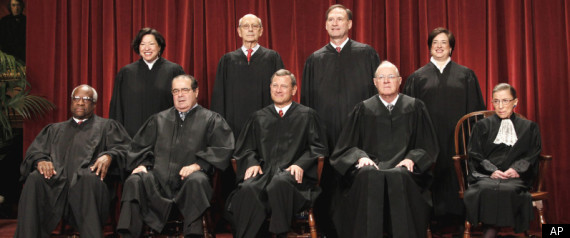
The Supreme Court 2011

The Supreme Court 2011 (Photo credit: DonkeyHotey) License Creative Commons Attribution

The Supreme Court was sharply divided about what to do and reaching for options to deal with a very messy situation.

One option that got a lot of play and seemed attractive to justices on both sides of the court’s ideological spectrum was the possibility of just punting and letting the DC court issue its preclearance ruling, presumably some time in February. The suggestion came first from Justice Alito and later in the argument Justice Sotomayor asked directly, “What’s our absolute drop dead date?”  (Answer: maybe June)  Justice Kagan also raised the possibility.

Another option which came up was the possibility of shifting the burden to the State of Texas for showing that it had a likelihood of success on parts of the map that had been challenged in the section 5 case – a suggestion made by Justice Kagan.

Justice Kennedy also suggested that maybe the appropriate route might be to say that the San Antonio court should limit itself to section 2, equal protection, and other constitutional inquiries while leaving section 5 issues to the DC court (as opposed to having the San Antonio court guess whether there would be problems with the state’s maps).   But the retort to that was that it would sidestep section 5, even if just on an interim basis, and based on the questioning from other justices to the lawyers, it did not appear there would be a broad consensus for that option.

One thing that the justices seemed not very inclined to do was get into the messy business of telling the San Antonio (or future district courts) the details of what it should do on things like coalition districts and population deviations.

The other major thing that did not come up, except for a very brief allusion by the state’s lawyers, was the constitutionality of section 5. However, while the court did not seem interested in taking the issue head on, Justice Kennedy did wrestle publicly on a couple of occasions with how you reconcile the differing treatment of states.

As for the alignment on the court, it largely fell along familiar lines- with the more liberal justices (Sotomayor, Kagan, Breyer, and Ginsburg) having sharp questions about the state’s position and more conservative justices (Scalia, Alito, Roberts, Kennedy) being more skeptical of the plaintiff’s defense of the interim maps, though to differing degrees. (Justice Thomas did not ask any question but given his dissent in NAMUDNO, it can be presumed that he is not very sympathetic to arguments that section 5 prevents use of the state’s maps.)

Let’s just say things keep getting interesting.

Read More: http://txredistricting.org

SUBSCRIBE to The Hispanic Blog and stay on top of the latest Latino news, politics and entertainment!

Don’t be shy SUBSCRIBE – COMMENT – LIKE ME -CIRCLE ME AND FOLLOW ME

If you have any questions, concerns or simply would like to get a quote on my Marketing, Public Relations, Social Media and/or Events services, please feel free to contact me at thehispanicblog@gmail.com.

God Bless and may you have a fabulous day!

powered by Influential Access – “Transforming the Ordinary to EXTRAordinary!” – CEO – Jessica Marie Gutierrez – Creator of The Hispanic Blog #thehispanicblog

WHY IS MITT ROMNEY AGAINST THE DREAM ACT? WHAT IS THE DREAM ACT?

THE HISPANIC BLOG BY JESSICA MARIE GUTIERREZ

DREAM Act supporters to Romney:

Do you know the facts on immigration? Music to a Republican‘s ear during a contested presidential

primary? Criticism from supporters of the DREAM Act, who sent out the following press release in

opposition to Mitt Romney’s promise to veto the bill if he ever became president and if it ever reached

his desk:

Open Letter to Governor Mitt Romney from DREAMers

Governor Mitt Romney, You recently stated that if elected president of the United States, you would veto the federal DREAM Act and would not support any legislation that grants in-state tuition for undocumented students. At this point, we are wondering whether you know the facts about the DREAM Act as your statement appears highly inconsistent considering your political record.

Your political history indicates that you once supported several immigration reforms, some of which included the DREAM Act. *

In 2005, you supported an immigration reform plan that Sen. Jon Kyl (R-AZ), and Sen. John Cornyn, (R-TX) proposed and called it a “reasonable proposal”. During an interview with the Boston Globe in November 2005, you showed your support and said it was not amnesty. The Comprehensive Enforcement and Immigration Reform Act of 2005 (S. 1438), which failed to pass in Congress, would have required undocumented immigrants to pay a fee and would be allowed to apply for citizenship.*

In 2007, you also supported the McCain-Kennedy immigration reform that provided a pathway to citizenship for those who entered the country illegally. During an interview with Meet the Press, you showed your support for the bill saying,

“My own view is…those people who come here illegally and are in this country, the 12 million or so that are here illegally, should be able to sign up for permanent residency or citizenship.” *

Two months later, in 2008, while running for president for the first time, you changed your stance on illegal immigration and campaigned against it. *

Now, in your second attempt to run for president, you are again opposing creating a path to legalization for the undocumented immigrant population. During a Republican presidential debate in November you stated, “To say that we’re going to say to the people who have come here illegally that now you’re going to get to stay or some large number are going to get to stay and become permanent residents of the United States, that will only encourage more people to do the same thing. People respond to incentives and if you can become a permanent resident of the United States by coming here illegally, you’ll do so.”

Vitriolic, anti-immigrant rhetoric has been the platform for some of the current presidential Republican candidates. However, we want you to set the record straight on the DREAM Act. You have to recognize the positive impact this legislation would have on the U.S. and the lives of the 2.1 million undocumented young immigrants who would benefit from it.

A 2010 study by the UCLA North American Integration and Development Center estimates that the total earnings of DREAM Act beneficiaries over the course of their working lives would be between $1.4 trillion and $3.6 trillion. This translates into greater tax revenue and scores of new jobs. If you are serious about fixing the economy, the DREAM Act is the solution, not the problem.

On Saturday, you said you support creating a path to legalization for undocumented immigrants who serve in the military. In fact, this is included in the DREAM Act. You also said that if elected president, you would veto the federal DREAM Act and that you don’t support giving benefits to young immigrants, such as in-state tuition. Once again, the current DREAM Act does not give undocumented youth in-state tuition or preferences over U.S. citizens. Instead, it would allow each state to decide whether or not to grant undocumented students in-state tuition and would only allow them to apply for student loans and federal work-study programs.

Moreover, your recent stance on opposing a pathway to citizenship is contrary to the wishes of the American people. A recent Fox News national poll showed that 66 percent of Americans think there should be a path to citizenship for undocumented immigrants, but only if individuals meet requirements such as paying back taxes and learning English. Indeed, your current stance will not give you the support from our immigrant community and Latino voters, who will be a determining factor in the 2012 presidential race. According to a Pew Hispanic Center poll released in December, 88 percent of Latino registered voters nationwide support the DREAM Act.

Over the past 10 years, since the DREAM Act was first introduced, Republicans and Democrats have used us to score cheap political points, and we will no longer stand for that. Even though we are still not allowed to drive, work, and use our college degrees, we have not given up. We will continue to mobilize our communities until we’re given the opportunity to give back to this country we love and call home. Sincerely, DRM Capitol GroupMaryland DREAM TeamEl Cambio in North CarolinaArizona DREAMersNew Mexico DREAMers in ActionConnecticut Students for a DREAMNew York DREAMersDREAM Team Los AngelesGaby Pacheco, Trail of DreamsDREAM Big Vegas

Read more here: http://miamiherald.typepad.com/nakedpolitics/2012/01/dream-act-supporters-to-romney-do-you-know-the-facts-on-immigration.html#storylink=cpy

SUBSCRIBE to The Hispanic Blog and stay on top of the latest Latino news, politics and entertainment!

Don’t be shy SUBSCRIBE – COMMENT – LIKE ME -CIRCLE ME AND FOLLOW ME

If you have any questions, concerns or simply would like to get a quote on my Marketing, Public Relations, Social Media and/or Events services, please feel free to contact me at thehispanicblog@gmail.com.

God Bless and may you have a fabulous day!

powered by Influential Access – “Transforming the Ordinary to EXTRAordinary!” – CEO – Jessica Marie Gutierrez – Creator of The Hispanic Blog #thehispanicblog