MITT ROMNEY WINS SUPER TUESDAY

THE HISPANIC BLOG IS THE LATEST HISPANIC NEWS BY JESSICA MARIE GUTIERREZ

Mitt Romney Pulls Ahead on Super Tuesday But Faces Challenges

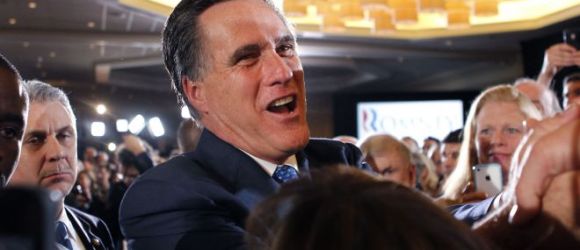
Mitt Romney secured a decisive advantage on Super Tuesday but also suffered several defeats, highlighting the frontrunner’s inability to unite the Republican Party behind his nomination.

Romney had a home-state win in Massachusetts to go with victories in Vermont and in Virginia, where neither Santorum nor Newt Gingrich qualified for the ballot. He also led in early Idaho caucus returns and — most important — padded his lead for delegates to the Republican National Convention.

But a resurgent Santorum broke through in primaries in Oklahoma and Tennessee and in the North Dakota caucuses, while Newt Gingrich scored a home-field win in Georgia — fresh evidence that they retain the ability to outpace the former Massachusetts senator in parts of the country despite his huge organizational and financial advantages.

Texas Rep. Ron Paul pinned his hopes on Alaska as he scratched for his first victory of the campaign season.

The most contentious electoral battlefield was Ohio, where Romney trailed for much of the night before forging ahead. With 96 percent of the ballots counted, Romney led by only 12,000 of the 1.1 million votes cast — a one percentage point advantage.

Likely Latino voters favor Mitt Romney for the GOP nomination with 35 percent support, compared to Texas Rep. Ron Paul’s 13 percent, former Speaker of the House Newt Gingrich’s 12 percent, and former Pennsylvania Sen. Rick Santorum‘s 9 percent, according to a Fox News Latino poll released Monday.

None of the Republican candidates inspire Hispanic voters much, however. No GOP hopeful earned more than 14 percent support in head-to-head matches against Obama, the poll found.

Romney’s expected victories in Massachusetts, Virginia and Vermont, coupled with his struggle against Rick Santorum in Ohio, will not change GOP operatives’ conviction that he is the likeliest nominee. He still has the most delegates, money, organization and experience. And his opposition is still divided among three rivals.

“This is a process of gathering enough delegates to become the nominee, and I think we’re on track to have that happen,” Romney told reporters as he arrived home in Massachusetts to vote in the primary.

Later, he told supporters, “I’m going to get this nomination.”

Romney picked up at least 129 delegates during the evening, Santorum 47, Gingrich 42 and Paul at least 10.

That gave the former Massachusetts governor 332, more than all his rivals combined, a total that included endorsements from members of the Republican National Committee who automatically attend the convention and can support any candidate they choose. Santorum had 139 delegates, Gingrich 75 and Paul 35. It takes 1,144 delegates to win the nomination at the Republican National Convention in Tampa, Fla., this summer.

Santorum waited until Oklahoma and Tennessee fell into his column before speaking to cheering supporters in Ohio.

“We’re going to win a few. We’re going to lose a few. But as it looks right now, we’re going to get a couple of gold medals and a whole passel of silver,” he said.

Santorum’s recent rise has translated into campaign receipts of $9 million in February, his aides announced last week.

Even so, Romney and Restore our Future, the super PAC supporting him, outspent the other candidates and their supporters on television in the key Super Tuesday states.

In Ohio, Romney’s campaign purchased about $1.5 million for television advertisements, and Restore Our Future spent $2.3 million. Santorum and Red, White and Blue, a super PAC that supports him, countered with about $1 million combined, according to information on file with the Federal Election Commission, a disadvantage of nearly four to one.

In Tennessee, where Romney did not purchase television time, Restore Our Future spent more than $1 million to help him. Santorum paid for a little over $225,000, and Winning our Future, a super PAC that backs Gingrich, nearly $470,000.

In Georgia, where Gingrich acknowledged he must win, the pro-Romney super PAC spent about $1.5 million in hopes of holding the former House speaker below 50 percent of the vote, the threshold needed to maximize his delegate take.

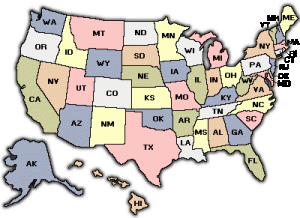
In all, there were primaries in Virginia, Vermont, Ohio, Massachusetts, Georgia, Tennessee and Oklahoma. Caucuses in North Dakota, Idaho and Alaska rounded out the calendar.

Some 419 delegates were at stake in the 10 states.

Based on reporting by the Associated Press

Read more: http://latino.foxnews.com/latino/news/2012/03/06/super-tuesday-mitt-romney-comes-out-on-top-but-faces-challenge-from-rick/#ixzz1oQ4NWOxe

SUBSCRIBE to The Hispanic Blog and stay on top of the latest Latino news, politics and entertainment!

Don’t be shy SUBSCRIBE – COMMENT – LIKE ME -CIRCLE ME AND FOLLOW ME

If you have any questions, concerns or simply would like to get a quote on my Marketing, Public Relations, Social Media and/or Events services, please feel free to contact me at thehispanicblog@gmail.com.

God Bless and may you have a fabulous day!

powered by Influential Access – “Transforming the Ordinary to EXTRAordinary!” – CEO – Jessica Marie Gutierrez – Creator of The Hispanic Blog #thehispanicblog


HOW DID TEXAS COME OUT IN REDISTRICTING: REPUBLICANS VS. DEMOCRATS

THE HISPANIC BLOG IS THE LATEST HISPANIC NEWS BY JESSICA MARIE GUTIERREZ

In Battle for Political Conquest, Ethnicity Sets the Boundaries for Both Parties

photo of Texas State Capitol Building in Austin at night

The political maps are out, finally, and this is as good as it gets for Texas Republicans unless they can figure out how to win votes from black and Hispanic voters.

For the Democrats, this is probably the bottom. They have to find more voters or be forced to continue relying on the ethnicity of their voters — and the protections that come with that ethnicity — to protect the seats they still have.

The Republicans have snapped up everything not nailed down by the federal Voting Rights Act.

Redistricting nods to fairness but is actually about power. It allows a Republican Legislature, for instance, to put a dog collar and a short leash on Democratic voters in Austin.

Travis County is one of just a few Texas counties that voted for Barack Obama for president. In the new Congressional maps, five districts reach into the county (none is based there), and only one is likely to produce a Democratic representative.

As it stands, the county would be represented by two people from Austin, one from San Antonio, one from Georgetown (a suburb) and one from Bryan. One of the Austin residents, Lloyd Doggett, an incumbent Democrat, will face tough opposition from San Antonio; the other, Michael McCaul, an incumbent Republican, has a district that runs east to Houston.

It’s safe to say lawmakers weren’t trying to empower the locals. It makes you wonder why the city of Austin rewards them with free airport parking.

Lawmakers don’t have to be fair. If they did, the court would have repaired the damage. It’s just that the law doesn’t protect geography as carefully as it protects minorities.

In Travis County, the minority populations are too scattered to draw a Congressional district protected by the Voting Rights Act. The seat most likely to elect a Democrat stretches into central San Antonio, and it is uncertain whether Mr. Doggett can prevail over someone from San Antonio. His district wasn’t protected.

The remaining Democratic seats in the state result from legal protections for minority groups that happen to vote for Democrats. The Republicans don’t have the legal ability to take more ground; the Democrats don’t have the political juice to win anything not legally protected.

Maps aren’t everything. Using the current maps, the Republicans got 101 seats in the Texas House; using the same maps two years earlier, they got only 76.

But maps mean a lot. The partisan compositions of the Texas Senate and of the state’s Congressional delegation have changed only marginally between redistricting episodes over the last 20 years. If you want change in those places, the most effective strategy is to change the maps.

The redistricting fights have been about the clout of minority voters. Virtually every legal skirmish was over a district that either is, or arguably should be, one in which minority voters have the power to decide the winners.

With few exceptions, the decision to create or protect a minority district was also a decision about whether it would elect a Republican or a Democrat. Talk about walking on eggshells — every conversation or argument about the maps teeters between politics and race.

This year’s elections will clear up the remaining questions. Mr. Doggett is the last Anglo Democrat in the Congressional delegation who wasn’t elected in a minority opportunity district. If he wins re-election, it will be in a Latino district. (Representative Gene Green, Democrat of Houston, also an Anglo, has represented a Latino district for years.)

The only genuine swing district on the Congressional map is District 23, where Representative Francisco Canseco, Republican of San Antonio, will face the winner of a Democratic primary that could include former United States Representative Ciro Rodriguez, whom Mr. Canseco beat in 2010. That’s a test of whether Republicans can hold a minority district.

United States Representative Blake Farenthold, Republican of Corpus Christi, got a district with a Republican voting history but where a majority of the voters are either black or Latino. That’s another political test tube.

Republicans can’t increase their already stout majorities without winning minority votes or getting rid of the law that protects minority voters. And Democrats have to figure out a way to win in districts drawn by the opposition.

Read more: Ross Ramsey, the executive editor at The Texas Tribune, writes a column for The Tribune article from the NYT

SUBSCRIBE to The Hispanic Blog and stay on top of the latest Latino news, politics and entertainment!

Don’t be shy SUBSCRIBE – COMMENT – LIKE ME -CIRCLE ME AND FOLLOW ME

If you have any questions, concerns or simply would like to get a quote on my Marketing, Public Relations, Social Media and/or Events services, please feel free to contact me at thehispanicblog@gmail.com.

God Bless and may you have a fabulous day!

powered by Influential Access – “Transforming the Ordinary to EXTRAordinary!” – CEO – Jessica Marie Gutierrez – Creator of The Hispanic Blog #thehispanicblog


IS ROMNEY FOR SB1070?

THE HISPANIC BLOG IS THE LATEST HISPANIC NEWS BY JESSICA MARIE GUTIERREZ

For Romney, ‘model’ policy on migration isn’t SB 1070

image source

State Rep. J. M. Lozano said Monday he will switch parties and become a Republican, making him the second South Texas lawmaker to abandon the Democratic Party in what has traditionally been a blue corner of the state.

In a phone interview, Lozano said he plans to formally announce his decision Thursday in Austin and in his home district, which includes Kingsville and stretches along the Gulf Cost to the Rio Grande Valley, near the border with Mexico.

The move further pads the GOP House supermajority, giving the Republicans 102 of 150 seats. But the Legislature is not set to meet again until next year, meaning his switch will matter only if Gov. Rick Perry calls a special session – something Perry says he has no plans to do.

Elected in 2010, Lozano filed for re-election as a Democrat on Nov. 30, just three days after the filing period opened. A second filing period has begun, however, after a legal battle over the Texas redistricting maps delayed the state’s primary until May 29.

Lozano’s district was altered significantly by maps drawn by the Republican-dominated Legislature, but those maps may change again based on the forthcoming decision of a federal court in Washington. The Texas Democratic Party says no other Democrat has filed to challenge Lozano.

Lozano said his decision had less to do with redistricting and more to do with his support of oil and natural gas exploration, his opposition to abortion and other conservative convictions popular with his constituents.

“My job now is to let the Hispanic community know that our values are welcome in the Republican Party,” he said.

Lozano becomes the third Democratic state representative to change parties in less than 18 months. In December 2010, Rep. Allan Ritter of Nederland, east of Houston, became a Republican, as did Rep. Aaron Pena, who represents the Rio Grande Valley community of Edinburg.

Pena has since announced he’s not planning to seek re-election this year, however, after he said the redrawn voting maps made it impossible for a Republican to win in his district.

South Texas has traditionally been a Democratic stronghold, but Lozano said the state party leadership ignored the issues most important to him. The owner of a trio of chicken wing franchises, Lozano was born in Mexico and became a U.S. citizen at 6.

He said he was persuaded to change parities after a conversation this week with George P. Bush, the founder of the Hispanic Republicans of Texas political action committee. He is also the son of former Florida Gov. Jeb Bush and nephew of former President George W. Bush.

“We talked about everything, our lives and how there’s this misconception out there that the Republican Party is not welcome to Hispanics,” Lozano said.

The Texas Democratic Party called Lozano’s decision “unprincipled and cowardly.”

“Just 15 months ago, Lozano was elected to office as a Democrat. The instant things got tough, Lozano jumped ship and joined a party that has betrayed his constituents,” Chairman Boyd Richie said in a statement. “He’s proven he has no core and stands for nothing but his quest to grab and hold power.”

Thank you for reading my post. If you have not registered to vote or know of someone that needs to register, please click on the box to your right that states Voto Latino.

SUBSCRIBE to The Hispanic Blog to stay on top of the latest latino news, politics and entertainment!

Don’t be shy SUBSCRIBE – COMMENT – LIKE ME -CIRCLE ME AND FOLLOW ME

If you have any questions, concerns or simply would like to get a quote on my Marketing, Public Relations, Social Media and/or Events services, please feel free to contact me at thehispanicblog@gmail.com.

God Bless and may you have a fabulous day!

powered by Influential Access – “Transforming the Ordinary to EXTRAordinary!” – CEO – Jessica Marie Gutierrez – Creator of The Hispanic Blog #thehispanicblog

WHO ARE “THE LITTLE BROWN ONES” IN UNISON WITH THE GOP?

THE HISPANIC BLOG IS THE LATEST HISPANIC NEWS BY JESSICA MARIE GUTIERREZ

"More than five years later, Bush, who along with two siblings was dubbed one of “the little brown ones” by his grandfather, former President George H.W. Bush, is in Austin discussing how the 18-month-old Hispanic Republicans of Texas Political Action Committee, which he co-founded, moves ahead after redistricting."

 photo by: Bob Daemmrich George P. Bush, founding board member of the Hispanic Republicans of Texas, pauses at the Austin Club on March 1st, 2012

The seeds of political ascension for a member of the Bush family may have been planted in an Austin eatery whose name conjures up images of Janis Joplin jam sessions.

After Election Day in 2006, George P. Bush — the son of former Gov. Jeb Bush of Florida and the nephew of former President George W. Bush — met with a friend at Threadgill’s to discuss how to propel more Hispanics within the ranks of the Republican Party.

More than five years later, Bush, who along with two siblings was dubbed one of “the little brown ones” by his grandfather, former President George H.W. Bush, is in Austin discussing how the 18-month-old Hispanic Republicans of Texas Political Action Committeewhich he co-founded, moves ahead after redistricting.

“There really wasn’t an entity that was focused on the campaign finance element of Hispanic outreach, nor was there really an entity that was doing the blocking and tackling and mechanics of educating Latinos to actually run for office,” Bush, a 35-year-old lawyer, said of the PAC’s genesis.

Its board includes lawyers, former aides to government officials, advertising executives and a professor, who are working to reach a traditionally blue-collar demographic. Bush said that is part of the message.

“They represent the American dream and are less than a generation from very humble origins,” Bush said of the board members, who have endorsed candidates from myriad backgrounds.

“This organization is also meant to be aspirational, and I think the Hispanic community is aspirational,” said Bush, whose mother is from Mexico.

Democrats say the PAC faces an uphill battle.

“They are delusional if they think they’re making any inroads with Latinos,” said Rebecca Acuña, a Texas Democratic Party spokeswoman. “In Texas, there are 668 Democratic Hispanic elected officials to the 60 in the Republican Party.”

Though Bush is careful when speaking about his own goals, he says he is inextricably linked to politics. For now, however, he is content with his role with the PAC.

His future political success could hinge on how Republicans move forward on specific issues. He supports portions of the DREAM Act, and said he thinks most Republicans would also favor at least certain aspects of it, including a pathway toward legalization for illegal immigrants if they serve in the military.

He also calls himself a “George W. Bush” Republican on other aspects of immigration reform.

“That is essentially securing the border, placing an importance on that,” he said. “In terms of folks already here? Figure out a way where they can be taken out of the shadows and contribute to society and provide an opportunity to contribute and pay their fair share.”

Like his uncle, he also supports the U.S. government’s efforts to aid Mexico in that country’s battles against organized crime.

“My opinion is that we both have a vested national security interest and increasingly [the cartel wars] are infringing upon our national security,” he said. “Therefore, collaboration at the highest level is called for and that means continued collaboration on intelligence and information-sharing.”

It was under President George W. Bush that the U.S. and Mexico signed the Mérida Initiative, an aid package of about $1.5 billion that provides equipment, technology and training to Mexico.

George P. Bush said he wishes he spoke more Spanish, his first language, but it has faded from his life due to a lack of practice. He advocates that Hispanics in America should learn English.

“Whether we like it or not, it is the language of commerce in our country,” he said. “That is not meant to be in a dispirited tone.”

Bush knows speculation about his future will persist. In some circles he has already been dubbed “47.” The talk is flattering, he said.

“I’d love to keep the door open. Politics is in my blood,” he said.

Read More: http://www.texastribune.org/texas-politics/2012-elections/george-p-aims-take-hispanics-higher-gop/

SUBSCRIBE to The Hispanic Blog and stay on top of the latest Latino news, politics and entertainment!

Don’t be shy SUBSCRIBE – COMMENT – LIKE ME -CIRCLE ME AND FOLLOW ME

If you have any questions, concerns or simply would like to get a quote on my Marketing, Public Relations, Social Media and/or Events services, please feel free to contact me at thehispanicblog@gmail.com.

God Bless and may you have a fabulous day!

powered by Influential Access – “Transforming the Ordinary to EXTRAordinary!” – CEO – Jessica Marie Gutierrez – Creator of The Hispanic Blog #thehispanicblog

DID FEDERAL JUDGES FINALLY APPROVE TX REDISTRICTING MAPS?

20120229-085038.jpg photo from Texas Tribune

A federal three-judge panel in San Antonio on Tuesday issued the last remaining sets of Texas political maps that had been at the center of a redistricting dispute, appearing to end uncertainty over the state’s long-delayed primary elections.

The judges released new interim maps for Congressional and State House districts. It had issued a State Senate district map this month.

The legal wrangling over the three sets of maps had thrown much of the state’s political machinery into limbo, as the judges twice pushed back the date of the primary and lawmakers and candidates struggled to campaign without viable electoral maps.

20120229-084612.jpg Joe Cardenas III Former TX State Director of LULAC and one of the main leaders of the Latino Task Force

Minority groups and Democratic lawmakers sued the state in federal court over the maps drawn by the Republican-controlled Legislature, arguing that they discriminated against blacks and Hispanics. Lawyers for Greg Abbott, the Texas attorney general, who is representing the state, have argued that the maps were drawn to help Republicans maintain power, not to discriminate.

At a hearing earlier this month, one of the judges said the primary, which had been set for March 6 and then April 3, would most likely be on May 29. Jacquelyn F. Callanen, the elections administrator for Bexar County, told the judges that elections officials statewide would need the maps by March 3. With all of the maps having been issued before March 3, May 29 appears to be the primary date, though the judges have yet to make the date official.

The court’s new Congressional map is based in large part on a compromise map that the state and lawyers for some of the minority groups had recently agreed to. The court’s map gives blacks and Hispanics three of the state’s four new Congressional seats, but it also appears to weaken the minority voting strength in three other seats that blacks and Hispanics had been competitive in, experts said.

“It clearly is better than the state’s map, but arguably it doesn’t go as far for minorities,” said Michael Li, an election law attorney in Dallas who has followed the case’s developments on his Web site, Txredistricting.org.

20120229-084112.jpg Texas Attorney General Greg Abbott has served as the 50th Attorney General of Texas since December 2, 2002. Prior to his election as Attorney General, he was a Justice on the Texas Supreme Court and a State District Judge in Harris County.

The attorney general said in a statement that the new maps reflect the intent of the Legislature, and he applauded the court for leaving numerous districts as they were drawn by the state and rejecting “the demands by some plaintiffs to draw drastic and overreaching interim maps.”

The federal judges had previously drawn a set of maps that differed from the Legislature’s maps and benefited minorities, but the attorney general asked the Supreme Court to intervene. The Supreme Court ruled in January that the San Antonio judges had not paid enough deference to the Legislature’s maps and sent the case back to the lower court.

Read More: Story from The New York Times

SUBSCRIBE to The Hispanic Blog and stay on top of the latest Latino news, politics and entertainment!

Don’t be shy SUBSCRIBE – COMMENT – LIKE ME -CIRCLE ME AND FOLLOW ME

If you have any questions, concerns or simply would like to get a quote on my Marketing, Public Relations, Social Media and/or Events services, please feel free to contact me at thehispanicblog@gmail.com.

God Bless and may you have a fabulous day!

powered by Influential Access – “Transforming the Ordinary to EXTRAordinary!” – CEO – Jessica Marie Gutierrez – Creator of The Hispanic Blog #thehispanicblog