MONDO GUERRA IS THE WINNER: FROM PROJECT RUNWAY TO NEIMAN MARCUS AND MARIE CLAIRE

THE HISPANIC BLOG IS THE LATEST HISPANIC NEWS BY JESSICA MARIE GUTIERREZ

On Thursday’s “Project Runway All Stars” finale, Mondo Guerra beat out Austin Scarlett and Michael Costello to win the cut-throat fashion design competition.

Photo by Jeff Ball for Vivid Photography Studio

A 5th generation Mexican-American, Guerra has been a fan favorite since he first appeared on the show in Season 8. He’s the first Latino to win in the “Project Runway” franchise. During the All Star finale runway show, Guerra described what went into make his winning collection, “Therapy.” After weeks of stressful design challenges, Guerra said “I needed some therapy, I put all my passion into my work.”

The six piece collection was true to Guerra’s signature design esthetic.  A master of mixing prints, Guerra’s use of black and white geographic patterns and unexpected pops of red wowed the judges. Judge and fashion designer Isaac Mizrahi told Guerra that of the three collections in the finale, his was “the most cohesive, in the whit of it.” Co-founder of fashion label Marchesa, judge Georgina Chapman, couldn’t rave enough about Guerra, calling him a brilliant designer. When host and model Angela Lindvall told Guerra he was the winner, he couldn’t believe it.

Designer Mondo Guerra speaks on the runway at the Project Runway Spring 2011 fashion show during Mercedes-Benz Fashion Week at The Theater at Lincoln Center on September 9, 2010 in New York City.
(September 8, 2010 – Photo by Frazer Harrison/Getty Images North America)

“Being on ‘Project Runway All Stars’ was the hardest thing I’ve done.” Guerra continued, “I came here with such confidence, understanding who I was…but being here has made me realize I can’t…take what I’ve been given for granted.”
Guerra made it into the finale in Season 8 as well, but lost the title to fellow designer Gretchen Jones. While in Season 8 the designer walked away empty handed, Guerra’s ‘All Star’ win has him taking home the biggest prize in “Project Runway” history.Aside from $100,000 in cash, Guerra also received a yearlong guest editor position at fashion magazine Marie Claire and an exclusive boutique in select Neiman Marcus department stores.

Read more: FOX NEWS LATINO

SUBSCRIBE to The Hispanic Blog to stay on top of the latest latino news, politics and entertainment!

Don’t be shy SUBSCRIBE – COMMENT – LIKE ME -CIRCLE ME AND FOLLOW ME

If you have any questions, concerns or simply would like to get a quote on my Marketing, Public Relations, Social Media and/or Events services, please feel free to contact me.

God Bless and may you have a fabulous day!

powered by Influential Access – “Transforming the Ordinary to EXTRAordinary!” – CEO – Jessica Marie Gutierrez – Creator of The Hispanic Blog #thehispanicblog

HOW IMMIGRATION GOT OUT OF CONTROL

THE HISPANIC BLOG IS THE LATEST HISPANIC NEWS BY JESSICA MARIE GUTIERREZ

Prior to 1965 a thriving Bracero Program was in place in which roughly 450,000 persons entered the U.S. from Mexico each year on temporary work visas.  These workers returned to Mexico regularly rather than staying in the U.S., thereby creating a circular flow of legal Mexican migrants.  The program had a lot of problems, however, so immigration reformers with a civil rights agenda successfully shut it down.  But while the program ended in 1965, the business need for this type of labor did not. The result was that Mexican workers continued to enter the country, although now without documentation.  Also in 1965, quantitative limits on immigration from the Western Hemisphere were established. Thus illegal immigration rose after 1965 not because there was a surge in Mexican migration, but because these immigration reforms rebranded legal migrants as undocumented workers and capped the number who could try to enter the country legally.

”]No longer legal guest workers but illegal immigrants, the number apprehended at the U.S.-Mexican borderincreased.  This allowed a new narrative to develop: illegal immigration was a crisis and new policies were desperately needed to stem the flow of the “alien invasion.”  The more this narrative was repeated by politicians, the more the populace supported increasingly stringent immigration and enforcement policies, setting off a chain reaction:  increased apprehensions led to increased calls and better tools for enforcement; increased enforcement led to more apprehensions; and increased apprehensions solidified in the public’s mind that illegal immigration was a growing problem that needed drastic reform.  Moreover, increased enforcement did not really deter people from entering the U.S. from Mexico, but it certainly encouraged them to stay; the conversion from legal migrant to illegal immigrant was complete.

President Kennedy and Secretary of Defense McNamara in an EXCOMM meeting, October 1962.

Second, the U.S. was involved in several Central American countries during the Cold War, which lead to further destabilization in the region and large scale migration north.  While Nicaraguan émigrés were welcome as refugees (since the U.S. disagreed with the leftist government they were fleeing), others from Salvador, Guatemala, and Honduras encountered the same restrictions for legal entry as Mexicans. After the 1990s, the threat of terrorism intensified border enforcement and brought about a sharp rise in deportations from the U.S.  Deportations replaced border apprehensions as “proof” that a Latino threat loomed.

November 6, 1986: President Reagan in the Roosevelt Room signing S. 1200 Immigration Reform and Control Act of 1986 with Dan Lungren Strom Thurmond George Bush Romano Mazzoli and Alan Simpson looking on.

Third, Latin American legal immigration – led by Mexico—was also on the rise after 1965, and particularly after 1986.  Again, this was not a result of a conscious policy effort, but rather an unintended consequence of the various immigration reforms. Due to concerns about terrorism and a growing xenophobia, Congress began in the 1980s to strip civil, social, and economic rights away from legal immigrants.  As it became increasingly problematic to be in the U.S. but not a citizen, the numbers seeking to naturalize increased.  This happened just as millions of former undocumented migrants became eligible to naturalize after receiving permanent residence under the Immigration Reform and Control Act (IRCA) of 1986. Adding to the numbers was a separate policy that exempted family members (spouses, minor children and parents) of U.S. citizens from country quotas as part of a family reunification effort.

The authors end the article noting the massive demographic transformation that has resulted from these unintended consequences – a rise in the Hispanic population from 9.6 million to 50.5 million.  They offer a counterfactual scenario, in which the Bracero Program was improved, not abolished, and the U.S. stayed out of Central America; the result might have been a smaller illegal population and a less divided country when the terrorists attacked.  More might have continued to cross the border legally and for temporary stays, resulting in fewer permanent immigrants, less undocumented migration, and slower population growth.  Amazingly – almost despite ourselves—we may actually be headed that way as both illegal and legal entries have fallen while temporary guest worker entry has risen.

The next step is for the U.S. to find a way to deal with the remaining legacy of failed policies – undocumented residents who number 11 million.  Of those, 3 million entered as children.  The authors argue that they should receive amnesty – such as that would have been granted in the Dream Act—while the adults should be able to participate in an earned legalization program.  As the Massey/Pren paper shows, a large number of permanent undocumented people is not a good situation for the country—and the next policy solution should aim to solve not create more problems.

Article by Douglas S. Massey, the Wilson School’s Henry G. Bryant Professor of Sociology and Public Affairs, and Karen A. Pren, Project Manager, Mexican Migration Project at Princeton’s Office of Population Research, argues that the post-1965 surge in Mexican, Central American, and to a lesser extent South American immigration was not a direct result of policy reforms enacted in the mid-1960s but rather the unintended consequences that unfolded afterward.

READ MORE: Hispanically Speaking News

SUBSCRIBE to The Hispanic Blog to stay on top of the latest latino news, politics and entertainment!

Don’t be shy SUBSCRIBE – COMMENT – LIKE ME -CIRCLE ME AND FOLLOW ME

If you have any questions, concerns or simply would like to get a quote on my Marketing, Public Relations, Social Media and/or Events services, please feel free to contact me at thehispanicblog@gmail.com.

God Bless and may you have a fabulous day!

powered by Influential Access – “Transforming the Ordinary to EXTRAordinary!” – CEO – Jessica Marie Gutierrez – Creator of The Hispanic Blog #thehispanicblog

LEARN A SECOND AND EVEN A THIRD LANGUAGE

THE HISPANIC BLOG IS THE LATEST HISPANIC NEWS BY JESSICA MARIE GUTIERREZ

It’s Politics: Dual-Language immersion program

With the rise of the global economy, school districts across the nation and plenty within the San Gabriel Valley have adopted dual-language immersion programs. The idea is simple: teach children a foreign language when their brains are still developing. From what experts in language development tell us, those dual-language learners will not only learn a second language, but will demonstrate an even greater mastery of their native tongue.

And it’s no surprise which languages are most popular with parents who choose to enroll their children in dual-language programs: Spanish and Mandarin (Chinese). The Latino population in the U.S. exploded in the last 20 years and it shows little signs of shrinking. Meanwhile, China has lent us enough money that it wouldn’t surprise anyone if the Yuan replaces the dollar as the world’s reserve currency. But what about teaching the children a third language? One that will benefit them every election cycle.

How about we teach the kids Politician Pig Latin? We have all heard Politician Pig Latin, the language of buzzwords, jargon and ambiguous phrases which politicians use during stump speeches and press conferences. It’s a language riddle with multi-syllabic words which say absolutely nothing. You have heard some of the words: “stakeholders,” “partners” “outreach” and “community buy-in.” The standards English definitions of these words don’t apply when translated from politician Pig Latin.

For example, “Stakeholder” is voting citizen who gave to the winning official’s campaign. A “Partner” is a local business person, and a voter, who gave enough money that when he or she calls, the elected official might pick up the phone. “Outreach” is a Facebook page or website enabled with a PayPal account. “Community buy-in” roughly translates into a meeting with the public scheduled at a time when those opposing the politician’s plan can’t show up. In newsrooms, we have seen the press releases written completely in Politician Pig Latin:
“I have long championed the need to balance our budget and pay down our debt, and will continue to do so,” wrote one local lawmaker in recent a press release.

Huh? The part about a “balanced budget”, clear. The part about “paying down our debt” , got it. But championed … what? Did this elected win some belt or a sports title? Merriam Webster defines championed as someone who “protects or fights for, as a champion.” The second definition is one who acts as a “militant supporter” for a cause. I doubt our elected leaders are “militant” supporters of anything. But the direct translation of “championed” from Politician Pig Latin to English is “one who barks really loud on the floor of a legislative body to pass a law, but achieves little actual success.”
Politician Pig Latin is not the hardest language to learn, but with all the things people are tasked with during the day – working, paying bills, raising children and picking those kids up from roller hockey – who has the time to learn another language as an adult? And I have yet to see a class in Politician Pig Latin at a local community college. Maybe it’s time we start equipping our children with the skills to decipher what our elected leaders are actually talking about. They might even grow up to make informed choices.

READ MORE: SGV Tribune

SUBSCRIBE to The Hispanic Blog to stay on top of the latest latino news, politics and entertainment!

Don’t be shy SUBSCRIBE – COMMENT – LIKE ME -CIRCLE ME AND FOLLOW ME

God Bless and may you have a fabulous day!

powered by Influential Access – “Transforming the Ordinary to EXTRAordinary!” – CEO – Jessica Marie Gutierrez – Creator of The Hispanic Blog #thehispanicblog

WHAT IS THE “SECURE COMMUNITIES” ACT: DON’T MEND IT…END IT!

THE HISPANIC BLOG IS THE LATEST HISPANIC NEWS BY JESSICA MARIE GUTIERREZ

Photo courtesy of ICE

Any day now Immigration and Customs Enforcement (ICE) will announce a second round of “reforms” to the disgraced “Secure Communitiesdeportation program, S-Comm. And once again, it appears that ICE is more interested in spin than substance. The timing of the announcement–immediately before the DHS Office of Inspector General Report–seems primarily designed to take the pressure off of ICE rather than an honest attempt to address the fundamental flaws of the program.

We’ve been here before. In 2010, ICE tried the same tactic by announcing “reforms” to S-COMM’s predecessor, the 287(g) program to try to save the agency from the embarrassment of that year’s Inspector General report that described the program as an unmitigated disaster.

“Secure Communities” turns local police into defacto agents of deportation, forcing them to enforce unjust immigration laws, inviting racial profiling, and undermining community safety. It’s a program that has been leading to the “Arizonification” of the country, and has placed ICE under fire since it’s start in 2008. The only way forward on S-Comm is termination.

Since its inception, “Secure Communities” has gained fame for outright deception, starting with its very name. And now, after the release of thousands of internal emails and the agency’s own deportation data, there is no longer any doubt that ICE lied to local lawmakers, Congress, and the American public.

So-called “Secure Communities”, “S-Comm” or “In-Secure Communities” as it has been dubbed is the most recent attempt of ICE-DHS to control the immigration “problem”. This anti-immigrant program allows Immigration and Customs Enforcement (ICE), the Federal Bureau of Investigation (FBI) and local law enforcement agencies to share all fingerprints processed at local jails. This mandated sharing occurs regardless of the type of crime and even if the charges are dropped. The inaccurately named program, “Secure Communities” was said to have been initiated to target “level one” criminals (kidnappers, drug dealers, murders), but in practice has been successful in targeting jay-walkers, victims of domestic violence, mentally challenged citizens, and those who do not look “American”.

So why is the Administration holding on to a program that has a very public record of deception? One that law enforcement officers, Governors, cities, and Congressional representatives reject as damaging to public safety. And why is it continuing to operate the program in places like Georgia, with its unconstitutional anti-immigrant hate law, HB 87, while finally suspending it–at least partially–in Alabama and restricting it in Maricopa County? Clearly, this violates common sense. It also demonstrates a distorted sense of priorities.

Janet Napolitano announces record high deportations at ICE headquarters in Washington. Photo: Getty Images/Chip Somodevilla

In its blind quest to meet its arbitrary deportation quota of 400,000 people per year, the Obama Administration is driving a wedge between communities and local police, making it more difficult to solve crimes, and turning a blind eye to the fact that people are being placed into deportation through unconstitutional arrests. Civil immigration enforcement above public safety and constitutional protections? Really?

The upcoming announcement will be a significant opportunity for the President to demonstrate leadership on a program that has come to symbolize his broken immigration promises. Will it be business as usual or will the Obama Administration finally abandon their growing legacy of deportation? Will the Obama Administration stop attempting to convince the public that ICE may reform itself, despite every indicator that it’s incapable? Will the Obama Administration embrace the consensus against S-Comm or continue gripping onto the program despite its failure?

The next few days will tell. For the communities that are left to cope with the disasters of the Administration’s draconian immigration enforcement policies, the commitment to break ICE’s hold continues regardless of this month’s announcement. Communities reeling from this growing crisis have already documented the conclusive demand that S-COMM be terminated. Their pledge to restore trust and to break ICE’s hold on their community and the country will only grow stronger.

READ MORE: THE HUFFINGTON POST 

SUBSCRIBE to The Hispanic Blog to stay on top of the latest latino news, politics and entertainment!

Don’t be shy SUBSCRIBE – COMMENT – LIKE ME -CIRCLE ME AND FOLLOW ME

If you have any questions, concerns or simply would like to get a quote on my Marketing, Public Relations, Social Media and/or Events services, please feel free to contact me at thehispanicblog@gmail.com.

God Bless and may you have a fabulous day!

powered by Influential Access – “Transforming the Ordinary to EXTRAordinary!” – CEO – Jessica Marie Gutierrez – Creator of The Hispanic Blog #thehispanicblog

HISPANIC NETWORKS MADE $88 MILLION IN NEW BUSINESS LAST YEAR

THE HISPANIC BLOG IS THE LATEST HISPANIC NEWS BY JESSICA MARIE GUTIERREZ

The race is on to capture the U.S. Hispanic market, with mainstream networks and their Hispanic counterparts battling for primacy. The result is an increasing cross-pollination of programs and a proliferation of networks, with Fox, Lionsgate and NBCU among those joining Hispanic allies to find and produce content aimed at the largest and fastest-growing minority group in the U.S.

New Hispanic channels are emerging, some in Spanish, some in English, in a bid to appeal to a mix of generations and language preferences that can exist under one Latino roof: The latest census reveals that of the 50.5 million Hispanics in the U.S., 30% are Spanish-dominant while the rest are either English-speaking or bilingual.

Broadcast leader Univision is now the clear No. 5 broadcast network (behind the Big Four) while rival Telemundo has been picking up steam.

'Q'Viva'‘Q’Viva’

“The number of networks focused on the Spanish space has increased from around 12 in 2001 to 100 just a month ago,” says Univision networks prexy Cesar Conde, who points out that Univision alone will have a dozen networks by year’s end compared with three last year.

These include Univision’s upcoming news and sports pay TV nets in addition to the telenovela channel now on Dish Network plus the six TuTV pay TV channels, jointly owned with Televisa.

One of the most anticipated new players is MundoFox, a joint venture between Fox Intl. Channels (FIC) and Colombia’s RCN, due to launch in the fall. The new Spanish-lingo network will showcase edgier Colombian telenovelas and look to build on Fox’s success in inserting itself into a market. Meanwhile, Fox and Univision recently bowed Jennifer Lopez and Marc Anthony’s pan-American talent competish “Q’Viva! The Chosen,” while Fox’s “Family Guy” airs on Univision sibling web TeleFutura.

Elsewhere, sister networks NBC and Telemundo share talent and resources in the exec ranks as well as on-air.

In the 2011-12 upfront season, an estimated $88 million of new business came to Spanish-Language TV, with Telemundo taking more than half (55%) of the new business, according to Lauren Zalaznick, chairman of NBCUniversal entertainment, digital networks and integrated media.

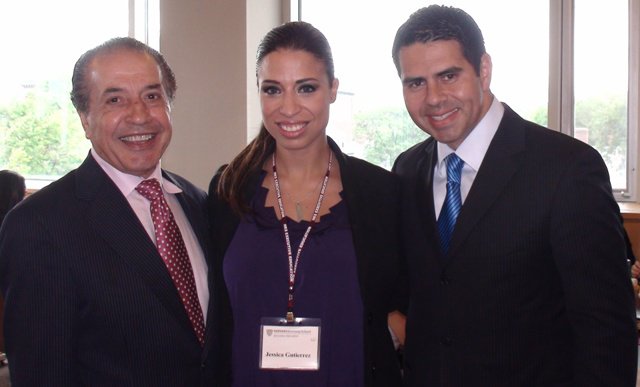
GUTIERREZ (CREATOR OF THE HISPANIC BLOG) WITH CESAR CONDE PRESIDENT OF UNIVISION

“The reported 2011/2012 upfront numbers were $1.75 billion for Univision, and $400 million for Telemundo, up 20% from the 2010/2011 upfront,” says Antonio Ruiz, partner-communications planning at leading Hispanic ad agency, the Vidal Partnership. Telemundo and its youth-skewed bicultural cable sibling Mun2 delivered more than 20% growth year-to-year, marking their best upfront season ever.

“Our Hispanic strategy is not limited to Telemundo (or Mun2) alone,” says Zalaznick, who points out that NBCUniversal’s theme parks, studio, cable and broadcast networks, digital assets and Comcast’s leading position among cablers in the U.S. allows the company to collectively reach 93% of all Hispanics. She adds that landing the Spanish-language U.S. rights to World Cup Soccer matches in 2018 and 2022 would not have happened without the joint efforts of NBC Sports and Telemundo Deportes.

NBCU parent Comcast has begun to fulfill its pledge to launch 10 independently owned channels on its cable systems over the next eight years. Of these, four will have Hispanic ownership.

Leading the initial pack is young-male-skewed El Rey from Latino helmer Robert Rodriguez and partners John Fogelman and Cristina Patwa of FactoryMade Ventures.

“When Fogelman approached me with the idea for this channel, I immediately said yes,” says Rodriguez. He’s building soundstages on his 25-acre property in Austin for the English-language channel, which will include animation, music, reality, scripted shows, movies, docus and sports programming.

“The key is to make it universal; I want viewers to watch it because it’s cool, not Latino,” adds Rodriguez.

Another upcoming Latino-owned Comcast network is BabyFirst Americas from Spanish-lingo TV exec Constantino “Said” Schwarz, which is slated to launch by April.

Meanwhile, Lionsgate and Mexican partner Televisa have expanded their joint film venture, Pantelion Films, onto the smallscreen as well. (Over the March 16-18 weekend, Pantelion scored big at the B.O. with “Casa de mi Padre,” which nabbed $2.4 million on 382 screens.) The partnership will include English-lingo format adaptations of TV content from Televisa’s library, and the development of scripted and unscripted English-language original programming.

The companies have set up a hefty development fund to enable them to attract top showrunners and talent for an average output of six to eight projects a year, including the sitcom spinoff of Pantelion’s debut pic, “From Prada to Nada”; “Badlands,” a scripted drama at ABC based on Televisa hit telenovela “Soy tu Duena“; Televisa’s drama skein “Terminales” for ABC Family; and “Teresa,” based on another Televisa telenovela.

Univision, an erstwhile strictly Spanish-language network, recently began providing English close-captioning for its primetime block of telenovelas and other programs, including long-running variety show “Sabado Gigante.” The network is a ratings winner, especially among adults 18-34, where its season average is double struggling English-language broadcaster CW (1.6 vs. 0.8) and is now within shouting distance of ABC, CBS and NBC. (No. 2 Hispanic-language net Telemundo has been offering English closed captions in its primetime block since 2004.)

“Forty-two of the top 50 shows are already watched by bilinguals on Univision,” says Conde.

But U.S.-partnered players aren’t the only ones gearing up to deliver Latino shows to the U.S.: Venezuela’s RCTV, once the oldest and most dominant broadcaster in Venezuela until president Hugo Chavez shuttered it for allegedly inciting rebellion, revived its production capabilities in October, keenly aware of the growing interest in Latino-themed stories.

RCTV Intl. head Jorge Granier is opening a Los Angeles office and has been meeting with showrunners and talent agencies to package English-language versions of RCTV telenovelas selected from its trove of 300 titles.

Latin America’s wealth of talent, formats, stories and programming innovations has not been fully tapped in the U.S., says Joshua Mintz, exec VP of Telemundo Studios, which is churning out six to seven telenovelas a year, mainly in Miami. Mintz points to ABC’s hit adaptation of Colombia’s “Ugly Betty” and, most recently, Fox Television Studios plans for an English-lingo version of “La Reina del Sur,” Telemundo’s biggest hit telenovela.

“If the U.S. TV industry needs new stories to tell, it doesn’t need to look any further than Latin America,” Granier says.”

READ MORE: VARIETY

SUBSCRIBE to The Hispanic Blog to stay on top of the latest latino news, politics and entertainment!

Don’t be shy SUBSCRIBE – COMMENT – LIKE ME -CIRCLE ME AND FOLLOW ME

If you have any questions, concerns or simply would like to get a quote on my Marketing, Public Relations, Social Media and/or Events services, please feel free to contact me at thehispanicblog@gmail.com.

God Bless and may you have a fabulous day!

powered by Influential Access – “Transforming the Ordinary to EXTRAordinary!” – CEO – Jessica Marie Gutierrez – Creator of The Hispanic Blog #thehispanicblog