
THE HISPANIC BLOG IS THE LATEST HISPANIC NEWS BY JESSICA MARIE GUTIERREZ
Meth in Mexico: A Turning Point in the Drug War?

photo by cbs/associated press
The Largest Seizure of Methamphetamine in Mexican History
Mexican authorities announced Feb. 8 the largest seizure of methamphetamine in Mexican history — and possibly the largest ever anywhere — on a ranch outside of Guadalajara. The total haul was 15 tons of pure methamphetamine along with a laboratory capable of producing all the methamphetamine seized. While authorities are not linking the methamphetamine to any specific criminal group, Guadalajara is a known stronghold of the Sinaloa Federation, and previous seizures there have been connected to the group.
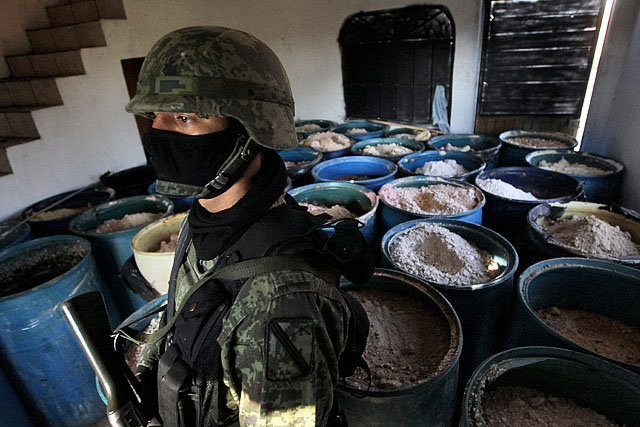
photo by Bruno Gonzalez from the Associated Press - A soldier stands in a room full of barrels containing white and yellow powder Thursday after the seizure of a small ranch in Tlajomulco de Zuniga, on the outskirts of Guadalajara, Mexico. According to the Mexican army, 15 tons of pure methamphetamine were seized at the ranch, an amount equivalent to half of all meth seizures worldwide in 2009.
Methamphetamine, a synthetic drug manufactured in personal labs for decades, is nothing new in Mexico or the United States. The U.S. Drug Enforcement Administration (DEA) has led numerous crusades against the drug, increasing regulations on its ingredients to try to keep it from gaining a foothold in the United States. While the DEA’s efforts have succeeded in limiting production of the drug in the United States, consumption has risen steadily over the past two decades. The increasing DEA pressure on U.S. suppliers and the growing demand for methamphetamine have driven large-scale production of the drug outside the borders of the United States. Given Mexico’s proximity and the pervasiveness of organized criminal elements seeking new markets, it makes sense that methamphetamine would be produced on an industrial scale there. Indeed, Mexico has provided an environment for a scale of production far greater than anything ever seen in the United States.
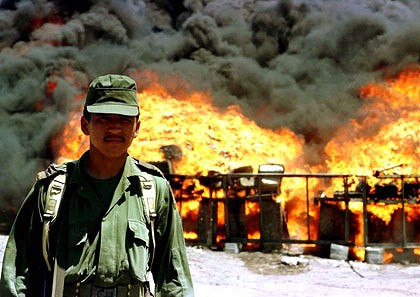
Cocaine trail ... a soldier stands guard as seized cocaine is burnt in Matamoros, Mexico. Photo: Gerardo Magallon
Authorities believe one of the world's most powerful and notorious Mexican drug cartels, the Sinaloa, has infiltrated Australia. Read more: http://www.smh.com.au/national/mexicos-most-wanted-man-taking-over-cocaine-trade-20100914-15azd.html#ixzz1mbdaIp9M
But last week’s methamphetamine seizure sheds light on a deeper shift in organized criminal activity in Mexico — one that could mark a breakthrough in the violent stalemate that has existed between the Sinaloa Federation, Los Zetas and the government for the past five years and has led to an estimated 50,000 deaths. It also reveals a pattern in North American organized crime activity that can be seen throughout the 20th century as well as a business opportunity that could transform criminal groups in Mexico from the drug trafficking intermediaries they are today to controllers of an independent and profitable illicit market.

Dark yellow is where Zetas control light yellow portion is disputed territory photo from wikipedia
While the trafficking groups in Mexico are commonly called “cartels,” they are not really cartels. A cartel is a combination of groups cooperating to control the supply of a commodity. The primary purpose of a cartel is to set the price of a commodity so that buyers cannot negotiate lower prices. The current conflict in Mexico over cocaine and marijuana smuggling routes shows that there are deep rifts between rival groups like the Sinaloa Federation and Los Zetas. There is no sign that they are cooperating with each other to set the price of cocaine or marijuana. Also, since most of the Mexican criminal groups are involved in a diverse array of criminal activities, their interests go beyond drug trafficking. They are perhaps most accurately described as “transnational criminal organizations” (TCOs), the label currently favored by the DEA.
Examples from the Past

photo from Hub Pages - FARC girl with gun
While the level of violence in Mexico right now is unprecedented, it is important to remember that the Mexican TCOs are businesses. They do use violence in conducting business, but their top priority is to make profits, not kill people. The history of organized crime shows many examples of groups engaging in violence to control an illegal product. During the early 20th century in North America, to take advantage of Prohibition in the United States, organized criminal empires were built around the bootlegging industry. After the repeal of Prohibition, gambling and casinos became the hot market. Control over Las Vegas and other major gambling hubs was a business both dangerous and profitable. Control over the U.S. heroin market was consolidated and then dismantled during the 1960s and 1970s. Then came cocaine and the rise in power, wealth and violence of Colombian groups like the Medellin and Cali cartels.
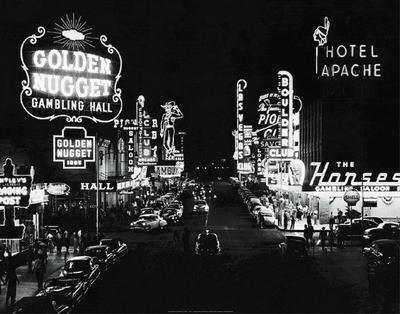
photo by vegasondemand.com
But as U.S. and Colombian law enforcement cracked down on the Colombian cartels — interdicting them in Colombia and closing down their Caribbean smuggling corridors — Colombian producers had to turn to the Mexicans to traffic cocaine through Mexico to the United States. To this day, however, Colombian criminal groups descended from the Medellin and Cali cartels control the cultivation and production of cocaine in South America, while Mexican groups increasingly oversee the trafficking of the drug to the United States, Europe and Africa.

The Mexican Weakness
While violence has been used in the past to eliminate or coerce competitors and physically take control of an illegal market, it has not proved to be a solution in recent years for Mexican TCOs. The Medellin cartel became infamous for attacking Colombian state officials and competitors who tried to weaken its grasp over the cocaine market. Going back further, Benjamin “Bugsy” Siegel is thought to have been murdered over disagreements about his handling of the Flamingo Hotel in Las Vegas.


The Flamingo Hotel, Las Vegas, 1946. It was Siegel's last big project. When the hotel-casino failed to bring an immediate profit, it was the end for Bugsy.
Before that, Prohibition saw numerous murders over control of liquor shipments and territory. In Mexico, we are seeing an escalating level of such violence, but few of the business resolutions that would be expected to come about as a result. Geography helps explain this. In Mexico, the Sierra Madre mountain range splits the east coast and the west from the center. The Gulf of Mexico and the Pacific Ocean coastal plains tend to develop their own power bases separate from each other.

Mexican drug traffickers are also split by market forces. With Colombian criminal groups still largely controlling the production of cocaine in jungle laboratories, Mexican traffickers are essentially middlemen. They must run the gauntlet of U.S.-led international interdiction efforts by using a combination of Central American traffickers, corruption and street-gang enforcers. They also have to move the cocaine across the U.S. border, where it gets distributed by hundreds of street gangs.

Profit is the primary motivation at every step, and each hurdle the Mexican traffickers have to clear cuts into their profit margins. The cocaine producers in Colombia, Peru and Bolivia can play the Sinaloa Federation and Los Zetas (as well as others) off of each other to strengthen their own bargaining position. And even though keeping the traffickers split appears to create massive amounts of violence in Mexico, it benefits the politicians and officials there, who can leverage at least the presence of a competitor for better bribes and payoffs.
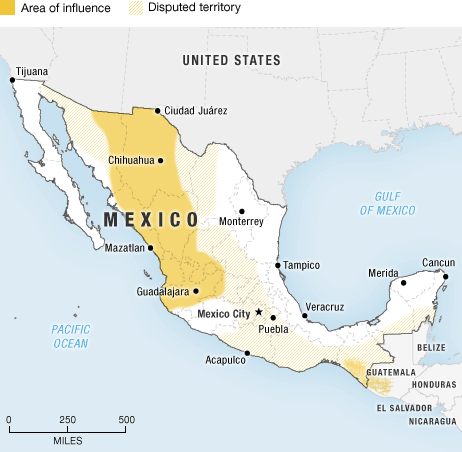
Sinaloa cartel in dark yellow light yellow is disputed territory photo from wikipedia
For Mexican drug traffickers, competition is bad for the bottom line, since it allows other actors to exploit each side to get a larger share of the market. Essentially, everyone else in the cocaine market benefits by keeping the traffickers split. The more actors involved in cocaine trafficking, the harder it is to control it.
The Solution
Historically, organized criminal groups have relied on control of a market for their source of wealth and power. But the current situation in Mexico, and the cocaine trade in general, prevents the Mexican groups (or anyone) from controlling the market outright. As long as geography and market forces keep the traffickers split, all sides in Mexico will try to use violence to get more control over territory and market access.

Mexican federal police lead suspected members of the 'Familia Michoacana' drug cartel to a news conference at the federal police center in Mexico City Photo: REUTERS
Mexican criminal organizations can overcome their weakness in the cocaine market by investing the money they have earned (billions of dollars, according to the most conservative estimates) into the control of other markets. Ultimately, cocaine is impossible for the Mexicans to control because the coca plant can only grow in sufficient quantity in the foothills of the Andes. It would be prohibitively expensive for the Mexicans to take over control of coca cultivation and cocaine production there. Mexican criminal organizations are increasing their presence in the heroin market, but while they can grow poppies in Mexico and produce black-tar heroin, Afghanistan still controls a dominant share of the white heroin market — around 90 percent.

In 2009, shark carcasses were stuffed with 894 kilograms of cocaine. A month later, Costa Rican authorities also seized another 419 kilos of cocaine from a fisherman, who carried the drug in refrigerated truck, hidden beneath the layers of red snapper and shark.
What Mexicans can control is the methamphetamine market. What we are seeing in Mexico right now — unprecedented amounts of the seized drug — is reminiscent of what we saw over the past century in the infancy of the illegal liquor, gambling, heroin and cocaine markets: an organized criminal group industrializing production in or control of a loosely organized industry and using that control to set prices and increase its power. Again, while illegal methamphetamine has been produced in the United States for decades, regulatory pressure and law enforcement efforts have kept it at a small scale; seizures are typically measured in pounds or kilograms and producers are on the run.

Display of methamphetamine seized in Project Coronado: Source: DEA
Mexican producers have also been in the market for a long time, but over the past year we have seen seizures go from being measured in kilograms to being measured in metric tons. In other words, we are seeing evidence that methamphetamine production has increased several orders of magnitude and is fast becoming an industrialized process.

Credit: Photo courtesy Customs & Border Protection.
Customs and Border Patrol officials find 25 pounds of methamphetamine smuggled from Mexico in a Mercedes tire in February, 2010.
In addition to the 15 tons seized last week, we saw a record seizure of 675 tons of methylamine, a key ingredient of methamphetamine, in Mexico in December. From 2010 to 2011, seizures of precursor chemicals like methylamine in Mexico increased 400 percent, from 400 tons to 1,600 tons. These most recent reports are similar to reports in the 1920s of U.S. liquor seizures going from barrels to shiploads, which indicated bootlegging was being conducted on an industrial scale. They are also eerily similar to the record cocaine seizure in 1984 in Tranquilandia, Colombia, when Colombian National Police uncovered a network of jungle cocaine labs along with 13.8 metric tons of cocaine. It was the watershed moment, when authoritiesmoved from measuring cocaine busts in kilograms to measuring them in tons, and it marked the Medellin cartel’s rise to power over the cocaine market.
A True Mexican Criminal Industry?
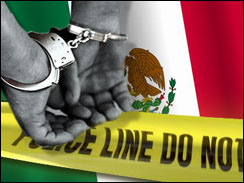
generic mexico arrest handcuffs border immigration smuggling bounty (CBS/AP)
Anyone can make methamphetamine, but it is a huge organizational, financial and legal challenge to make it on the industrial level that appears to be happening in Mexico. The main difference between the U.S. labs and the Mexican labs is the kind of input chemicals they use. The U.S. labs use pseudoephedrine, a pharmaceutical product heavily regulated by the DEA, as a starting material, while Mexican labs use methylamine, a chemical with many industrial applications that is more difficult to regulate. And while pseudoephedrine comes in small individual packages of cold pills, methylamine is bought in 208-liter (55-gallon) barrels. The Mexican process requires experienced chemists who have mastered synthesizing methamphetamine on a large scale, which gives them an advantage over the small-time amateurs working in U.S. methamphetamine labs.

photo by the Joint Interagency Task Force - West
Thus, while methamphetamine consumption has been steadily growing in the United States for the past two decades — and at roughly $100 per gram, unpure methamphetamine is just as profitable on the street as cocaine — it is even more profitable for Mexican traffickers. Methamphetamine does not come with the overhead costs of purchasing cocaine from Colombians and trafficking valuable merchandise through some of the most dangerous countries in the Western Hemisphere. Precursor materials such as methylamine used in methamphetamine production are cheap, and East Asian producers appear to be perfectly willing to sell the chemicals to Mexico. And because methamphetamine is a synthetic drug, its production does not depend on agriculture like cocaine and marijuana production does. There is no need to control large swaths of cropland and there is less risk of losing product to adverse weather or eradication efforts.

In Mexico City, the military has a museum used to train officials, diplomats and cadets about the war on drugs. Samples of various drugs including cocaine are labeled in a glass case. (Sarah L. Voisin/The Washington Post)
For the Mexican TCOs, industrializing and controlling the methamphetamine market offers a level of real control over a market that is not possible with cocaine. We expect fighting over the methamphetamine market to maintain violence at its current levels, but once a group comes out on top it will have far more resources to expel or absorb rival TCOs. This process may not sound ideal, but methamphetamine could pick the winner in the Mexican drug war.
Read More: Stratfor
SUBSCRIBE to The Hispanic Blog and stay on top of the latest Latino news, politics and entertainment!
Don’t be shy SUBSCRIBE – COMMENT – LIKE ME -CIRCLE ME AND FOLLOW ME
If you have any questions, concerns or simply would like to get a quote on my Marketing, Public Relations, Social Media and/or Events services, please feel free to contact me at thehispanicblog@gmail.com.
God Bless and may you have a fabulous day!
powered by Influential Access – “Transforming the Ordinary to EXTRAordinary!” – CEO – Jessica Marie Gutierrez – Creator of The Hispanic Blog #thehispanicblog


 The founding of the
  LULAC is set apart from its peer organizations in the Hispanic community by its political ideology. The founders of LULAC respected the precepts on which the United States was established, including the writings of the country’s founding fathers, and in an effort to imbue LULAC with the same spirit of purpose and opportunity that is the foundation of American democracy and free enterprise, they praised the nation in well-crafted written statements and speeches. This deference toward the American way of life was done largely, in the beginning, to placate the American public’s suspicion of the organization’s motives and to satisfy the personal beliefs and political preferences of the League’s membership. Officers and members of LULAC were required to take an oath swearing their loyalty to
  The founders of LULAC were economic conservatives who viewed racial discrimination, not class domination, as the primary cause of
  In the 1960s LULAC councils built more than two dozen housing projects to provide affordable housing to low income families. LULAC and the American GI Forum created SER-Jobs for Progress, the premiere Hispanic employment training program in 1966. Today SER provides employment and training services through more than forty-three employment centers located throughout the United States and Puerto Rico. In 1968 LULAC created the
  Jessica Marie Gutierrez




 THE HISPANIC BLOG
