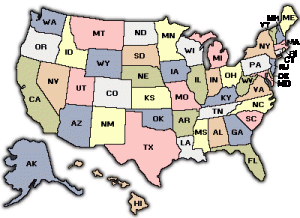
HOW DID TEXAS COME OUT IN REDISTRICTING: REPUBLICANS VS. DEMOCRATS

THE HISPANIC BLOG IS THE LATEST HISPANIC NEWS BY JESSICA MARIE GUTIERREZ

In Battle for Political Conquest, Ethnicity Sets the Boundaries for Both Parties

photo of Texas State Capitol Building in Austin at night

The political maps are out, finally, and this is as good as it gets for Texas Republicans unless they can figure out how to win votes from black and Hispanic voters.

For the Democrats, this is probably the bottom. They have to find more voters or be forced to continue relying on the ethnicity of their voters — and the protections that come with that ethnicity — to protect the seats they still have.

The Republicans have snapped up everything not nailed down by the federal Voting Rights Act.

Redistricting nods to fairness but is actually about power. It allows a Republican Legislature, for instance, to put a dog collar and a short leash on Democratic voters in Austin.

Travis County is one of just a few Texas counties that voted for Barack Obama for president. In the new Congressional maps, five districts reach into the county (none is based there), and only one is likely to produce a Democratic representative.

As it stands, the county would be represented by two people from Austin, one from San Antonio, one from Georgetown (a suburb) and one from Bryan. One of the Austin residents, Lloyd Doggett, an incumbent Democrat, will face tough opposition from San Antonio; the other, Michael McCaul, an incumbent Republican, has a district that runs east to Houston.

It’s safe to say lawmakers weren’t trying to empower the locals. It makes you wonder why the city of Austin rewards them with free airport parking.

Lawmakers don’t have to be fair. If they did, the court would have repaired the damage. It’s just that the law doesn’t protect geography as carefully as it protects minorities.

In Travis County, the minority populations are too scattered to draw a Congressional district protected by the Voting Rights Act. The seat most likely to elect a Democrat stretches into central San Antonio, and it is uncertain whether Mr. Doggett can prevail over someone from San Antonio. His district wasn’t protected.

The remaining Democratic seats in the state result from legal protections for minority groups that happen to vote for Democrats. The Republicans don’t have the legal ability to take more ground; the Democrats don’t have the political juice to win anything not legally protected.

Maps aren’t everything. Using the current maps, the Republicans got 101 seats in the Texas House; using the same maps two years earlier, they got only 76.

But maps mean a lot. The partisan compositions of the Texas Senate and of the state’s Congressional delegation have changed only marginally between redistricting episodes over the last 20 years. If you want change in those places, the most effective strategy is to change the maps.

The redistricting fights have been about the clout of minority voters. Virtually every legal skirmish was over a district that either is, or arguably should be, one in which minority voters have the power to decide the winners.

With few exceptions, the decision to create or protect a minority district was also a decision about whether it would elect a Republican or a Democrat. Talk about walking on eggshells — every conversation or argument about the maps teeters between politics and race.

This year’s elections will clear up the remaining questions. Mr. Doggett is the last Anglo Democrat in the Congressional delegation who wasn’t elected in a minority opportunity district. If he wins re-election, it will be in a Latino district. (Representative Gene Green, Democrat of Houston, also an Anglo, has represented a Latino district for years.)

The only genuine swing district on the Congressional map is District 23, where Representative Francisco Canseco, Republican of San Antonio, will face the winner of a Democratic primary that could include former United States Representative Ciro Rodriguez, whom Mr. Canseco beat in 2010. That’s a test of whether Republicans can hold a minority district.

United States Representative Blake Farenthold, Republican of Corpus Christi, got a district with a Republican voting history but where a majority of the voters are either black or Latino. That’s another political test tube.

Republicans can’t increase their already stout majorities without winning minority votes or getting rid of the law that protects minority voters. And Democrats have to figure out a way to win in districts drawn by the opposition.

Read more: Ross Ramsey, the executive editor at The Texas Tribune, writes a column for The Tribune article from the NYT

SUBSCRIBE to The Hispanic Blog and stay on top of the latest Latino news, politics and entertainment!

Don’t be shy SUBSCRIBE – COMMENT – LIKE ME -CIRCLE ME AND FOLLOW ME

If you have any questions, concerns or simply would like to get a quote on my Marketing, Public Relations, Social Media and/or Events services, please feel free to contact me at thehispanicblog@gmail.com.

God Bless and may you have a fabulous day!

powered by Influential Access – “Transforming the Ordinary to EXTRAordinary!” – CEO – Jessica Marie Gutierrez – Creator of The Hispanic Blog #thehispanicblog


IS ROMNEY FOR SB1070?

THE HISPANIC BLOG IS THE LATEST HISPANIC NEWS BY JESSICA MARIE GUTIERREZ

For Romney, ‘model’ policy on migration isn’t SB 1070

image source

State Rep. J. M. Lozano said Monday he will switch parties and become a Republican, making him the second South Texas lawmaker to abandon the Democratic Party in what has traditionally been a blue corner of the state.

In a phone interview, Lozano said he plans to formally announce his decision Thursday in Austin and in his home district, which includes Kingsville and stretches along the Gulf Cost to the Rio Grande Valley, near the border with Mexico.

The move further pads the GOP House supermajority, giving the Republicans 102 of 150 seats. But the Legislature is not set to meet again until next year, meaning his switch will matter only if Gov. Rick Perry calls a special session – something Perry says he has no plans to do.

Elected in 2010, Lozano filed for re-election as a Democrat on Nov. 30, just three days after the filing period opened. A second filing period has begun, however, after a legal battle over the Texas redistricting maps delayed the state’s primary until May 29.

Lozano’s district was altered significantly by maps drawn by the Republican-dominated Legislature, but those maps may change again based on the forthcoming decision of a federal court in Washington. The Texas Democratic Party says no other Democrat has filed to challenge Lozano.

Lozano said his decision had less to do with redistricting and more to do with his support of oil and natural gas exploration, his opposition to abortion and other conservative convictions popular with his constituents.

“My job now is to let the Hispanic community know that our values are welcome in the Republican Party,” he said.

Lozano becomes the third Democratic state representative to change parties in less than 18 months. In December 2010, Rep. Allan Ritter of Nederland, east of Houston, became a Republican, as did Rep. Aaron Pena, who represents the Rio Grande Valley community of Edinburg.

Pena has since announced he’s not planning to seek re-election this year, however, after he said the redrawn voting maps made it impossible for a Republican to win in his district.

South Texas has traditionally been a Democratic stronghold, but Lozano said the state party leadership ignored the issues most important to him. The owner of a trio of chicken wing franchises, Lozano was born in Mexico and became a U.S. citizen at 6.

He said he was persuaded to change parities after a conversation this week with George P. Bush, the founder of the Hispanic Republicans of Texas political action committee. He is also the son of former Florida Gov. Jeb Bush and nephew of former President George W. Bush.

“We talked about everything, our lives and how there’s this misconception out there that the Republican Party is not welcome to Hispanics,” Lozano said.

The Texas Democratic Party called Lozano’s decision “unprincipled and cowardly.”

“Just 15 months ago, Lozano was elected to office as a Democrat. The instant things got tough, Lozano jumped ship and joined a party that has betrayed his constituents,” Chairman Boyd Richie said in a statement. “He’s proven he has no core and stands for nothing but his quest to grab and hold power.”

Thank you for reading my post. If you have not registered to vote or know of someone that needs to register, please click on the box to your right that states Voto Latino.

SUBSCRIBE to The Hispanic Blog to stay on top of the latest latino news, politics and entertainment!

Don’t be shy SUBSCRIBE – COMMENT – LIKE ME -CIRCLE ME AND FOLLOW ME

If you have any questions, concerns or simply would like to get a quote on my Marketing, Public Relations, Social Media and/or Events services, please feel free to contact me at thehispanicblog@gmail.com.

God Bless and may you have a fabulous day!

powered by Influential Access – “Transforming the Ordinary to EXTRAordinary!” – CEO – Jessica Marie Gutierrez – Creator of The Hispanic Blog #thehispanicblog

HOW TO SOLVE ILLEGAL IMMIGRATION?

THE HISPANIC BLOG IS THE LATEST HISPANIC NEWS BY JESSICA MARIE GUTIERREZ

SOURCE: AP/Charles Rex Arbogast

An Opinion On How to Solve Illegal Immigration. What is Your Opinion and Would

This Be Enough? You Be the Judge and Leave a Comment!

Of all the issues Congress confronts, the most solvable and the one that would do the most to help our nation grow and prosper — with the possible exception of energy — is immigration reform.

We are a nation that has always drawn much of its strength from having people come here and add to the energy and prosperity of the country. The immigrants who have chosen to make the difficult and challenging choice to move to America have often been some of the most productive citizens of the countries they left behind.

They are, by nature, driven people who were willing to take the risk of pulling up roots and moving. As a result, the United States has, for the most part, gotten the benefit of talented and committed citizens who have raised our culture and our standard of living.

Our national policy should continue to encourage immigration. This is why we need an immigration policy that deals with the reality of our times and continues to reinvigorate our nation by bringing in new people.

Yet for reasons purely political and counterproductive, a reasonable immigration policy has been sidetracked by the desire of both Democratic and Republican officeholders and candidates to score points with groups that have no interest in effective policy but simply have single-issue concerns that have turned into non-debatable hyperbole.

It is not rocket science to know how to set up an effective immigration policy. The parameters are clear. The policy needs to encourage legal immigration that helps our nation prosper.

There are five steps to doing it:

• First, we need to secure the borders. Although progress has been made, the border with Mexico where most illegal immigrants cross is still not secure. It is inexcusable that the resources and technology needed to stop the flow are not in place. All it takes is funding and commitment.

• Second, there needs to be an effective and friendly guest-worker program. This allows people who need work to come here where there are jobs not being done by Americans.

• Third, once we have an effective guest-worker program, there needs to be a dramatic increase in surveillance and prosecution of businesses that employ people who are not here legally. There should be a significant price to pay for an employer that exploits people and encourages people to enter the country illegally.

• Fourth, there needs to be a new regime for attracting talented people to come here and stay here. We should say to the best and the brightest around the world that if they wish to come to America, we are interested in having them come. If they are already studying here, we are interested in having them stay. Instead, we say the opposite.

As Bill Gates says, every time he hires a talented individual from another country to work here it benefits America two ways. First, the individual usually ends up being a center around whom jobs are created, and second, it keeps him or her from being an overseas competitor.

• Fifth, we need to deal in a humane and reasonable way with the millions of people who are already here illegally. If they have acted inappropriately while here, then we should send them back to their native lands, but obviously that would be a small number of people.

We cannot deport millions of people, most of whom are hardworking and living quiet, orderly lives. We also cannot allow them, as a result of their illegal entry, to become citizens. This would violate the basic premise of following the rule of law that is a key standard of citizenship.

But there is a logical, fair and reasonable resolution to this conundrum. It is to allow these people, after they have agreed to some reasonable action, either through community service or fines, to compensate for their violation of the law when they entered the country to obtain a “blue card.” This blue card would give them legal status but not citizenship.

(I would add that for those that are undocumented under the age of 18 or are now older but came when they were under the age of 18 should not be penalized. -JMG)

It is time to push aside those in the political arena who wish to use immigration primarily as an election tool and do not seek or tolerate rational action. It is time to move forward with a policy that will make us more competitive, add to our economy and our culture and continue to lift our nation and give us the unique strength that comes from being a country built on the character of the people who immigrate here.

Judd Gregg is a former governor and three-term senator from New Hampshire who served as chairman and ranking member of the Senate Budget Committee and as ranking member of the Senate Appropriations subcommittee on Foreign Operations. He also is an international adviser to Goldman Sachs.

Thank you for reading my post. If you have not registered to vote or know of someone that needs to register, please click on the box to your right that states Voto Latino.

SUBSCRIBE to The Hispanic Blog to stay on top of the latest latino news, politics and entertainment!

Read More: http://thehill.com/opinion/columnists/judd-gregg/214011-opinion-how-to-solve-illegal-immigration

SUBSCRIBE to The Hispanic Blog and stay on top of the latest Latino news, politics and entertainment!

Don’t be shy SUBSCRIBE – COMMENT – LIKE ME -CIRCLE ME AND FOLLOW ME

If you have any questions, concerns or simply would like to get a quote on my Marketing, Public Relations, Social Media and/or Events services, please feel free to contact me at thehispanicblog@gmail.com.

God Bless and may you have a fabulous day!

powered by Influential Access – “Transforming the Ordinary to EXTRAordinary!” – CEO – Jessica Marie Gutierrez – Creator of The Hispanic Blog #thehispanicblog


TR3S PRESENTS THE RICARDO LAGUNA PROJECT

THE HISPANIC BLOG IS THE LATEST HISPANIC NEWS BY JESSICA MARIE GUTIERREZ

Tr3s presents the bilingual/bicultural life of Mexican-American BMX pro &

Las Vegas’ ‘most eligible bachelor’ on “The Ricardo Laguna Project”

photo of Ricardo Laguna / photo credit

Wilmer Valderrama & RelativityREAL Executive Produce new docu-series. 

Tr3s: MTV, Musica y Mas, the bilingual/bicultural entertainment destination for Latinos in the US, announces the premier of the new docu-series The Ricardo Laguna Project under Executive Producers Wilmer Valderrama and RelativityREAL. The new series takes a look inside the outrageously amusing life of bilingual/bicultural BMX star Ricardo Laguna as he attempts to break 3 world records and start his own family business – all while balancing his close knit Latin family and the enticing social scene in Las Vegas. Tr3s will produce eight 30-minute episodes of The Ricardo Laguna Project, which premiers every Wednesday at 9pm (ET), starting March 14th, 2012.

“Ricardo Laguna is a relatable young guy who’s experiencing the same bicultural realities of our audience – striving to stand out, embracing his Hispanic and American ethnicity, conquering new opportunities and keeping his family unit strong,” said Charlie Singer, SVP of Creative & Content for Tr3s. “He is unbelievably passionate about life and will be an incredible role model for our audience.”

“I have a passion for riding and being a part of the community – whether I’m helping kids or building huge dirt jumps at events – and of course I have a lot of fun along the way as it is Vegas, but I’m trying to do it all while building my brand AND in a way that makes my parents proud,” BMX champ Ricardo Laguna. “There aren’t really any Hispanic riders in BMX that give back so I’m hoping I can be a role model to some of the kids out there. All in a day’s work and I can’t wait for the world to see it!”

“When I met Ricardo, I immediately discovered a disarming, charming and inspiring young man with a vision larger than even his whole family expected. I related to him on so many levels. Ricardo and his family remind me and all of us the reason why we move away from our countries and come to America to embark in the search of the American dream,” commented Valderrama.

Moving from La Paz, Mexico to the states at the age of 13 was a struggle but looking back Ricardo merits his familia for his extraordinary bilingual/bicultural experience. Even after turning pro at 21, Ricardo chose to continue living with his parents. Now at 29, he’s left the nest but didn’t stray too far from home or dinner time with family. Ricardo has been riding for more than a decade and holds multiple titles including the Best Latin-American Dirt Jumper in 2004. Since then, the BMX renaissance man has joined the X Games, competed nationwide and mentored youth across the country – all while keeping a steady (and responsible) presence in the Las Vegas social scene.

The Ricardo Laguna Project is produced by RelativityREAL and Myra Santiago, Director of Production for Tr3s: MTV, Musica y Mas. Wilmer Valderrama and RelativityREAL’s Tom Forman, Brad Bishop and David Brown serve as Executive Producers.

Read More: http://nglc.biz/2012/03/05/tr3s-presents-the-bilingualbicultural-life-of-mexican-american-bmx-pro-las-vegas-most-eligible-bachelor-on-the-ricardo-laguna-project/

SUBSCRIBE to The Hispanic Blog and stay on top of the latest Latino news, politics and entertainment!

Don’t be shy SUBSCRIBE – COMMENT – LIKE ME -CIRCLE ME AND FOLLOW ME

If you have any questions, concerns or simply would like to get a quote on my Marketing, Public Relations, Social Media and/or Events services, please feel free to contact me at thehispanicblog@gmail.com.

God Bless and may you have a fabulous day!

powered by Influential Access – “Transforming the Ordinary to EXTRAordinary!” – CEO – Jessica Marie Gutierrez – Creator of The Hispanic Blog #thehispanicblog

 

WHICH STATE BLOCKED THE VOTER ID LAW?

THE HISPANIC BLOG IS THE LATEST HISPANIC NEWS BY JESSICA MARIE GUTIERREZ

Judge Blocks Voter I.D. Law

A Dane County judge has granted a temporary injunction against Wisconsin’s new voter identification law. Circuit Judge David Flanagan granted the injunction Tuesday, meaning the law would not apply for the April 3 presidential primary election. The NAACP‘s Milwaukee branch and immigration rights group Voces de la Frontera filed the lawsuit last year. A trial on a permanent injunction is scheduled for April 16.

“It’s a solid victory for voting rights and all voters in the state of Wisconsin,” said Richard Saks, attorney for the NAACP, who said the group was planning a news conference later Tuesday.

The Journal Sentinel added this to a later version of the story:

Flanagan’s 11-page order covered the history of Wisconsin Supreme Court rulings upholding votes even when they may have run afoul of technical procedural requirements imposed by the Legislature, and distinguished Wisconsin’s voter ID law from Indiana’s voter ID law that was recently upheld by the U.S. Supreme CourtHe also relied on the testimony and reports of the plaintiffs’ expert, professor Kenneth Mayer, whose work concluded there were more than 220,000 constitutionally qualified voters in Wisconsin who don’t have the type of ID required under Act 23, as well as affidavits from 40 residents describing the costs and difficulties they encountered while trying to obtain photo ID to allow them to vote.

Flanagan found the impact of the law hit disproportionately hard on the elderly, indigent and minorities.

“The scope of the impairment has been shown to be serious, extremely broad and largely needless,” Flanagan wrote. “There is no doubt that the plaintiffs have shown a very substantial likelihood of success on the merits.” There are multiple suits against the law: This separate case is pending.

Read more: The Political Environment Blog

SUBSCRIBE to The Hispanic Blog and stay on top of the latest Latino news, politics and entertainment!

Don’t be shy SUBSCRIBE – COMMENT – LIKE ME -CIRCLE ME AND FOLLOW ME

If you have any questions, concerns or simply would like to get a quote on my Marketing, Public Relations, Social Media and/or Events services, please feel free to contact me at thehispanicblog@gmail.com.

God Bless and may you have a fabulous day!

powered by Influential Access – “Transforming the Ordinary to EXTRAordinary!” – CEO – Jessica Marie Gutierrez – Creator of The Hispanic Blog #thehispanicblog