
IN MEMORY OF THE COURAGEOUS ARCHBISHOP OSCAR ARNULFO ROMERO: THE BLOODBATH THAT LED EL SALVADOR TO A CIVIL WAR

THE HISPANIC BLOG BY JESSICA MARIE GUTIERREZ
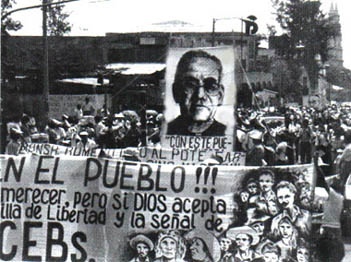
20120304-132549.jpg
photo by: http://www.marypages.com/RomeroEng.htm

The powerful biography of the Latino Archbishop Oscar Arnulfo Romero y Galdamez who spent his life helping the poor. People so poor that children died because their parents could not afford penicillin; people who were paid less than legal minimum wage; people who had been savagely beaten for “insolence” after they asked for long overdue pay.

20120304-131812.jpg
photo from http://satucket.com/lectionary/Oscar_Romero.htm

Romero began using resources of the diocese-and his own personal resources to help the poor, but he knew that simple charity was not enough.

He said, “The world of the poor teaches us that liberation will arrive only when the poor are not simply on the receiving end of handouts from government, but when they themselves are the masters and protagonists of their own struggle for liberation.”

After the brutal murder of two campesinos – one being his friend and trusted aide – Romero deeply saddened demanded the President look into it. The government’s failure to offer more than lip service reinforced the archbishop’s growing conviction that the right-wing government was in collusion with the aristocrats who killed for personal gain. He then notified the president that representatives of the archdiocese would no longer appear with government leaders at public ceremonies.

20120304-132227.jpg
photo by http://www.americanrhetoric.com/MovieSpeeches/moviespeechromero1.html

Archbishop Romero presented the Pope with seven detailed reports of institutionalized murder, torture and kidnapping throughout El Salvador. He also wrote President Jimmy Carter, appealing to him as a fellow Christian, to stop sending military aid to the Salvadoran government. His letter went unheeded. President Carter finally suspended aid in 1980, after the murders of four churchwomen, but President Reagan resumed and greatly increased aid to the Salvadoran government. In all, the U.S. aid averaged $1.5 million/day for 12 years.

20120304-133019.jpg
photo from http://onlineministries.creighton.edu/CollaborativeMinistry/romero.html

There was so much persecution that in 1979 four priests were assassinated, along with many hundreds of catechists and delegates of the Word. The peasant toll exceeded 3,000/month.

In all, at least 75-80,000 Salvadorans would be slaughtered, 300,000 would disappear and never be seen again; a million would flee their homeland and an additional million would become homeless fugitives, constantly fleeing the military and police. All of this occurred in a nation of only 5.5 million people.

Romero had nothing left to offer his people but faith and hope. On March 23, 1980 Romero used his nationally broadcast sermons to speak directly to the soldiers and policemen:

“Brothers, you are from the same people; you kill your fellow peasants…No soldier is obliged to obey an order that is contrary to the will of God…In the name of God, in the name of suffering people, I ask you-I command you in the name of Jesus: stop the repression!”

The following evening while performing a funeral mass, Archbishop Romero was shot to death by a paid assassin. Although, only moments before he was shot, he reminded the mourners of the parable of wheat:

“Those who surrender to the service of the poor through the love of Christ will live like grain of wheat that dies…The harvest comes because of the grain that dies…We know that every effort to improve society, above all when society is so full of injustice and sin is an effort that God blesses, that God wants, that God demands of us.”

20120304-131542.jpg
photo from http://www.bridgebuilding.com/narr/norom.html

An estimated 500,000 people attended his funeral when small bombs were hurled into the ground and 40 mourners died while hundreds were seriously wounded.

20120304-133346.jpg
Salvadorans rally in honor of Archbishop Oscar Romero in the capital on the 30th anniversary of his assassin and when El Savador asks forgiveness in 2010 for his slaying (Jose Cabezas / AFP/Getty Images) (to read more of what happened on 30th anniversary http://articles.latimes.com/2010/mar/24/world/la-fg-salvador-romero25-2010mar25).

Soon after his death El Salvador was plunged into a full blown civil war that would last 12 years.

Read More: The Full Biography of Archbishop Oscar Romero (1917-1980)

SUBSCRIBE to The Hispanic Blog and stay on top of the latest Latino news, politics and entertainment!

Don’t be shy SUBSCRIBE – COMMENT – LIKE ME -CIRCLE ME AND FOLLOW ME

If you have any questions, concerns or simply would like to get a quote on my Marketing, Public Relations, Social Media and/or Events services, please feel free to contact me at thehispanicblog@gmail.com.

God Bless and may you have a fabulous day!

powered by Influential Access – “Transforming the Ordinary to EXTRAordinary!” – CEO – Jessica Marie Gutierrez – Creator of The Hispanic Blog #thehispanicblog

IS DISH DEBUTING UNIVISIÓN NOVELAS?

THE HISPANIC BLOG IS THE LATEST HISPANIC NEWS BY JESSICA MARIE GUTIERREZ

20120301-142057.jpg

Dish Debuts Univision Novelas on Latino Package Network is First of Quartet of Cable Services DBS Provider will Launch under New Distribution Pact

Dish Network has rolled out Univision Novelas, the first of four new cable networks being launched by the U.S. Hispanic media leader this spring. Featuring a mix of current and library novelas from Univision’s vast archives, Univision Novelas is now available to DishLatinos customers. The network will be flanked by an online website at http://www.univisiontlnovelas.com for women to connect on issues and topics explored in the novelas and that are close to their hearts. Fans can also engage with the new network on Univision Novelas’ forums , on Twitter via @unitlnovelas and on facebook.com/unitlnovelas.
Novelas’ bow is part of a far-reaching affiliation deal Univision struck with the nation’s No. 3 distributor in January. As part of the agreement, terms of which were not disclosed, Dish will also become the first distributor to carry dedicated sports and news services, Univision Deportes Univision Noticias. Another network sports service, Univision Deportes Dos will be exclusive to Dish subs during 2012. All three of those networks are slated to bow during the first half of the year, according to a Univision spokeswoman.
20120301-141850.jpg
“We are thrilled to unveil Univision tlnovelas, a network dedicated to the novela phenomenon which has transcended decades and generations as one of the most watched genres on television and continues to have mass appeal across all age groups,” said Jessica Rodriguez, senior vice president of Univision Cable Networks in a statement. “This network will attract the novela fan at all levels, from novela addicts to closet viewers, who for the first time will have access to a replay of the most popular, romantic stories of all time, available at one destination.”

20120301-141602.jpg
In what will be its fist authenticated partnership, Univision is developing “TV Everywhere” applications for Novelas — and the other services– that will be available to verified Dish subscribers at a later juncture.

“We are pleased to have reached a multi-platform, multi-year agreement with Univision for their newest channels, including their award-winning novelas on this new linear channel, Univision tlnovelas,” noted Dish senior vice president of Programming Dave Shull. “These novelas and thousands of hours of other Univision content will be available on demand on TVs, PCs and mobile devices for our customers.”

Coming out of the gate, the Univision Novela lineup includes:

20120301-141207.jpg
6:00 p.m. (ET) – “Esmeralda” (Emerald) – Starring Leticia Calderón and novela heart-throb Fernando Colunga, this is a story of switched destinies. Two babies are born, but the obsessive desire for a male heir and a trick of destiny causes their lives to change. The boy who was born in a miserable shack opens his eyes to the opulence of a mansion; and the beautiful little girl who was born to a silken crib takes her first steps inside the corrugated walls of poverty. The little girl, Esmeralda, is born blind, but years later, she meets the boy and they fall in love, but the secrets of the past threaten to keep them apart.
20120301-141031.jpg
7:00 p.m. – “Palabra de Mujer” (A Woman’s Word) – Starring Edith González, Ludwika Paleta, Yadhira Carrilo and Lidia Avila. Vanesa approaches her friend Delia to help her establish a production company to produce quality programming for women with Fernanda, Paulina, Matilde and Irmita supporting the business venture. The television program they seek to create becomes the motivation that Vanesa needs to rebuild her life after Julian, her husband of 22 years, leaves her for a younger woman. The show they produce, Palabra de Mujer, follows the interconnected lives of these four women from varied social backgrounds in Mexico City and how they leverage their professional success to gain control of their personal lives that have spiraled out of control.
20120301-140820.jpg
8:00 p.m. – “Yo Amo a Juan Querendón” (I Love Irresistible Juan) – Eduardo Santamarina plays the decidedly un-dashing Juan Querendón. This leading man isn’t rich, isn’t very handsome, and doesn’t dress well, but all the ladies love him for his kind heart and “colorful” ways. Juan holds women in very high esteem. He considers them the most beautiful creatures on the face of the Earth, nature’s masterpiece, to be respected and worshipped like goddesses. As a result, he falls madly in love with them all, and they with him. One misadventure leads to another, but one thing is clear from the start: viewers find Juan Querendón irresistible, too.
20120301-140205.jpg

FYI THE WOMAN (ANGELICA RIVERA) IS WIFE OF MEXICAN PRESIDENTIAL CANDIDATE PRI PARTY

9:00 p.m. – “Huracan” (Hurricane) – The late Eduardo Palomo and the beautiful Angélica Rivera star in this story set in the beautiful Mexican port of Mazatlán. Helena and Ulises vowed to love each other forever, carving their names on a rock by the sea. They never suspected that because of a juvenile mistake, destiny would drive them apart and change their lives completely.
20120301-140007.jpg
10:00 p.m. – “Rosa Salvaje” (Wild Rose) – The classic story of a young girl who goes from rags to riches, twice. Rosa marries into a wealthy family, but leaves her husband when she learns that he only married her to spite his sisters and refuses to accept any alimony. To her surprise, Rosa is reunited with her long-lost mother, an upper-class woman, and becomes extremely wealthy. The novela stars Veronica Castro, Guillermo Capetillo, and Laura Zapata.
20120301-142324.jpg
11:00 p.m. – “Niña Amada Mía” (My Beloved Little Girl) – Starring Karyme Lozano and the dashing Sergio Goyri. Don Clemente is a rich landowner who has been widowed for some time. When he decides to remarry, the three daughters he has raised since infancy suspect their new stepmother is only after their father’s fortune. Soon all three daughters must make life changing decisions of whether to follow their hearts or obey their loving but strict father’s wishes.

Read More: on Multichannel News

SUBSCRIBE to The Hispanic Blog and stay on top of the latest Latino news, politics and entertainment!

Don’t be shy SUBSCRIBE – COMMENT – LIKE ME -CIRCLE ME AND FOLLOW ME

If you have any questions, concerns or simply would like to get a quote on my Marketing, Public Relations, Social Media and/or Events services, please feel free to contact me at thehispanicblog@gmail.com.

God Bless and may you have a fabulous day!

powered by Influential Access – “Transforming the Ordinary to EXTRAordinary!” – CEO – Jessica Marie Gutierrez – Creator of The Hispanic Blog #thehispanicblog

CAN SOMEONE EXPLAIN ENERGY POLICY?

THE HISPANIC BLOG BY JESSICA MARIE GUTIERREZ

20120301-120146.jpg

The United States desperately needs an energy policy. It is fundamental to our economic growth, environmental sustainability and national security. With five percent of the world’s population and 20 percent of its energy use, the U.S. has an obligation to lead globally. We need to set the right example at home.

20120301-120413.jpg

When President Obama took office three years ago, he put climate change at the top of the agenda. However, to have climate change policy you need an energy policy. People confuse the two — you need both for sustainable development.

20120301-120602.jpg

In this year’s State of the Union address, President Obama tempered his message, saying the country needs an “all of the above” energy policy to provide supplies that are cleaner and cheaper. That is nice political rhetoric — but a gross oversimplification of the challenges ahead.

At the same time, the energy industry must do a much better job informing the public and educating political leaders about the pragmatic realities we face and the difficult choices we must make. Sound energy policy can only emerge if the government, energy industry and the public have a shared understanding of the challenge. To achieve this, the energy industry needs to regain the public trust. In a Gallup poll last year of public opinion of 25 business sectors and government, oil and gas ranked next to last. Only the federal government had worse ratings.

20120301-122218.jpg

These are the energy realities that we face:

Eighty-five percent of the world’s energy comes from hydrocarbons: 35 percent oil, 30 percent coal and 20 percent natural gas.

It is estimated that the world population will grow from seven billion today to nine billion by 2050, with much of that growth in developing countries. With a corresponding increase in living standards, hydrocarbon energy is essential for economic development.

20120301-122511.jpg

World demand for oil is expected to grow on an annual basis by at least one million barrels per day, driven by the developing economies of the world and growth in transportation, which is forecast to increase from one billion cars today to two billion in 2050.

We are not running out of oil. We have already produced one trillion barrels and globally there are approximately two trillion barrels remaining of conventional oil. While we currently have world surplus oil production capacity of two to three million barrels per day, as demand grows in the next decade we will not have enough oil production capacity to keep up. Without greater investment in new capacity, tight supply will ration demand and prices will skyrocket — which could bring the world economy to its knees. The per barrel oil price of $140 four years ago was not an aberration, but a warning.

While renewable energy is needed and development should be encouraged to meet future energy demand and reduce our carbon footprint, hydrocarbons will fuel the world’s economy for many decades to come. Renewables do not have the scale, development timeframe or economics to materially change this outcome as much as we would hope.

The energy industry has to stand up to provide strategic vision. Here are some thoughts for a United States energy policy.

20120301-122636.jpg

Oil: U.S. energy policy for oil should aim at moderating demand through efficiency and increasing supply by focusing on drilling. In terms of demand, we need to raise the mileage performance standard to 50 miles per gallon as quickly as possible. This can be achieved first and foremost through hybrid electric cars, as well as a combination of vehicle mix, engine downsizing and advanced combustion technology. Replacing the nation’s fleet of 230 million cars and light duty trucks with more fuel-efficient vehicles over 15 years could save three million barrels of oil equivalent per day. At today’s price of $100 per barrel, this change would save over $100 billion a year in energy costs — a worthy prize.

20120301-123124.jpg

Electric battery powered cars are viewed by some as the ultimate solution for moderating oil demand. Unfortunately, there are significant obstacles to the widespread implementation of electric cars. The challenge is that range is generally limited to 40 miles on an eight-hour charge and batteries cost more than $10,000 per car. The laws of physics explain the range challenge. The energy density of today’s best battery is 200 watt-hours per kilogram versus the energy density of gasoline — 13,000 watt-hours per kilogram.

To increase oil supply, we must maintain tax provisions that incentivize drilling and strengthen energy security. In 2010, the oil and gas industry spent approximately $135 billion in intangible drilling costs (IDCs), which are current cash operating costs of drilling that tax law allows companies to expense in the year incurred. President Obama recently said in his State of the Union Address that we have subsidized oil companies for a century and that is long enough. Taking this position might be good politics — but it’s not good policy. It serves nobody’s purpose for our political leadership to vilify oil producers. These costs are neither tax breaks nor subsidies for oil companies; they are an investment in America’s energy future. Eliminating expensing of IDCs would decrease domestic supply, increase foreign imports, hurt our balance of trade, decrease jobs and reduce energy security.

20120301-123426.jpg

We also must do all we can to increase the world’s oil supply. With non-OPEC production nearing a plateau, the supply burden in the future will increase on OPEC, specifically Saudi Arabia and Iraq. The global oil and gas industry is expected to spend $600 billion this year on exploration and production, or 10 percent more than a year ago. With the long lead times in our business, the world is not investing enough globally to ensure surplus capacity in the next five to ten years.

20120301-123730.jpg

Natural Gas: U.S. energy policy for natural gas should focus on shale gas, which is a real game changer. Five years ago, shale gas accounted for approximately five percent of U.S. natural gas production; today it makes up almost 30 percent. Natural gas provides a significant competitive cost advantage for the United States in terms of cost per unit, which is several times lower than it is in other countries. It also has environmental advantages, with half the carbon footprint of coal, and helps our nation’s energy security as supplies are forecast to last for the next 100 years.

We should grow gas demand as a fuel in heating, electricity, petrochemical manufacturing and transportation. However, the biggest opportunity is electricity generation, where natural gas has lower costs and higher efficiency than in transportation. An electric plant is 50 percent efficient, whereas natural gas used in transportation is 15 percent efficient.

20120301-124231.jpg

We must use hydraulic fracturing to develop our abundant natural gas resources. This has been a common practice since 1949 and over one million wells have been hydraulically fractured in the U.S. Eighty percent of the 44,000 wells drilled in our country each year require hydraulic fracturing, using a closed system with water, sand and a small percentage of additives to fracture rock and release hydrocarbons. Most states do a very good job regulating this activity. Adding duplicative federal regulation would be counterproductive.

20120301-124453.jpg

Coal: U.S. energy policy for coal should reduce its use until research breakthroughs make clean coal technically feasible and commercially viable. While almost 50 percent of our electricity comes from coal, Al Gore’s words ring true: “Clean coal,” he said, “is like healthy cigarettes.” At present, it does not exist. We have more than 600 coal plants in the U.S., one third of which are over 50 years old; many need significant investments to meet anticipated environmental regulations. With the superior economics of natural gas, older plant capacity should be replaced with gas-fired plants.

20120301-124750.jpg

Nuclear: Even before the disaster in Japan, nuclear power had problems due to the high cost of new plants, the long lead time needed to build them and the challenges of secure nuclear waste disposal. While we need to maintain our technical capability and portfolio options by building a few new plants a year, the high cost of nuclear plants means they cannot compete economically against natural gas and they will have a limited role going forward.

20120301-125026.jpg

Climate change: U.S. energy policy must also deal with climate change in a way that sets targets that sustain economic growth and protect the environment. Proposals to reduce the world’s carbon emissions by 80 percent by 2050 are not achievable. A study done by Princeton University’s Carbon Mitigation Initiative sets forth strategies needed to mitigate emissions globally such as setting 60 miles per gallon for fuel efficiency, doubling the number of nuclear plants, capturing and storing carbon from 800 coal plants and increasing wind power by 10 times today’s capacity. Executing eight of these herculean initiatives would hold CO2 emissions flat by 2060. We should be realistic about targets we set and make sure we do not put the economy into reverse.

20120301-125439.jpg

The United States and Europe cannot meet the challenge of climate change alone. The role of China, which now accounts for 10 percent of the world GDP, is critical. China recently surpassed the U.S. in CO2 emissions and will probably triple its CO2 emissions in the next 30 years. China’s energy policy is integral to its national security and foreign policy. In the last three years, China spent over $45 billion to acquire oil and gas reserves worldwide.

20120301-125614.jpg

The United States needs to get serious about climate change once our economy recovers and people get back to work. Some say we should then consider energy taxes, such as a $1 per gallon gasoline tax for transportation and a $10 per ton carbon tax for electric generation. While it would take political courage, these taxes should be given full examination. They should be introduced over a five-year period and only when other major industrial powers in the G-20 take similar measures.

20120301-133506.jpg

Carbon price signals would ensure that we use hydrocarbon energy more efficiently and make meaningful reductions in CO2 emissions. When fully implemented, such taxes would generate over $200 billion per year. Ninety percent of the revenue could be directed at reducing our nation’s financial deficit — provided it is coupled with spending cuts. The remaining ten percent could be dedicated to research in alternative energy technologies such as batteries, biofuels and carbon capture and storage, as well as infrastructure projects such as smart grids and the hydrogen economy. We need to develop these technologies so that one day they can reach their promise and competitively position the U.S. economy for the future.

20120301-130333.jpg

Three C’s: Energy and climate change have been called the greatest challenge of the 21st Century. Energy industry leaders should help offer a solution by following three principles I call the “Three C’s”: Communication, Courage and Collaboration.

20120301-130637.jpg

First, we must communicate the pragmatic realities we face and the fact that hydrocarbons are critical to our future.

20120301-130923.jpg

Second, we must have the courage to provide the strategic vision for a secure energy future that underpins economic growth and protects the environment.

20120301-131238.jpg

Third, we must collaborate — Democrats and Republicans, government and industry and the United States with the rest of the world — in the spirit of compromise for the common good. We need to put energy policy at the top of the U.S. political agenda and that of the G-20 as well. Together, we can create an energy policy to make our country more competitive and secure economic prosperity for future generations.

20120301-131802.jpg

Read More: part of the HBR Insight Center on American Competitiveness .

20120301-132751.jpg
Get full story by John B. Hess

SUBSCRIBE to The Hispanic Blog and stay on top of the latest Latino news, politics and entertainment!

Don’t be shy SUBSCRIBE – COMMENT – LIKE ME -CIRCLE ME AND FOLLOW ME

If you have any questions, concerns or simply would like to get a quote on my Marketing, Public Relations, Social Media and/or Events services, please feel free to contact me at thehispanicblog@gmail.com.

God Bless and may you have a fabulous day!

powered by Influential Access – “Transforming the Ordinary to EXTRAordinary!” – CEO – Jessica Marie Gutierrez – Creator of The Hispanic Blog #thehispanicblog


JUNOT DIAZ: THE PULITZER PRIZE WINNER AND OPRAH ENDORSED LATINO ICON RELEASES A NEW BOOK

THE HISPANIC BLOG by JESSICA MARIE GUTIERREZ

‘Oscar Wao’ author Junot Diaz announces new book

20120301-004055.jpg
Image Credit: Pascal Perich. Portfolio design by Neon Sky

It’s been five years since Junot Díaz’s first novel The Brief Wondrous Life of Oscar Wao and more than 15 since his first book of short stories Drown. Oscar Wao was a literary sensation upon its release in 2007, topping several year-end best lists and racking up major prizes, including the Pulitzer.

20120301-004518.jpg Image from Central Square Theater Blog – Junot Diaz

Díaz returns to the short story form and focuses on the topic of love in This Is How You Lose Her, scheduled for a Sept. 11 release.

20120301-005704.jpg Pulitzer Prize Winning Author Junot Diaz with Gutierrez at Fenway Park

A description from Riverhead books:

The stories in This Is How You Lose Her, by turns hilarious and devastating, raucous and tender, lay bare the infinite longing and inevitable weaknesses of our all-too-human hearts. They capture the heat of new passion, the recklessness with which we betray what we most treasure, and the torture we go through – “the begging, the crawling over glass, the crying” – to try to mend what we’ve broken beyond repair. They recall the echoes that intimacy leaves behind, even where we thought we did not care. They teach us the catechism of affections: that the faithlessness of the fathers is visited upon the children; that what we do unto our exes is inevitably done in turn unto us; and that loving thy neighbor as thyself is a commandment more safely honored on platonic than erotic terms. Most of all, these stories remind us that the habit of passion always triumphs over experience, and that “love, when it hits us for real, has a half-life of forever.”

Read More: ENTERTAINMENT WEEKLY BY STEPHEN LEE

Read about Junot Diaz on OPRAH

SUBSCRIBE to The Hispanic Blog and stay on top of the latest Latino news, politics and entertainment!

Don’t be shy SUBSCRIBE – COMMENT – LIKE ME -CIRCLE ME AND FOLLOW ME

If you have any questions, concerns or simply would like to get a quote on my Marketing, Public Relations, Social Media and/or Events services, please feel free to contact me at thehispanicblog@gmail.com.

God Bless and may you have a fabulous day!

powered by Influential Access – “Transforming the Ordinary to EXTRAordinary!” – CEO – Jessica Marie Gutierrez – Creator of The Hispanic Blog #thehispanicblog

WHAT IS THE FASTEST-GROWING HISPANIC CABLE NETWORK?

THE HISPANIC BLOG by JESSICA MARIE GUTIERREZ

Mun2 Delivers Best February In Network Prime Time History, Up 10% Year-To-Year

20120229-200031.jpg

Fastest-growing Hispanic Cable Network Amongst Total Hispanic Viewers and Hispanics 18-49, Both Up +31% Month-to-Month

Mun2, the leading bicultural cable network, continued its record breaking deliveries among key demos, marking its best February prime time audience Monday – Sunday (7-11 p.m.), up +10% year-to-year in total viewers, according to Nielsen. The network’s February growth was fueled by the success of the reality series Operación Repo and the English-language subtitled blockbuster novela, La Reina del Sur (“Queen of the South”), which more than doubled its daypart in its premiere week. In addition, in February, mun2 was the fastest growing Hispanic cable network among Hispanics viewers and Hispanics 18-49, up +31% month-to-month in both demos.

Program Highlights for February 2012:

20120229-200717.jpg

During its premiere week, La Reina del Sur delivered 128,000 total viewers (up +146% vs. prior month) and 83,000 adults 18-49 (up +118%) in Monday – Thursday 10 p.m. time period. On February 23, Reina was the #1 show amongst YLAs (Young Latino Americans adults 18-34) in its time period for Hispanic cable networks, beating Galavision, Discovery en Español, Discovery Familia, Fox Deportes, ESPN Deportes, Tr3s, Music y Mas and Gol TV.

20120229-200837.jpg

Operación Repo (Monday-Friday 7-8 p.m.) finished the month with 40,000 adults 18-49, up +18% vs. prior month during the same time period. The show also averaged 65,000 total viewers, up +8% vs. prior month.

Reventon con Yarel (Sunday 12 p.m.), the genre defining Regional Mexican music & lifestyle show anchoring the networks You’re On Weekend programming block, averaged 76,000 total viewers (up +36% vs. prior month) and 47,000 adults 18-49 (up +24% vs. prior month).

In Monday through Sunday prime, mun2 had an average of 91,000 total viewers, 53,000 adults 18-49 (up +13% year-to-year), of which almost 65% were composed of Young Latino Americans.

Read more: TV BY THE NUMBERS

SUBSCRIBE to The Hispanic Blog and stay on top of the latest Latino news, politics and entertainment!

Don’t be shy SUBSCRIBE – COMMENT – LIKE ME -CIRCLE ME AND FOLLOW ME

If you have any questions, concerns or simply would like to get a quote on my Marketing, Public Relations, Social Media and/or Events services, please feel free to contact me at thehispanicblog@gmail.com.

God Bless and may you have a fabulous day!

powered by Influential Access – “Transforming the Ordinary to EXTRAordinary!” – CEO – Jessica Marie Gutierrez – Creator of The Hispanic Blog #thehispanicblog